Year: 2020

My topic, political perspectives on immigration, can be looked at through two sociological lenses: an interactionist perspective as well as a functionalist perspective.

An image of protesters defending the rights of immigrants.

Looking at immigration through an interactionist perspective is evidently appropriate since immigration is all about interacting with others. The main interaction that occurs is between foreigners and natives throughout the immigration process. Foreigners must interact with natives in order to assimilate into the new culture and way of life of the country they move to. Foreigners also must interact with other foreigners in order preserve one’s culture and carry on traditions in the new location as well as to learn about other cultures; one learns to become well-rounded and cosmopolitan. Natives also interact amongst each other, debating over whether they feel invaded or they feel that immigration is a positive. Interactionism looks at how people interact using symbols, aiming to explain social behavior and what takes place in these relations. According to interactionists, the way one views oneself is shaped by the relationships made with other people which result from the interpretation of symbols.[1] The act of migrating is a symbol in itself since, for the migrants, this act of moving symbolizes moving toward a hopefully better future. The way that people interpret this topic as a symbol differs though which is why this topic is a heavily controversial one. In regards to conversations between natives, some people embrace immigration while others view it as a threat to one’s home country. Associations to issues such as terrorism are symbolic and frame a native’s mindset into thinking that they are superior to immigrants. However, those who see immigration in a positive light do not view themselves this way but rather as human beings looking to make oneself more diverse and to help in whatever way they can. Immigrants are solely looking for a new home that would provide them a better livelihood; they hope for positive encounters with other people that would help them get accustomed to how this unfamiliar system works.

An infographic showing some of the ways immigrants contribute to the US, specifically in the realm of education and of the workforce.

As for functionalists, who believe that every part of society serves a purpose to help it function properly and in a fine and organized fashion, they see immigration as a structure that greatly impacts society. Functionalists believe that these functions explain social behaviors and the vital structures that make up society. They additionally believe that these structures serve a beneficial purpose and that society will always move toward stability; thus, all structures in society, including immigration, try to do so in the best way possible.[2] Functionalists, conclusively, see immigration as a way to help society progress, not regress. It has served a purpose since the beginning of time. There has always been movement occurring in our world; presently, the rate of people moving has been skyrocketing which causes concern to arise. Immigration is part of American history and has made it the country and the strong national society it has become, enriched with culture and individuality. Functionalists see this as an asset to our nation, finding the positives in immigration as a societal structure.

An infographic showing the population concentration of immigrants in the US.

Bibliography:

[1] Chegg Tutors, “Symbolic Interactionism”. February 10, 2016. YouTube video, 4:20. https://www.youtube.com/watch?time_continue=2&v=crZOxoAZGa4&feature=emb_logo

[2] Chegg Tutors, “Functionalism”. March 22, 2016. YouTube video, 3:43. https://www.youtube.com/watch?time_continue=4&v=JSmaNnU3uAI&feature=emb_logo

There were many waves of LGBTQ movements that started in the 1920s. The 1950s was a generally negative time for LGTBQ. This includes the lavender scare in which Eisenhower fired federal employees if they were homosexual. This was due to the belief that they were connected to communism and were a threat to national security. By the 60s though, there were increasing advancements.

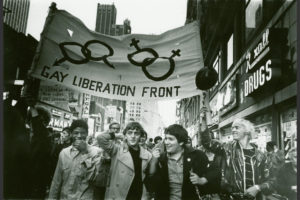
Gay Liberation Front march on Times Square in New York, N.Y., 1969.

Since then the Stonewall riot happened in 1969, Harvey Milk, was the first openly gay man who was elected in California, homosexual marriage was legalized, and it was no longer deemed a mental disease.

This is part of the Army’s official ‘Don’t Ask Don’t Tell’ Homosexual Policy Comic Book (2001). The poster in the image states Army Regulation 600-20. A basis for discharge exists if 1) The solider is engaged in homosexual acts. 2)The solider has said that he or she is homosexual or bisexual… 3) The solider has married or has attempted to marry a person of the same sex.

In the military specifically, before the “don’t ask, don’t tell legislation in 1993 under Clinton, homosexuality was completely illegal in the military due to medical reasons. Eisenhower in the 50s put forth an executive order firing homosexuals from federal offices. Department of Defense claimed that Homosexuality was incompatible with the military and thousands were discharged. Don’t ask don’t tell policy allowed LGBTQ in the military, as long as they did not claim they were homosexual. In 2011, the Don’t ask Don’t Tell policy, or Amry regulation 600-20, was repealed. By 2015 there were an increase in pro-LGBTQ legislation, representation, and attitudes.  In 2015, transgender were allowed in the military, but by 2018, Trump reversed this because “‘accommodating gender transition could impair unit readiness,’ ‘undermine unit cohesion’ and ‘lead to disproportionate costs.’ 1

Sociology has a few lenses in which sociologists can view the world. Two of these theories are the functionalism and the symbolic interactionist theory.

The functionalist perspective claims that, whether positive or negative, the social issue exists because it has a function within society. For example, the don’t ask don’t tell policy and the recent anti-transgender law can be explained through this theory because it has a purpose. Many service members argue for anti-LGBTQ laws because “ (a) homosexuality is immoral; (b) homosexuality would have adverse effects of cohesion, morale, and good discipline; and (c) the fear of intimate situations with someone of the same gender who may be attracted to them.” 2 Under the functionalist perspective, this social issue exists because military would not function as well with LGBTQ members. One can also look at the opposite side of this claiming that this social issue exists since pro-LGBTQ legislation’s purpose is to get more service members. As for the symbolic interactionist perspective, society is explained by how people interact with each other through symbols. One can say that the constant use of the word faggot between younger men is an example of this. Even if the term is used and is not in reference to homosexuals, by calling each other fags, the theory is fulfilled. Fag is now associated with not only homophobia but also masculinity and identity. If you are a fag, you aren’t a man. The term itself is completely negative and within boys, it is used as a checking system to prevent one from going outside gender norms. The novel, “Dude, you’re a Fag: Masculinity and Sexuality in High School” by C. J. Pascoe goes in-depth about this topic and studies how the term Faggot affects the identity of adolescent boys. 

   Work Cited and Footnotes

 1 Moreau, Julie. “Trump’s Transgender Military Ban ‘Worse than Don’t Ask, Don’t Tell,’ Advocates  Say.” NBCNews.com. NBCUniversal News Group, March 26, 2018. https://www.nbcnews.com/feature/nbc-out/trump-s-transgender-military-ban-worse-don-t-ask-don-n860181.

2 PhdLCSW, G. Dean Sinclair. “Homosexuality and the Military: A Review of the Literature.” Taylor & Francis, May 10, 2007. https://www.tandfonline.com/doi/full/10.1080/00918360903054137.

The Perpetual Labor Problem

Exploring the ‘New World’ must have been a thrilling adventure for the Conquistadors of the 16th century, but they soon ran into a serious issue. In order to fulfill one of the central goals of their mission, which was to send shiploads of riches back to the royals that founded the expeditions, the Conquistadors needed a vast labor force to sow the new crops and to dig gold mines. Unfortunately, the unsuspecting Native Americans or ‘Indians’ were easy prey. Similarly, the Britsh people that came on the heels of the Conquistadors ran into a similar issue. Since the British despised the Native ‘Savages’ that lived on their newly acquired land, they turned to indentured servants. However, the horrific hazards of the position soon drove the indentured servants into a riot called Bacon’s Rebellion, which ended the popularity of indentured servitude. Desperate, the colonizers turned to chattel slavery with disastrous consequences that still affect the ‘modern’ American society. After the demolition of slavery, weakening of racism, and the establishment of labor standards, the next victims in line for hungry businesses in need of cheap labor were undocumented immigrants, which gave rise to sweatshops. To clarify, sweatshops are hazardous working places that exploit vulnerable people for wages less than the minimum set by the State and Federal government. While increasing globalization has its benefits, it has played a role in increasing the cheap labor demand as American businesses struggle to compete with the cheap goods from abroad. In other words, the problem of labor and product cost has always been a delicate balance. Due to this, it is no surprise that sweatshops that are currently operating are very reminiscent of sweatshops from two centuries ago. Thanks to the Tenement Museum in New York, we have historical records of the Rogarshevsky family that moved to the United States in 1908 and were employed in a sweatshop where they sat in rows in front of primitive sowing machines for hours on end for low pay (1). However, current sweatshops have to constantly dodge government inspections. According to Ms. Teresa Garcia, a sweatshop worker that was interviewed by the New York Times, “the name on her checks….changed, though she worked in the same grungy factory in the heart of downtown”(2). In other words, current sweatshops change their name, location, and manager frequently to avoid detection by the government and they hire only vulnerable people, in this case, undocumented immigrants who would struggle to file a lawsuit for labor violations. Similarly to Abraham from the Rogarshevsky family, who died of tuberculosis after fifteen years of hard labor pressing garments, many sweatshop workers end up seriously harmed or terminally ill (1). Furthermore, according to Ms. Cortes, another sweatshop worker that the New York Times interviewed, the twelve dollar clothes that she sewed were, “‘very expensive for what they pay us'”(2). The real benefactors of sweatshops are the companies that make serious cash from selling sweatshop merchandise at ‘unbelievable’ prices.

A picture of Rogarshevsky family after moving to New York from Tenement Museum in New York (1)


Footnotes:

1.“97 Orchard Street.” Tenement Museum. Accessed February 19, 2020. https://www.tenement.org/explore/97-orchard-street/.

2. Kitroeff, Natalie. “Fashion Nova’s Secret: Underpaid Workers in Los Angeles Factories.” The New York Times. The New York Times, December 16, 2019. https://www.nytimes.com/2019/12/16/business/fashion-nova-underpaid-workers.html.

Though I have heard of sweatshops before I visited the Tenement Museum, my understanding of them after the visit was so much more in-depth. I was amazed to hear how families of eight would live in the small apartments, with kids still sleeping on the floor of what would be their work area or garment sweatshop.

Image is taken from The Tenement Museum’s Website.
https://www.tenement.org/

The difference between sweatshops now compared to the 1800s is the size and location. As briefly mentioned earlier, they were usually just one room with a few workers. Their wives would occasionally bring them food, and as discussed at the museum, they were at least able to see their kids since they were working from home. However, nowadays, sweatshops are in cafeteria-like large rooms with as many workers packed in as possible. Very rarely will workers get a lunch break, and they do not see their families during the day. Conditions have changed mainly because as prominent retailers and department stores have emerged, they all want one thing: the most profit. And unfortunately, that means their factory workers, get the short end of the stick. However, in American sweatshop factories, conditions are not as bad as they are in international ones. Internationally, child labor is still happening at extremely young ages, and women that are pregnant must continue working as well. The website, “The World Counts” posted the statistic that “250 million children between 5 and 14 are forced to work in sweatshops in developing countries. The pay? Sometimes less than 20 cents per day or about one cent per hour.”

What is most disturbing is that these major companies know what they are doing. According to an article on WWD, in 2016, “more than $65,000 in civil penalties were levied against repeat or willful violators. The factories that violated laws regulating minimum wage, overtime and record-keeping made clothes for retailers including Ross Stores, T.J. Maxx, Forever 21, Bealls, Charlotte Russe, Burlington, Windsor, Nordstrom, Macy’s and Dillard’s.” (1) The keyword in this quote being repeat and willful.

The link between sweatshop work and immigration is that when immigrants come to the United States, they are not necessarily aware of all the rules and regulations, therefore, they are seen as easy targets. More specifically, they are not necessarily aware of wage requirements, “mandatory” working conditions, and other important factors that should be normally enforced by employers. Therefore, when they hear of a job opportunity in the U.S., they would rather take it than being left unemployed.

Though sweatshops, for the most part, have horrendous conditions and pay their workers unfairly, there are minor benefits for immigrants and other workers. First, as mentioned earlier, they provide more jobs and do not necessarily require any identification or paperwork to be hired. Second, as we saw in the Tenement Museum, immigrants were able to connect with others from their culture and help each other from getting homesick and not feel as lonely. Additionally, “The World Counts” did report that if workers’ rights are being properly followed, then it may benefit poor countries. They mention Honduras, where the average sweatshop “worker earns 13 US dollars per day, which is a decent wage considering that 44 percent of the country’s population lives on less than 2 dollars per day.” (2) While this wage would not really work to the United States’ federal standards, news sites have reported that it is somewhat beneficial to poorer countries. Overall, this comes down to ensuring that all people are treated like people and are given a fair chance for a good quality of life.

References:

  1. “Sweatshops Persist in U.S. Garment Industry.” WWD. WWD, December 5, 2016. https://wwd.com/business-news/government-trade/sweatshops-persist-in-u-s-garment-industry-10716742/.
  2. The World Counts. Accessed February 17, 2020. https://www.theworldcounts.com/challenges/people-and-poverty/slavery-and-sweatshops/sweatshop-workers-conditions.

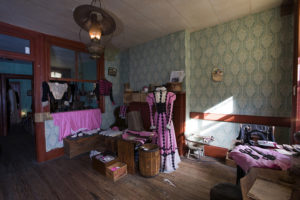
After leaving the Tenement Museum, my knowledge of sweatshops and its workers expanded beyond my imagination.  As our tour guide, Joshua, transported us back into the 1800s traveling through the single home of hundreds of immigrants, we learned that the individuals residing in the tenement house also ran their businesses within the small confinement of their four walls.  A distinct difference between the sweatshops in the past and those operated today are the locations. While past sweatshops were operated within the homespace, given a designated spot in the living room, the sweatshops operating today are more so located in factories or confined workplaces.  A significant difference between the sweatshops of the past and those in present-day is the advancement in technology and efficiency.  In the past, individuals working in sweatshops were forced to breath in fabric dust, which was fatal.  The Levine family we learned about had their own family business designated in their living room space (pictured below).  Nowadays, the sweatshops are more modern and depict a more factory-like environment, compared to the home environment that was used in the late 1800s.

This image depicts the Levine family’s living room/sweatshop. The room would have been dimly lit during its existence, full of toxic fabric dust (Monica Suma).

Compared to today, wages in both eras are low, and workers are underpaid for their labor.  The Levine family’s rent was fifteen dollars a month while they sold dresses for ten dollars each piece.^1  Today, there are existing sweatshops for large companies, such as Forever 21.  One of the workers was earning six dollars an hour for pinning tags on shirts and cutting their loose threads.^2  Most of these workers, unlike history’s, were women.

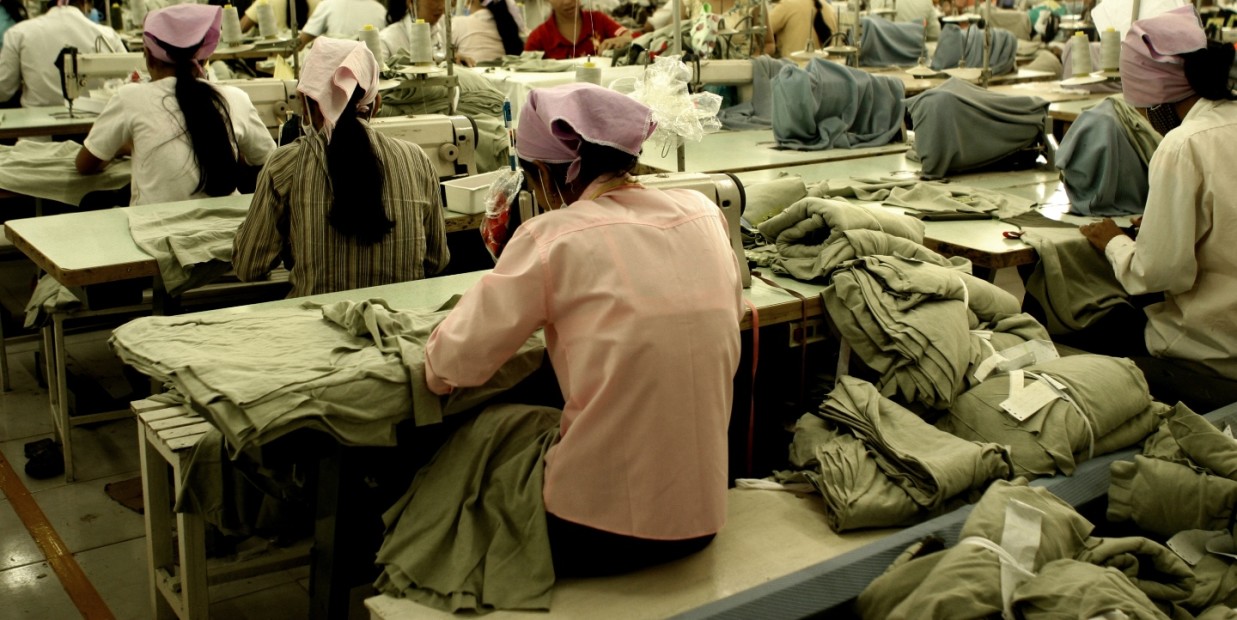
This image depicts the sweatshops’ harsh conditions still existent today (Los Angeles Times).

Upon entering a new nation, there are more opportunities, but that does not mean that those opportunities have been granted.  Immigration and sweatshops are typically interconnected because immigrants are more willing to conduct this type of work than those who are native to the nation and dominate the language.  Immigrants’ options are limited, so they are more accepting of any opportunities coming their ways.  The Levine family immigrated, and like others’ situations, “They had few skills and little money. They couldn’t really read or write and they didn’t speak English. Needing to support themselves and their five children, the Levines, like many other immigrants in the area, literally set up shop in their home.”^3  Immigrants did not have many options, so they were willing to make do with whatever came their way in order to support their families.

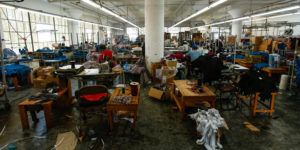
Pictured above are the materials used at a sewing factory in downtown Los Angeles (Los Angeles Times).

Considering their harsh conditions, sweatshops can be beneficial for immigrants and other workers only in the sense of getting acclimated to surroundings and the language.  There are no monetary upsides as workers are extremely underpaid for the amount of work and hours they put into production, but as discussed on the tour, sweatshops were often the places where individuals met their spouses and worked with their families.  For immigrants, sweatshops allowed families to stay together while navigating their way into their new residing nation.  On the contrary, sweatshops are not all that beneficial to natives or citizens of a nation. Being a native-born citizen already elicits an advantage in which he/she is exposed to more opportunities in education, work opportunities, and financial stability.  There is more aid that is able to be provided to the citizens given the circumstances of their situations.  Sweatshops benefit large companies/corporations, as seen in retailers such as Forever 21.^4  They save money since they pay people less for their labor while they earn more profit from their products, benefitting in both areas of production and labor.  Sweatshops benefit the large companies, but they take more from their workers than they give them. 


Bibliography

(^2, ^4) Kitroeff, Natalie, and Victoria Kim. “Behind a $13 Shirt, a $6-an-Hour Worker.” Los Angeles Times. Los Angeles Times, August 31, 2017.

(Image 1, ^1, ^3)Wanderer, The World, and Monica Suma. “The Tenement Museum, Immigration and My Grandmother.” Monica Suma, August 13, 2013.

Visiting the tenement museum was a great experience to have last Wednesday. Never before had I heard of tenements but after seeing them I was amazed. They were just regular apartments that were occupied by immigrants but I never knew that immigrants used them to operate sweatshops. This amazed me because it showed me how relentless and determined people can be when they want to provide for their family. Operating a workshop from your home is dangerous. Anything can occur out of the blue moon such as equipment issues or a child issue and those are just a couple examples. The article Sweatshop Subjectivity and The Politics of Definition and Exhibition states, “Inspectors relied on their sensory responses. Citing odors as evidence, inspectors united fears of poverty, pestilence, and promiscuity in their definition of the sweatshop. Clothing produced in filthy shops by diseased workers could infect consumers and male and female immigrants working in close quarters were becoming an enfeebled, immoral race.”
While that can be said for sweatshops in the 1800s, things are different in the world today. Sweatshops are different today than they were back then because sweatshops to people in the 1800s was just being in a small room surrounded by lots of equipment with other people occupying the room. The article states, “ The work is done under the eyes of task-masters, who rent a small room or two in the rear part of an upper floor of a high building, put in a few sewing machines, a stove suitable for heating irons, and then hire a number of men and women to work for them.” Even in those times that was considered to be a form of slavery because of the work conditions people were subjected to, yet no one did anything about it. Which led to people continuing on with the process. That was until 1994, where the United States General Accounting Office gave a definition for a sweatshop. Sweatshops were defined as, “‘a workplace’”that violates more than one federal or state labor law governing minimum wage and overtime, child labor, industrial homework, occupational safety and health, workers compensation, or industry regulation.”Image result for sweatshops ny
Lots of these workers were immigrants who did not have the opportunity or resources for anything better. They came from another country clueless to the environment and the struggles that were ahead of them because they were foreigners. This connects all immigrants because they are subjects to the same conditions. Working in the sweatshop conditions is illegal if they face conditions that are below the human standard, such as not being paid minimum wage. Yet, they are clueless to this fact because they do not possess the resources to learn this information when they first arrive in this country. So they instead break their backs and teach their children the value of having an education or pursuing anything greater than working some factory for someone who underappreciated them. Immigrants from the 1800s-2000s face the same conditions, which I believe connects us. But I believe there is a chance for sweatshops to be good. All a sweatshop needs to be good in my opinion is for someone that is someone in charge that actually cares about their workers. When you have an employer who cares about you, they take care of you, so you can help take care of them and their business.

Bender, Daniel. “Sweatshop Subjectivity and the Politics of Definition and Exhibition.” International Labor and Working-Class History, no. 61 (2002): 13-23. Accessed February 19, 2020. www.jstor.org/stable/27672769.

Gannon, Devin. “Tenement Museum Will Stay Open Late on Thursday Nights for Special Tours and Programs.” 6sqft, 24 Sept. 2018, www.6sqft.com/tenement-museum-will-stay-open-late-on-thursday-nights-for-special-tours-and-programs/.

Intern. “American Sweatshops.” Boston Review, 1 Mar. 2019, bostonreview.net/gordon-american-sweatshops.

Sweatshops are referred to as a place of work, typically a factory or clothing production company, that abuses their workers by placing them in inhuman working conditions for very long hours with very little pay. While sweatshops were typically more common in less developed countries many years ago, suspicion has led to the investigation of big companies today, such as Nike, for making their factories into sweatshops. Being that Nike operates their production in about 41 countries, some being less developed countries such as Bangladesh and Cambodia, Nike has been accused of operating sweatshops in these smaller regions. Research from

Cartoon illustration of Nike sweatshop    treatment.

WHO shows that Nike workers in Cambodia, since the year 2000, have complained of working in small buildings in which temperatures went as high as 37 degrees Celsius (98.6 degrees Fahrenheit) and earned wages of approximately fourteen cents and hour.  While Nike has covered its tracks in recent years and have begun to include sustainability and women’s/LBGTQ+/minority group empowerment in their campaigns, it is unsure if the working conditions have entirely approved as Nike claims that they are not all responsible because those factories are subcontracted.

Sweatshops have been historically shown to provide employment for foreign immigrants and individuals expected not to work, such as women. In the years 1880-1940, the United States population grew by approximately 26 million people through immigration according to Smithsonian records. Being that so many immigrants traveled to the United Sates to start a new life with new opportunities, it was often hard to find employment. Sweatshops would become rather popular in the US at this time as they allowed a countless number of employees as the work environment was often overcrowded and it was cheap labor. Often, sweatshops were located in larger factory buildings to ensure the most amount of labor could be fit and used, however, sweatshops were also found in many tenement apartments.

The third, factory room of a tenement apartment in which the family business would be run in.

Tenement apartments were typically three room apartments that would house families with any number of members; in this time period, families sizes were around five to nine members. The first room would be a bedroom in which the bed took up predominantly the entire room; some families would fit a much smaller futon-like piece of furniture in this room to maximize sleeping space. The second room in the apartment also contained at least one other bed while the rest of the space was the kitchen. Most apartments contained a stove and sink area although running water was not always running throughout the building, rather it was just outside and families would fill buckets up and bring them to their rooms. The third room was the sweatshop/factory space. This room, unless your family worked in a factory located outside of your home, would consist of sewing machines and fabrics as the father, possibly other families members, and outside workers would work long days constructing clothing. Many workers would fit in the rather tight space to complete their work tasks and pay levels were never that high.

Sweatshops were very commonly linked to immigration as they were the easiest form of employment to obtain and their were always open positions. While conditions were not always the best, immigrants would take these jobs because it was better than being unemployed and gave them a chance to provide income to the family. Containing a factory setup in a tenement apartment also allowed families to work longer hours and be in the environment of their own home and family. Sweatshops were very common at this time, however, they quickly grew out of business once labor laws begun to be implemented and workers were provided better working conditions.


I was amazed walking through the tenement house, seeing how small the apartments were and finding out how many people lived in each; it was surprising to me that an eight-person family would have had to make due living and sometimes working in a space that small. Learning about two particular immigrant families touched me since each had their own story and way of life that were both similar to and different from each other. Learning about the garment factories that families ran in their own homes as well as the larger sweatshop factories that were established was an additional eye-opening experience for me. I remember learning about the sweatshop factories in middle school and high school, but to be put in the immigrants’ shoes by touring a legitimate tenement house, seeing printed government census reports as well as images of these families, of Orchard Street, and of the sweatshop factories impacted me.

I learned at the museum that mostly women worked in the sweatshops and they were paid very low wages, following the gender roles of the time. The health conditions were fatal, especially because of all the fabric dust they would inhale from the air. Additionally, they worked very long hours, ranging from fifty to close to one hundred hours per week. The larger sweatshop factories resembled a high school cafeteria; they were very crowded spaces with little to no sanitation. Unfortunately, immigrants had to deal with these conditions because they had just moved to a new country where they were unfamiliar with the language and had no idea where to start; they were desperate to find a job to start rebuilding their lives and to support their families. However, many joined labor unions and went on strikes, but this did not bring positive results. I believe sweatshops can be a good thing for immigrants to an extent, that being that they were at least employed and were paid. It is difficult for foreigners who have no idea how society runs in a country other than their own to find a job, and other jobs that do not require one to speak a certain language or to have a specific skill set, such as various housekeeping jobs, would have had equally unfair working traditions. Employers took advantage of the immigrants’ desperation to find a job, and found no shame in treating them unjustly.

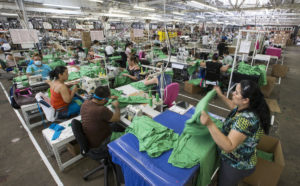
This is a picture taken from an article published by the LA Times of a present-day sweatshop factory of Forever 21 located in Los Angeles, California.

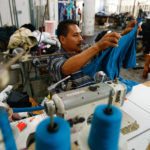
This is a picture of an immigrant worker at a sweatshop. This photo is borrowed from the same LA Times article the other photo was borrowed from.

According to Benjamin Powell, the author of the article Meet the Old Sweatshops: Same as the New, the conditions in the sweatshops of the past were worse than those in many currently operating sweatshops. Child labor was very common back then and the cities were dangerously swelling with people and disease.[1] However, an article published by Los Angeles Times about the factory workers for Forever 21 proves the unfortunate fact that sweatshops still persist today in America and that many of the unsanitary conditions in the early sweatshops exist in those of today. The claims made in this article parallel those made on our tour in the city. It is distressing to think that many of the articles of clothing we wear, even those that are sold to us at a high price, are made by laborers who work about 10 hours a day and are paid a few dollars an hour. As said in the article, these factories are “stifling” and “sweltering” and consist of only “one-room workshops” where workers sit “behind a sewing machine,” similar to those of the past. Additionally, the factories in America such as the one located in Los Angeles where the workers produce the clothing for the brand Forever 21, aim to keep the prices low so they hire immigrants, many of them undocumented, who are willing to work for below minimum wage.[2]

After the field trip to the museum and reading these two articles, my eyes have been opened and I have become more sensitive and curious about the past in relation to the present as well as about the stories of different immigrants.

Bibliography

[1] Powell, Benjamin. “Meet the Old Sweatshops: Same as the New.” The Independent Review, v. 19, n. 1, Summer 2014, ISSN 1086–1653, 2014, pp. 109–122.https://www.independent.org/pdf/tir/tir_19_01_08_powell.pdf

[2] Kitroeff, Natalie, and Victoria Kim. “Behind a $13 Shirt, a $6-an-Hour Worker.” Los Angeles Times. Los Angeles Times, August 31, 2017. https://www.latimes.com/projects/la-fi-forever-21-factory-workers/.


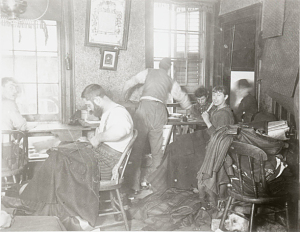
Sweatshop in Ludlow Street tenement, New York City, around 1889 Photographer: Jacob Riis. Courtesy Library of Congress.

You would be surprised how many similarities the sweatshops of the past have to the ones of today. In the past, during the late 1800s, many families, especially immigrants lived in small tenements. The majority eventually began their own garment business within their own homes with manual machines.

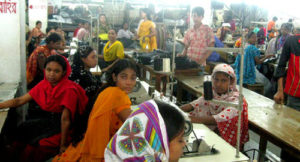
In Bangladesh, 3.5 million workers in 4,825 garment factories produce goods for export to the global market, principally Europe and North America. The Bangladeshi garment industry generates 80% of the country’s total export revenue. However, the wealth generated by this sector has led to few improvements in the lives of garment workers, 85% of whom are women.


In fact, immigrants created more than 60% of the clothes for women in America during this time. The fabric dust commonly caused lung issues. This is still true today, but unlike in the past, the majority of the workers are women. If clothing appears to have been done by hand, like embroidery, “there’s a good chance the garment was quite literally homemade, at least in part—and most likely by a woman who was paid a pittance for it.” 1 By the early 1900s, garment making had shifted. Many people began working in factories, but they were still mostly immigrants. Today immigrants are still exploited to work in sweatshops, but especially in developing countries, the workers may be citizens or migrants. Both had extreme work hours, disease, and poor working conditions. Child labor is a huge problem especially

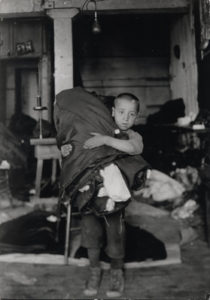
Italian boy holding a bundle of cloth, New York City, around 1910 Photographer: Lewis Hine. Courtesy Eastman House Children often carried goods to and from shops and performed simple operations such as removing basting threads.

today. Children in the past worked, but in the case of sweatshops producing garments, many children did small tasks like transporting smaller items. Today “in developing countries, an estimated 168 million children ages 5 to 14 are forced to work.” 2 Immigration is heavily connected to sweatshop labor. Coming to a new country, especially one where the language is different, is extremely difficult. The work you can do without knowing English or having connections is limited to labor-intensive work. This includes sewing in sweatshops. One woman was “lured to the United States by a human trafficker promising a good job as a nanny. She was exploited, undocumented, and unable to speak either English or Spanish.” 3 Immigrants are easily taken advantage of because of their lack of support and the temptation of a new and better life. Many of those who are first-generation immigrants take these jobs to get a footing in a new place and plan to have their children learn English and get better jobs in the future. Despite the poor conditions and pay, sweatshops have a silver lining. In history, immigrants could eventually rise the ranks of wealth to live a mostly comfortable wife. For example, one family living in a tenement in New York City was eventually able to gain enough money to start their own garment factory and move to a new building. Even if one is unable to do this, they have a job at the very least. Today ideas for anti-sweatshop laws would prevent America from importing goods made in sweatshops. Unfortunately “anti-sweatshop laws would make third-world workers worse off by lowering the demand for their labor.” 4 Despite the sweatshops not being good work, at the current moment, without them, many people would be living even worse than they are.


Work Cited and Footnotes

1 Bain, Marc. “A Huge Underclass of Ghost Workers Are Making Your Shirts in Their Homes.” Quartz.      Quartz, January 20, 2016. https://qz.com/494818/in-much-of-the-world-the-sweatshop-isnt-a-factory-its-someones-kitchen-floor/.

2 “11 Facts About Sweatshops.” DoSomething.org. Accessed February

3 Davis, Charles. “The Dark Side of Your Clothes Being ‘Made in America’ No One Talks About.” ATTN. ATTN: July 26, 2017. https://archive.attn.com/stories/18483/made-america-how-sweatshops-exploit-immigrants-make-your-clothes.

4 Powell, Benjamin, Craig J. Richardson, Jon Murphy, John Schuler, Jeffrey Rogers Hummel, Charles L. Hooper, and David R. Henderson. “In Defense of ‘Sweatshops.’” Econlib, June 3, 2019. https://www.econlib.org/library/Columns/y2008/Powellsweatshops.html.

The stigma surrounding mental health would be the first social issue that I would like to explore. When doing some preliminary research, I was fascinated to learn that there is actually a fair amount of recorded history on mental health. For my project, I will definitely be able to dive deeper into the history of mental health a bit more. According to the World Health Organization, in January 2020 they published that “depression is a leading cause of disability worldwide and is a major contributor to the overall global burden of disease,” (1) with over 260 million people suffering from a mental health illness, more specifically depression. This affects me because I am one of those 260 million people that has had to overcome struggles from depression.

Photo by Anthony Tran on Unsplash.

The path I plan to take with researching this topic is to definitely focus on and mention the overall aspect of mental health in New Jersey while touching upon the United States as well, however taking it one step further and researching how mental health is perceived on college campuses by both students and faculty. This will allow me to examine how mental health and its effects vary among different economic classes, genders, races, and ethnicities. Most importantly, the main aspect of my project will allow me to see how my fellow peers feel when it comes to the topic during the years they are more prone to developing a mental health disorder due to the pressures of truly transitioning into adulthood.

Furthermore, it affects the community because of the insane number of people that are affected by mental health and because when mental health is left untreated or if the treatment is not working, the number of people who feel that suicide is the only option has unfortunately greatly increased, and is now, therefore, one of the leading causes of death in the United States. WHO also mentions that while mental health disorders are treatable, about 76%-85% of people that are diagnosed do not have the resources or even necessary funds to get the treatment which has been known for a very long time, yet not much has actually been done.

Another social issue that is very important to me is women’s rights, especially it comes to the pay gap. This is yet another topic in which most of society has acknowledged that there is a present gender disparity in the labor force, yet not that much significant action has been taken to truly solve this issue. One may say, wait, wasn’t there the Equal Pay Act of 1963 which was signed into law by President John F. Kennedy? Yes, however, according to numerous publications, women are still only earning seventy-nine cents for every dollar a man makes. AND this is not accounting for women of different races or people from different educational backgrounds.

Photo by lucia on Unsplash.

Furthermore, within the past few years, there have been multiple class-action suits that argue against gender discrimination as well. For example, in April 2019 a group of women claimed that media giant Disney treats women extremely poorly and like cheap labor. (2) Similarly, in August 2018, four women who had worked for the athletic company Nike filed a class-action lawsuit acquired that Nike participated in activities that covered up sexual harassment and gender wage discrimination. (3) This affects both me and women of my community because as a woman myself, it is important that both genders are treated equally and given the same opportunities to grow. I have done research on this topic before and as mentioned earlier in this section, there are many statistics and a great deal of history to support the argument for women’s rights.

The final social issue that I would potentially research is government and political problems. This is an area in which I am probably most inexperienced but do have some background knowledge from an internship I had through the House of Representatives in the summer of 2019. While the internship did somewhat show me behind the scenes of being a Congressman and what goes into being a politician, what I saw most was the distrust that the people have in our government as a whole. When the government was first created, it was to help and better express the needs of the people. However, as it modernized, it seems that it has become more of a game and a competition.

Photo by Marco Oriolesi on Unsplash.

According to a study done by the Pew Research Center in 2018, (4) 63% of Americans have very little to no trust in their elected officials. And the numbers only grow larger when looking at the people’s trust in major institutions. Not only do the people then feel uncomfortable with their officials for the time of their position, but Americans have also reported that this distrust prevents societal issues from getting solved as well. According to a New York Times Article, people believe that this distrust can be solved through electing officials that are “older, more educated, and had higher household incomes…” (5)

This effects my community and myself because it is very obvious that there are many pressing issues happening in our society, but the public and politicians need to come together in order to come up with a solution that will take time but overall improve the situations. A way this research can be conducted is by looking at trust in elected officials over the years and identifying what events took place at the time when trust sank. There are many statistics and studies done such as the one previously mentioned by the Pew Research Center.

References:

  1. “Depression.” World Health Organization. World Health Organization. https://www.who.int/news-room/fact-sheets/detail/depression.
  2. Sam Levin, “Treated as Cheap Labor’: Disney Underpays Women, Lawsuit Alleges,” The Guardian (Guardian News and Media, April 4, 2019), https://www.theguardian.com/film/2019/apr/03/disney-company-women-pay-gap-lawsuit).
  3. Alexia Fernández Campbell, “Why the Gender Discrimination Lawsuit against Nike Is so Significant,” Vox (Vox, August 15, 2018), https://www.vox.com/2018/8/15/17683484/nike-women-gender-pay-discrimination-lawsuit).
  4. “Distrust in America Viewed as Problem.” Pew Research Center for the People and the Press, December 31, 2019. https://www.people-press.org/2019/07/22/how-americans-see-problems-of-trust/.
  5. Stevens, Matt. “Falling Trust in Government Makes It Harder to Solve Problems, Americans Say.” The New York Times. The New York Times, July 22, 2019. https://www.nytimes.com/2019/07/22/us/politics/pew-trust-distrust-survey.html.
css.php