
Overview
Planning the Strike

The 1927-1928 Colorado Coal Strike marked an intense period in the state’s labor history. In August of 1927, leaders of the International Workers of the World prepared and submitted a strike petition to the Colorado Industrial Commission (CIC). Officially unveiled at a September 4th meeting, it largely focused on demands for better pay and working conditions. It also laid out the plan for a strike that would begin on October 8th. The petition deliberately omitted anything that referred to the International Workers of the World, also called the IWW or Wobblies, because they were not a legally recognized union in Colorado. Instead, they called themselves the All State Conference of Colorado Coal Miners. However, the CIC realized that they were a front for the IWW and rejected their petition on the grounds that it was submitted by an unrecognized union. This meant that regardless of how closely the Wobblies followed the CIC rules, their petition to strike would always be rejected.1 Leigh Campbell-Hale, Remembering Ludlow but Forgetting the Columbine: The 1927-1928 Colorado Coal Strike (Boulder, CO: University Press of Colorado, 2023), 79.
Deeming any and all IWW strikes illegal backfired on the CIC; it encouraged previously hesitant workers to participate in the Wobbly strike, and the date was pushed back from October 8th to October 18th in order to properly organize the northern and southern coal fields of Colorado.2 Campbell-Hale, Remembering Ludlow but Forgetting the Columbine, 80.
On October 17th, coalminers gathered in Lafayette, Colorado to vote on the strike. So many workers were present that they had to move from a local meeting hall to a baseball field. The workers unanimously voted to strike. Afterwards, a few men from each mine were called to a closed door meeting to begin planning the protests.3 “Thousands of Colorado Coal Miners Strike Under Orders of I. W. W.,” Boulder Daily Camera, (Boulder, CO), October 18, 1927, https://www.coloradohistoricnewspapers.org/?a=d&d=BDC19271018-01.2.9. Miners began to walk off the job the very next day, officially beginning the 1927-1928 Coal Strike on October 18th.4 Campbell-Hale, Remembering Ludlow but Forgetting the Columbine, 81.
Government Response
On October 19th, Thomas Annear, the state industrial commissioner and representative of the CIC, stated that the strike was illegal on the grounds that the picketers had not provided 30 days notice. The petition that they had submitted as the All State Conference of Colorado Coal Miners remained, in his eyes, illegal.5 Campbell-Hale, Remembering Ludlow but Forgetting the Columbine, 82.
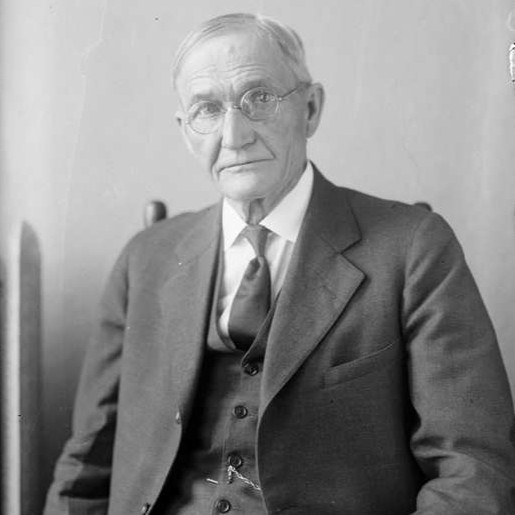
On October 26th, Governor William H. Adams issued his first official statement on the strike:
“An unfortunate condition exists in the coal fields of the State by reason of the I. W. W., an un-American organization, having attempted to bring about a strike, and in this attempt has openly and publicly advocated and practiced deviance and violation of the law.
Governor William H. Adams of Colorado6 Campbell-Hale, Remembering Ludlow but Forgetting the Columbine, 87.
The government’s immediately hostile response to the strike was just the beginning; tensions would only increase for the duration of the strike, and they would eventually lead to bloodshed in Colorado.
Columbine Mine Keeps Running
Columbine Mine was run by the Rocky Mountain Fuel Company, or RMFC. It was the newest and largest mine run by the company and was surrounded by the company town of Serene. It was also the only large coalmine that remained in operation after the strike began. Picketers were very active at Columbine Mine because it was so close to many other towns, including Lafayette and Erie. It allowed protesters to walk or drive to Columbine while scabs were preparing for work and try to dissuade them from working or convince them to join them in the strike.7 Campbell-Hale, Remembering Ludlow but Forgetting the Columbine, 89.
Columbine, like other northern Colorado coalmines, operated seasonally. The kind of coal that was rich there could not be stored well, but if it was left out too long it would not burn but could, potentially, spontaneously combust. Normally, coal miners only worked from October to March. The strike coincided with the opportune mining season as well as the time when people needed coal most; they needed it to heat their homes and businesses and provide them with electricity.8 Campbell-Hale, Remembering Ludlow but Forgetting the Columbine, 96. The timing of the strike placed more pressure on coal companies, including the RMFC and its lone operating mine at Columbine.
Columbine Mine Workers Negotiate
On October 27th, the workers that had been manning Columbine Mine throughout the strike filed a petition with the CIC to raise their pay and impose better working conditions. The CIC considered this document legal, unlike the petition sent in to get permission for the state-wide strike. This was because the petition was filed separately from the strike by miners that worked while others were protesting. Crucially, the petition, and the miners that filed it, had no affiliation with the unrecognized IWW.9 “Industrial Commission Investigates Demand of Weld County Miners,” Daily Times, (Longmont, CO), October 27, 1927, https://www.coloradohistoricnewspapers.org/?a=d&d=TDT19271027-01.
This legal recognition scared mine owners, who believed a CIC decision favoring the miners could encourage strikers to keep pushing for wage increases. Simultaneously, owners feared that a decision against the petition could lead to yet more workers walking off of the job.10 “Gov. Adams Meets Striking Miners Not Affiliated With the I. W. W.,” Boulder Daily Camera, (Boulder, CO), October 27, 1927, https://www.coloradohistoricnewspapers.org/?a=d&d=BDC19271027-01. M. D. Vincent, the Vice-President of the RMFC, penned a response to the petition. He acknowledged that the workers had “causes for just complaint” and stated that the company would be willing to increase wages, however he also claimed that the company was not turning a large profit. He said that if miners considered the difficulties the company faced, it would “consider their complaints, and it will be possible, not all at once, but gradually, to improve the conditions of both miners and operators.”11 “Company Makes Reply to Columbine Miners,” Daily Times, (Longmont, CO), October 28, 1927, https://www.coloradohistoricnewspapers.org/?a=d&d=TDT19271028-01.
Two days after receiving the petition, the CIC announced that the basic wage at the Columbine Mine would be increased from $6.27 to $6.77 per 8 hour day. The decision was to be applicable at all six of the mines owned by RMFC, and many officials hoped it would spark the end of the strike in the northern Colorado coal fields.12 “1,000 Coal Miners Are Affected by Columbine Award,” Rocky Mountain News, (Denver, CO), October 29, 1927, https://www.coloradohistoricnewspapers.org/?a=d&d=RMD19271029-01. Many Columbine miners were disappointed with the CIC decision, as they had hoped to earn at least $7.25 per day.13 “Columbine Miners Not Satisfied with Wage Increase Given Them,” Daily Times, (Longmont, CO), October 29, 1927, https://www.coloradohistoricnewspapers.org/?a=d&d=TDT19271029-01. Nonetheless, representatives of the Columbine Mine workers accepted the fifty-cent wage increase on October 30th, and by November 2nd more workers began returning to the job. However, this limited win was not enough to quell the strike in the rest of the state. The IWW encouraged protesters to hold out for the higher wage that they wanted, and the demonstrations continued throughout Colorado.14 “Miners In North Field Accept Pay Increase,” Rocky Mountain News, (Denver, CO), October 30, 1927, https://www.coloradohistoricnewspapers.org/?a=d&d=RMD19271030-01; “Miners Returning to Work at Columbine Mine, Force Gains 60 Since First Day of Strike,” Longmont Daily Call, (Longmont, CO), November 2, 1927, https://www.coloradohistoricnewspapers.org/?a=d&d=LDC19271102-01.
The Strike Continues

During the first two weeks of the strike, meetings, rallies, and parades continued to grow stronger and more impactful throughout Colorado. Many picketers were able to convince scabs to join the strike, impacting coal mine production. On November 4th, as they grew more desperate, Colorado Fuel & Iron, or CF&I, told strikers that they would do anything to protect their property. Up to that point, the company had publicly claimed that production had actually increased during the strike, but the day before they had to lay off half of their steel workers because there was insufficient coal to run the plant. In response to this development, Governor Adams decided to intervene.15 Campbell-Hale, Remembering Ludlow but Forgetting the Columbine, 101.
The Colorado State Strike Police
On November 4th, the same day CF&I laid out their willingness to protect their coal mines, Governor Adams revived the controversial prohibition force used by his predecessor, Governor Clarence Morely. Adams had actually campaigned against the force but brought it back as the state strike police, possibly to avoid calling in the more expensive National Guard.16 Campbell-Hale, Remembering Ludlow but Forgetting the Columbine, 102.
The new police force was under the direction of Louis Scherf. He and his men raised tensions with the protesters almost immediately. On November 6th, Scherf and seventeen strike officers arrested seven speakers who were about to address a crowd of protesters in Berwind, Colorado. They beat the speakers and, despite being under orders not to open fire, were all armed with pistols. That same day, roughly one thousand strikers gathered in Lafayette for a rally; two hundred of them then marched into Columbine Mine.17 Campbell-Hale, Remembering Ludlow but Forgetting the Columbine, 103.
On November 7th, Adams further expanded the strike police and sent them to the southern fields. When three thousand people rallied at a monument to the Ludlow Massacre, a 1914 slaughter of coal strikers, four airplanes controlled by the strike police flew overhead. One of them was armed with bombs. Meanwhile, in the north, protesters blocked the road leading to Serene and for the first time were able to halt production at Columbine Mine.18 Campbell-Hale, Remembering Ludlow but Forgetting the Columbine, 103-4.
Tensions at Columbine Mine
On November 8th, a large parade marched through Serene and the Columbine camp. County sheriffs tried and failed to arrest some protesters, who were defended by swarms of picketers that prevented police from getting close enough to arrest their targets. The picketers also convinced some scabs to join their movement, and the number of people working at the Columbine Mine fell to just 75.19 Campbell-Hale, Remembering Ludlow but Forgetting the Columbine, 104.
The arrests the strike police made in the southern fields may have angered and motivated protesters, as roughly one thousand men, women, and children all demonstrated at Columbine Mine at 4 o’clock on the morning of November 12. Another mass rally was held on November 14th. When it marched through Columbine, Weld County sheriffs were once again unable to arrest anyone due to the sheer size of the crowd. That seems to have been a turning point, as strike policemen then told newspaper reporters that the state strike police officers were going to begin enforcing the law in Weld County.20 Campbell-Hale, Remembering Ludlow but Forgetting the Columbine, 107-8.
Columbine Mine closed for fortification on November 15th. Governor Adams sent twelve strike police officers to the northern coal mine, and when it reopened the next day, it was guarded by thirty-fix armed men and two machine guns. Notably, the state legislature only allocated $18,600 for emergency state police funding. Since November 4th, $16,000 of that money had been spent. By November 17th, only a few hundred dollars remained.21 Campbell-Hale, Remembering Ludlow but Forgetting the Columbine, 108-9. It was crucial for Adams to end the strike before the funding for the state police ran out.
The Columbine Mine Massacre
As the sun rose on November 21st, roughly 500 people arrived to parade through Columbine and Serene as they had for the past few weeks. For the first time, however, they found the gates locked. They were met with local sheriffs, RMFC officials, and at least twenty armed state police. Louis Scherf was among the strike police, and he told the crowd they would not be allowed to protest that day. They insisted on their right to march through the company town, and Scherf demanded to talk to their leaders. The strikers responded by saying they were all leaders.22 Campbell-Hale, Remembering Ludlow but Forgetting the Columbine, 110.
The stories of what happened next conflict. Scherf testified that the crowd stormed through the gate unprovoked and attacked the police with knives and rocks. He claimed he gave them verbal warnings to stop, then fired an ineffective warning shot. Left with no other options, he gave his men the order to fire into the crowd.23 Campbell-Hale, Remembering Ludlow but Forgetting the Columbine, 111.
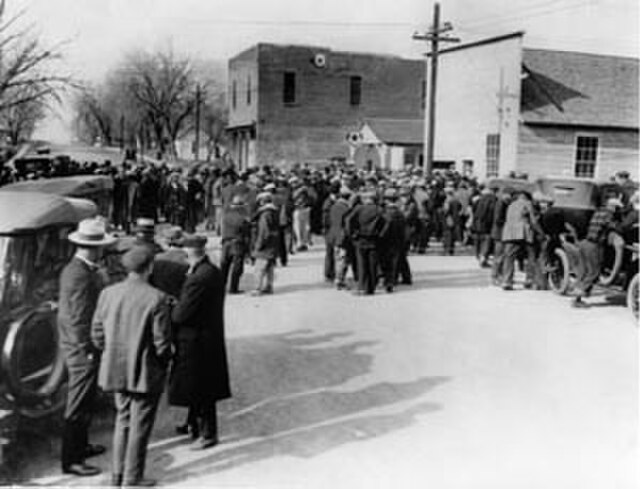
The protesters that witnessed the massacre were not called to testify but showed up at the Weld County Coroner’s office regardless, insisting on telling their story. They argued that after telling Scherf they were all leaders, he began yelling and threatening them. One of the protesters, Adam Bell, began to argue with one of the police officers, and both men tried to climb the fence. Picketers testified that Bell was pulled over the fence by the policeman and beaten. They claimed that they had no choice but to push the fence down in order to save Bell. They stated that, per strike instructions, they carried no weapons with them. However, they admitted to fighting back when the police began to attack them. In the midst of the violence, the police knocked down the picketing flag bearer and trampled the American flag. One eyewitness claimed a woman named Elizabeth Veranek tried to shield the flag with her own body, after which it was picked up and someone tried to continue marching with it.24 Campbell-Hale, Remembering Ludlow but Forgetting the Columbine, 111-12.
It did not take long for shots to be fired, and World War I veterans that participated in the protests testified that the bullets came so fast that they had to have come from machine guns. People began to flee from the mine and soon returned with cars draped in white flags in order to collect the injured.25 Campbell-Hale, Remembering Ludlow but Forgetting the Columbine, 111.
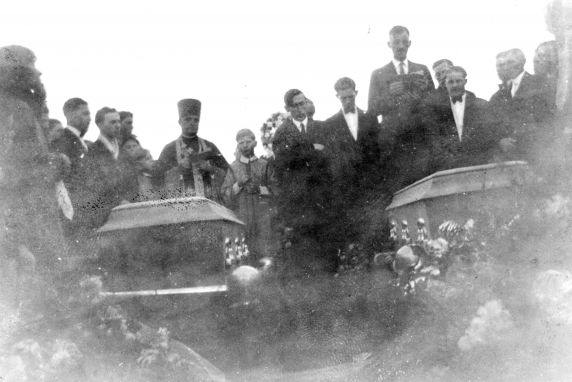
Two men, John Eastenes and Nick Spanandakis, were killed immediately. Jerry Davis, Rene Jacques, and George Kovovitch, died by sunset. Although doctors amputated both of his legs in an attempt to save his life, Mike Vidovich died of gangrene by the end of the week. He was the last to die as a result of the Columbine Massacre.26 Campbell-Hale, Remembering Ludlow but Forgetting the Columbine, 111-12.
Aftermath of the Massacre
In spite of the testimony protesters gave, the County Coroner ultimately ruled that the strikers that had been killed were “assembled and invading the mine property after having been properly and legally warned not to enter,” meaning that the deaths were “not felonious.” 27 “Coroner’s Jury Blames Strikers for Deaths Columbine Mine Battle,” The Fort Collins Coloradoan (Fort Collins, CO), Nov. 25, 1927. No one would be charged for any of the six deaths. Following the Massacre, the IWW largely lost control over the strikes, as many protesters refused to risk their lives.28 Campbell-Hale, Remembering Ludlow but Forgetting the Columbine, 112-13.
The day after the Massacre, Governor Adams ordered 325 men to occupy the area surrounding the mine and declared martial law in the northern fields. He also decided to finally mobilize the National Guard, however he never sent them to the Columbine Mine. Instead, they remained in Denver, ninety miles north east of the site of the Massacre. Despite his activation of the Guard, Adams still trusted the state police, allowing them to deal with any unrest for the remainder of the strike.29 Charles J. Bayard, “The 1927-1928 Colorado Coal Strike,” Pacific Historical Review 32, no. 3 (1963), 245. As a result of the martial law in the northern fields, the largest protests shifted to the south. There, demonstrators were often arrested or attacked by the strike police. This went on for for the remainder of the strike, until workers finally voted to end it at a meeting near Walsenburg on February 19th, 1928.30 Campbell-Hale, Remembering Ludlow but Forgetting the Columbine, 113-17.
Significance
Governmental Anti-Reform Sentiment
The Columbine Mine Massacre demonstrates the strong push against reform in the 1920s. Part of this was caused by “the political and economic climate that strangled union and worker initiative.”31 Lynn Dumenil, The Modern Temper: American Culture and Society in the 1920s (New York, NY: Hill and Wang, 1995), 65. Indeed, the Colorado state government’s direct involvement in suppressing the strikes was an effort to protect the interests of large corporations. By refusing to legally recognize the strikes, arresting IWW leaders and protesters, and of course firing upon demonstrators at Columbine Mine, the Colorado government demonstrated its willingness to intervene on behalf of coal companies at the expense of workers. The government’s defense of its actions also demonstrates its anti-labor stance, as Governor Adams blamed victims of the shooting by claiming that Scherf had only “ordered his men to fire only when it appeared that his own life and those of his deputies where in jeopardy.” 32 “Four Strikers Killed in Riot in Coal Fields,” The Buffalo Evening News (Buffalo, NY), Nov. 21, 1927.
Public Anti-Reform Sentiment
The public reaction to the Massacre also demonstrates America’s hostility towards the reform movement in the 1920s. During the First Red Scare, when the workers’ rights movement was tainted with the threat of communism, most Americans were afraid of or unsympathetic towards workers and unions. 33 Dumenil, The Modern Temper, 23. Newspaper articles from the wake of the Massacre show the animosity many people held towards striking works. For example, one headline refers to the protesters as a mob and writes that the strike officers were “protecting the Columbine Mine.” 34 “2 Miners Die, 30 Hurt As Police Fire on Mob,” The Brooklyn Daily Times (New York, NY), Nov. 21, 1927. The antagonistic manner in which the strikers are discussed, combined with the heroic characterization of the state strike police, exhibits the strong anti-reform sentiment seen during the 1920s. Recognizing the push against reform allows for a deeper understanding of what led to the 1927 Columbine Mine Massacre.
Citations
Bibliography
- “1,000 Coal Miners Are Affected by Columbine Award.” Rocky Mountain News. (Denver, CO), October 29, 1927. Accessed May 5, 2026. https://www.coloradohistoricnewspapers.org/?a=d&d=RMD19271029-01.
- “2 Miners Die, 3 Hurt As Police Fire on Mob.” Brooklyn Daily Times. (New York, NY), November 21, 1927.
- “Campbell-Hale, Leigh. Remembering Ludlow but Forgetting the Columbine: The 1927-1928 Colorado Coal Strike. Boulder, CO: University Press of Colorado, 2023.
- “Columbine Miners Not Satisfied with Wage Increase Given Them.” Daily Times. (Longmont, CO), October 29, 1927. Accessed May 5, 2026. https://www.coloradohistoricnewspapers.org/?a=d&d=TDT19271029-01.
- “Company Makes Reply to Columbine Miners.” Daily Times. (Longmount, CO), October 28, 1927. https://www.coloradohistoricnewspapers.org/?a=d&d=TDT19271028-01.
- “Coroner’s Jury Blames Strikers for Deaths Columbine Mine Battle.” Fort Collins Coloradoan. (Fort Collins, CO), November 25, 1927.
- Dumenil, Lynn. The Modern Temper: American Culture and Society in the 1920s. New York: Hill and Wang. 1995.
- “Four Strikers Killed in Riot in Coal Fields.” Buffalo Evening News. (Buffalo, NY), November 21, 1927.
- “Gov. Adams Meets Striking Miners Not Affiliated With the I. W. W.” Boulder Daily Camera. (Boulder, CO), October 27, 1927. Accessed May 5, 2026. https://www.coloradohistoricnewspapers.org/?a=d&d=BDC19271027-01.
- “Industrial Commission Investigates Demand of Weld County Miners.” Daily Times. (Longmont, CO), October 27, 1927. Accessed May 5, 2026. https://www.coloradohistoricnewspapers.org/?a=d&d=TDT19271027-01.
- “Miners In North Field Accept Pay Increase.” Rocky Mountain News, (Denver, CO), October 30, 1927. Accessed May 5, 2026. https://www.coloradohistoricnewspapers.org/?a=d&d=RMD19271030-01.
- “Miners Returning to Work at Columbine Mine, Force Gains 60 Since First Day of Strike.” Longmont Daily Call. (Longmont, CO), November 2, 1927. Accessed May 5, 2026. https://www.coloradohistoricnewspapers.org/?a=d&d=LDC19271102-01.
- “Thousands of Colorado Coal Miners Strike Under Orders of I. W. W.” Boulder Daily Camera. (Boulder, CO), October 18, 1927. Accessed May 5, 2026. https://www.coloradohistoricnewspapers.org/?a=d&d=BDC19271018-01.2.9.
Suggested Resources
- “Colorado Historic Newspapers Collection.” Colorado State Library. Accessed May 5, 2026. https://www.coloradohistoricnewspapers.org/?a=p&p=home&e=——-en-20–1-byDA-img-txIN%7CtxCO%7CtxTA-columbine+mine——-0——.
- “Columbine Mine Incident Collection.” University of Colorado Boulder Libraries, Rare and Distinctive Collections, https://archives.colorado.edu/repositories/2/resources/518.
- Kerwin, Hugh L. “Industrial Disputes: Strikes and Lockouts in the United States in November, 1927.” Monthly Labor Review 26, no. 1, (1928): 111-120, https://www.jstor.org/stable/41860658.

Grace Martinez is a Ramapo college history major with a minor in museum & exhibition studies.
- 1Leigh Campbell-Hale, Remembering Ludlow but Forgetting the Columbine: The 1927-1928 Colorado Coal Strike (Boulder, CO: University Press of Colorado, 2023), 79.
- 2Campbell-Hale, Remembering Ludlow but Forgetting the Columbine, 80.
- 3“Thousands of Colorado Coal Miners Strike Under Orders of I. W. W.,” Boulder Daily Camera, (Boulder, CO), October 18, 1927, https://www.coloradohistoricnewspapers.org/?a=d&d=BDC19271018-01.2.9.
- 4Campbell-Hale, Remembering Ludlow but Forgetting the Columbine, 81.
- 5Campbell-Hale, Remembering Ludlow but Forgetting the Columbine, 82.
- 6Campbell-Hale, Remembering Ludlow but Forgetting the Columbine, 87.
- 7Campbell-Hale, Remembering Ludlow but Forgetting the Columbine, 89.
- 8Campbell-Hale, Remembering Ludlow but Forgetting the Columbine, 96.
- 9“Industrial Commission Investigates Demand of Weld County Miners,” Daily Times, (Longmont, CO), October 27, 1927, https://www.coloradohistoricnewspapers.org/?a=d&d=TDT19271027-01.
- 10“Gov. Adams Meets Striking Miners Not Affiliated With the I. W. W.,” Boulder Daily Camera, (Boulder, CO), October 27, 1927, https://www.coloradohistoricnewspapers.org/?a=d&d=BDC19271027-01.
- 11“Company Makes Reply to Columbine Miners,” Daily Times, (Longmont, CO), October 28, 1927, https://www.coloradohistoricnewspapers.org/?a=d&d=TDT19271028-01.
- 12“1,000 Coal Miners Are Affected by Columbine Award,” Rocky Mountain News, (Denver, CO), October 29, 1927, https://www.coloradohistoricnewspapers.org/?a=d&d=RMD19271029-01.
- 13“Columbine Miners Not Satisfied with Wage Increase Given Them,” Daily Times, (Longmont, CO), October 29, 1927, https://www.coloradohistoricnewspapers.org/?a=d&d=TDT19271029-01.
- 14“Miners In North Field Accept Pay Increase,” Rocky Mountain News, (Denver, CO), October 30, 1927, https://www.coloradohistoricnewspapers.org/?a=d&d=RMD19271030-01; “Miners Returning to Work at Columbine Mine, Force Gains 60 Since First Day of Strike,” Longmont Daily Call, (Longmont, CO), November 2, 1927, https://www.coloradohistoricnewspapers.org/?a=d&d=LDC19271102-01.
- 15Campbell-Hale, Remembering Ludlow but Forgetting the Columbine, 101.
- 16Campbell-Hale, Remembering Ludlow but Forgetting the Columbine, 102.
- 17Campbell-Hale, Remembering Ludlow but Forgetting the Columbine, 103.
- 18Campbell-Hale, Remembering Ludlow but Forgetting the Columbine, 103-4.
- 19Campbell-Hale, Remembering Ludlow but Forgetting the Columbine, 104.
- 20Campbell-Hale, Remembering Ludlow but Forgetting the Columbine, 107-8.
- 21Campbell-Hale, Remembering Ludlow but Forgetting the Columbine, 108-9.
- 22Campbell-Hale, Remembering Ludlow but Forgetting the Columbine, 110.
- 23Campbell-Hale, Remembering Ludlow but Forgetting the Columbine, 111.
- 24Campbell-Hale, Remembering Ludlow but Forgetting the Columbine, 111-12.
- 25Campbell-Hale, Remembering Ludlow but Forgetting the Columbine, 111.
- 26Campbell-Hale, Remembering Ludlow but Forgetting the Columbine, 111-12.
- 27“Coroner’s Jury Blames Strikers for Deaths Columbine Mine Battle,” The Fort Collins Coloradoan (Fort Collins, CO), Nov. 25, 1927.
- 28Campbell-Hale, Remembering Ludlow but Forgetting the Columbine, 112-13.
- 29Charles J. Bayard, “The 1927-1928 Colorado Coal Strike,” Pacific Historical Review 32, no. 3 (1963), 245.
- 30Campbell-Hale, Remembering Ludlow but Forgetting the Columbine, 113-17.
- 31Lynn Dumenil, The Modern Temper: American Culture and Society in the 1920s (New York, NY: Hill and Wang, 1995), 65.
- 32“Four Strikers Killed in Riot in Coal Fields,” The Buffalo Evening News (Buffalo, NY), Nov. 21, 1927.
- 33Dumenil, The Modern Temper, 23.
- 34“2 Miners Die, 30 Hurt As Police Fire on Mob,” The Brooklyn Daily Times (New York, NY), Nov. 21, 1927.
