
David J. Goldberg’s article “Rethinking the 1920s: Historians and Changing Perspectives” offers brief descriptions of over 50 books written between 1929 and 2006. The author organizes the books by topic, for example books about women in the 1920s or how big business grew during this time. He does not, however, discuss the events and historical changes that influenced how scholars view the 1920s. Still, his article provides a very useful timeline that demonstrates when exactly historians were examining different aspects of the 1920s and writing monographs about them.
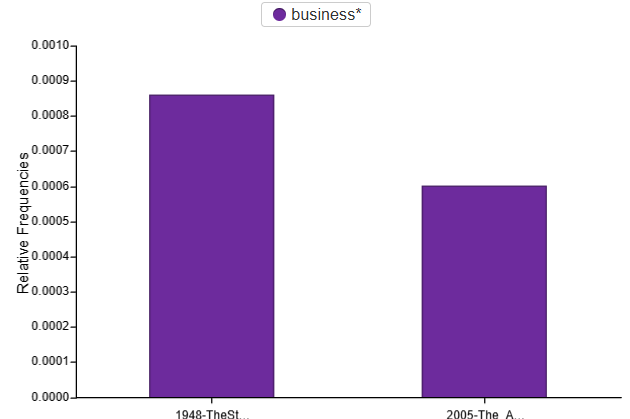
The textbook chapters from The Story of Our Country (1948) and The Americans (2005) largely reflect the topics historians were writing about during their respective time periods. The Story of our Country focuses more on business than The Americans does, as demonstrated in the visualization to the right. This was fairly consistent with the historical scholarship written shortly after the textbook was published. Some of these monographs include The Dollar Decade: Business Ideas in the 1920s by James Warren Prothro and The Great Crash by John Kenneth Galbraith. These books were both written in 1954 and they address the corporate ideology of the 1920s and the leadup to the Wall Street Crash respectively. 1 David J. Goldberg, “Rethinking the 1920s: Historians and Changing Perspectives,” OAH Magazine of History, no. 3 (2007): 8-10. This focus on business reflects the concerns of historians at the time. One way that The Story of Our Country does not fit neatly into the historiographical timeline Goldberg outlines is in its discussion of World War I. The only book that Goldberg references that discusses the war is his own 1999 monograph Discontented America: The United States in the 1920s, which “emphasizes the extent to which conflicts during the decade emanated from World War I.” 2 Goldberg, “Rethinking the 1920s,” 7. The textbook’s focus on conflict is an outlier in the historiographical discussion of the decade because most books written around the same time focus on business and the economy.
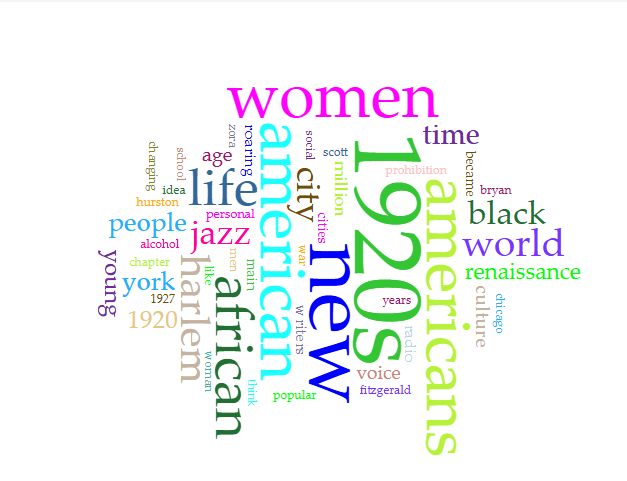
The Americans has a stronger emphasis on people than it does business, which is demonstrated in the word cloud to the right. Ideas about minorities, including women and Black Americans, are featured more heavily in this chapter than they are in The Story of Our Country. Both of these trends are consistent with the books published 10 to 15 years before the textbook. For example, Kristi Andersen’s 1996 book After Suffrage: Women in Partisan and Electoral Politics before the New Deal examines the lives of women after the 19th Amendment was ratified, and the 2002 books “We Return Righting:” The Civil Rights Movement in the Jazz Age by Mark Robert Schneider and Managing White Supremacy: Race, Politics and Citizenship of Jim Crow Virginia by J. Douglas Smith examine Black Americans in the North and South respectively. 3 Goldberg, “Rethinking the 1920s,” 9-10. The textbook’s discussion of people that have been excluded from the historical narrative in the past is consistent with much of the scholarship that was published in the years preceding it.
The textbooks have very different focuses when compared to one another. The Story of Our Country has a stronger emphasis on business and the war, taking a broader approach that focuses less on what life was like for everyday people during the 1920s. Voyant’s reader tool (below, left) demonstrates the book’s emphasis on what happened in the war itself rather than how it impacted people. Similarly, the bubbleline tool (below, right) indicates how much more important conflict was in the 1948 textbook’s narrative than it was in 2005. The Americans takes a much more in-depth look at the lives of specific demographics in 1920s society. For example, it has a more robust discussion of the lives of Black people during this time. Even accounting for the outdated descriptions of raced utilized when The Story of Our Country was written, it contains far less description of Black history than The Americans. The latter includes more information about Black experiences during the 1920s, although the organization of its bubbleline indicates it was largely relegated to a single section. Still, comparing the two textbooks demonstrates the vastly different priorities of the time they were written in. Specifically, it shows a concern for business and war in the late 1940s and a focus on the lives of minorities in the mid-2000s.
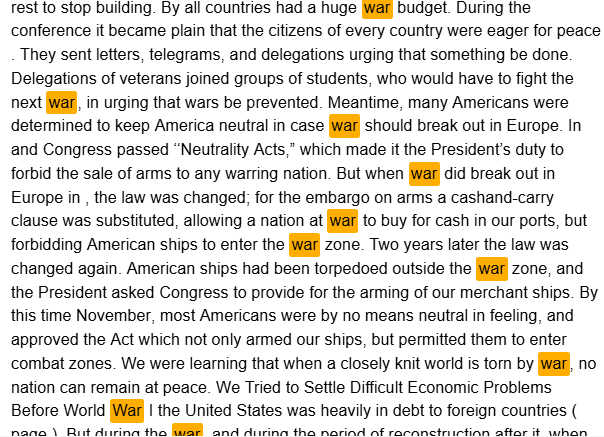

The reader tool (left) shows how The Story of Our Country discusses war. The bubbleline (right) shows the difference in how both textbooks discuss Black history.
While older history is not necessarily less professional than what scholars produce today, knowing when a historian writes helps to evaluate and understand a source. Society’s values and priorities have shifted drastically over the years and they will only continue to do so; acknowledging what most historians considered important during a certain time period allows readers to understand why scholars may include some information and ignore others. It may also reveal an author’s personal biases, as it is very difficult for anyone, including historians, to completely disregard the prejudices and values of their time when writing. Understanding the era a source was created in allows researchers to recognize not only what a scholar was writing about but why and how they chose to do so.

Grace Martinez is a Ramapo college history major with a minor in museum & exhibition studies.
- 1David J. Goldberg, “Rethinking the 1920s: Historians and Changing Perspectives,” OAH Magazine of History, no. 3 (2007): 8-10.
- 2Goldberg, “Rethinking the 1920s,” 7.
- 3Goldberg, “Rethinking the 1920s,” 9-10.
