
The 1927 Columbine Mine Massacre was part of a greater pattern of unsuccessful coal strikes in the 1920s. According to Lynn Dumenil’s book The Modern Temper, strikes were rare during this period. However, she writes that “some industries and areas experienced persistent labor unrest,” and “Strikes punctuated the troubled coal industry.” 1 Lynn Dumenil, The Modern Temper: American Culture and Society in the 1920s (New York, NY: Hill and Wang, 1995), 63. Dumenil examines how coal miner strikes in other parts of the country, such as Pittsburgh, were met with violence in the form of armed guards. She also writes that although “Many observers decried the brutality and terrorism of the owners…the union was broken, as it was in other coal strikes during the decade.” 2 Dumenil, The Modern Temper, 63. The aggressive reaction to the strike and the movement’s eventual failure were mirrored in Columbine. There, picketers were fired upon by the Colorado State Police. Three were killed instantaneously and three died from their wounds at a later time. 3 Charles J. Bayard, “The 1927-1928 Colorado Coal Strike,” Pacific Historical Review 32, no. 3 (1963): 245. Accessed March 31, 2026. https://www.jstor.org/stable/4492179. This violent response to labor unrest was very common in the 1920s, as evidenced in Dumenil’s writing.
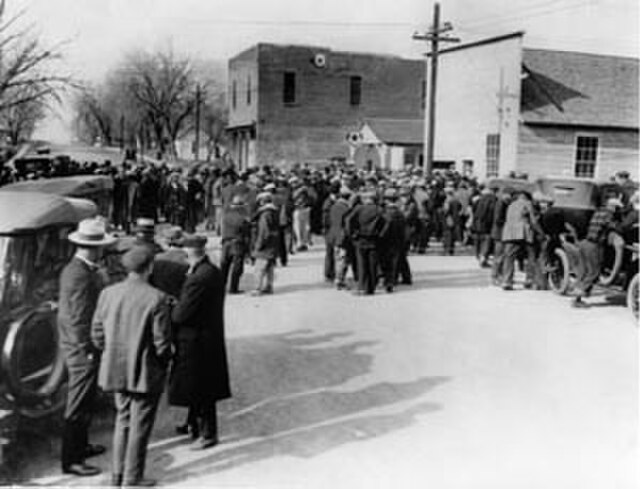
The aftermath of the strikes also reflects the anti-reform sentiment of the time. Dumenil argues that part of the reason for this aggression was “the political and economic climate that strangled union and worker initiative. The considerable power of corporations…gave employers a sympathetic government and public.” 4 Dumenil, The Modern Temper, 65. The state’s involvement in suppressing the strike clearly demonstrates its partnership with corporate powers. The two were so entwined that the government was willing to intervene in order to protect the interests of large companies. Furthermore, Colorado Governor William H. Adams later said that the state police chief had “ordered his men to fire only when it appeared that his own life and those of his deputies where in jeopardy.” 5 “Four Strikers Killed in Riot in Coal Fields,” The Buffalo Evening News (Buffalo, NY), Nov. 21, 1927. This demonstrates the anti-labor stance taken up by the government during this time.
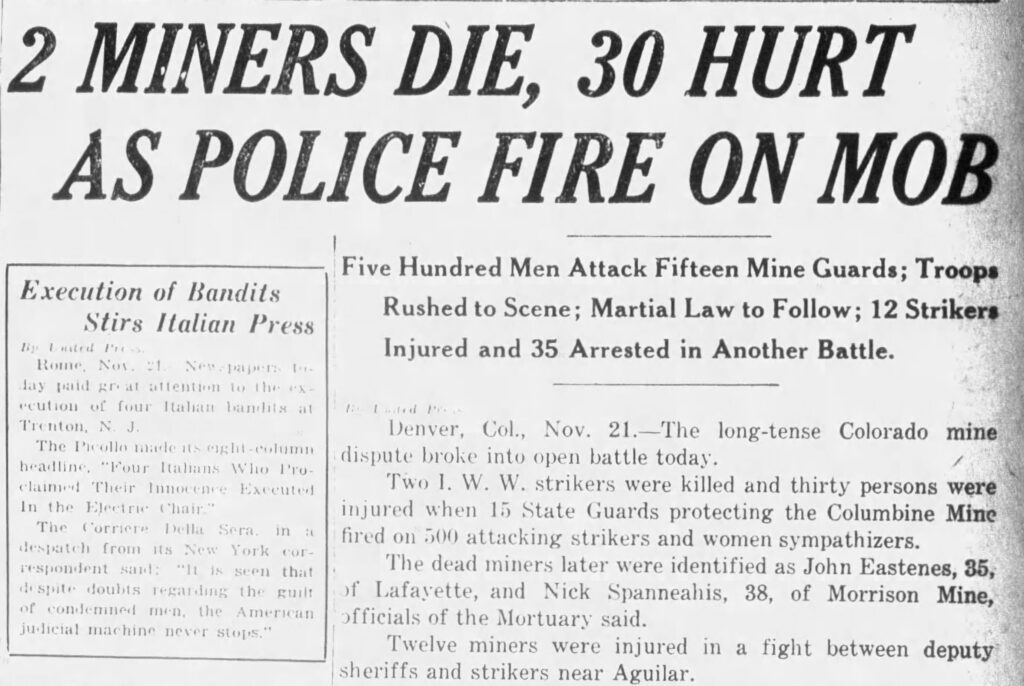
Additionally, the lack of any convictions for the killings shows how the public responded to the Massacre. Just four days after the shooting, a coroner’s jury in Colorado ruled that the strikers that were killed had been “assembled and invading the mine property after having been properly and legally warned not to enter,” meaning that the deaths were “not felonious.” 6 “Coroner’s Jury Blames Strikers for Deaths Columbine Mine Battle,” The Fort Collins Coloradoan (Fort Collins, CO), Nov. 25, 1927. The verdict of this jury, which was made up of regular Colorado citizens, was a demonstration of how public opinion had turned against labor power in the 1920s. These anti-reform beliefs are also evident in newspaper articles published in the wake of the Massacre. One of these, written and distributed by the United Press, characterized the strike as an attack on police that were “protecting the Columbine Mine.” 7 “2 Miners Die, 30 Hurt As Police Fire on Mob,” The Brooklyn Daily Times (New York, NY), Nov. 21, 1927. This negative depiction of the strikers and the heroic terms used to describe the police exhibit the widespread anti-labor beliefs discussed by Dumenil.
The 1920s were a time of strong anti-reform sentiment in America. Included in these beliefs were suspicion of and hostility towards unions and pro-labor movements. The Columbine Mine Massacre is one example of a violent reaction to worker strikes. It demonstrates how state governments stepped in to protect large companies and their capital, and also shows the strong anti-labor beliefs held by individual politicians. Additionally, the Massacre’s aftermath, including the lack of a conviction for the killing and the response in the press, illustrates the anti-reform attitude that had taken hold in much of the American populace. Overall, analyzing the Columbine Mine Massacre itself as well as the public and governmental responses to it allows for a deeper understanding of anti-labor beliefs in the 1920s.

Grace Martinez is a Ramapo college history major with a minor in museum & exhibition studies.
- 1Lynn Dumenil, The Modern Temper: American Culture and Society in the 1920s (New York, NY: Hill and Wang, 1995), 63.
- 2Dumenil, The Modern Temper, 63.
- 3Charles J. Bayard, “The 1927-1928 Colorado Coal Strike,” Pacific Historical Review 32, no. 3 (1963): 245. Accessed March 31, 2026. https://www.jstor.org/stable/4492179.
- 4Dumenil, The Modern Temper, 65.
- 5“Four Strikers Killed in Riot in Coal Fields,” The Buffalo Evening News (Buffalo, NY), Nov. 21, 1927.
- 6“Coroner’s Jury Blames Strikers for Deaths Columbine Mine Battle,” The Fort Collins Coloradoan (Fort Collins, CO), Nov. 25, 1927.
- 7“2 Miners Die, 30 Hurt As Police Fire on Mob,” The Brooklyn Daily Times (New York, NY), Nov. 21, 1927.
