
Overview
Discovering the Epidemic
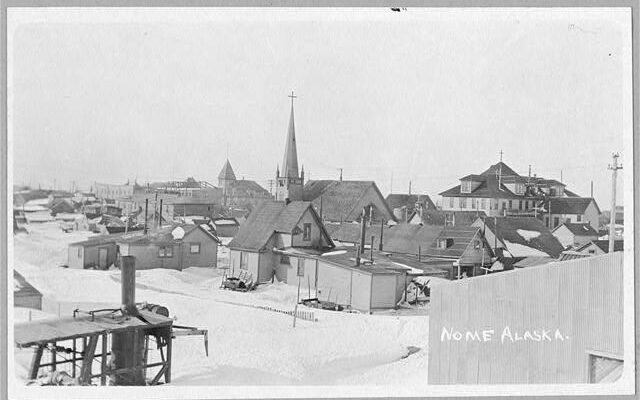
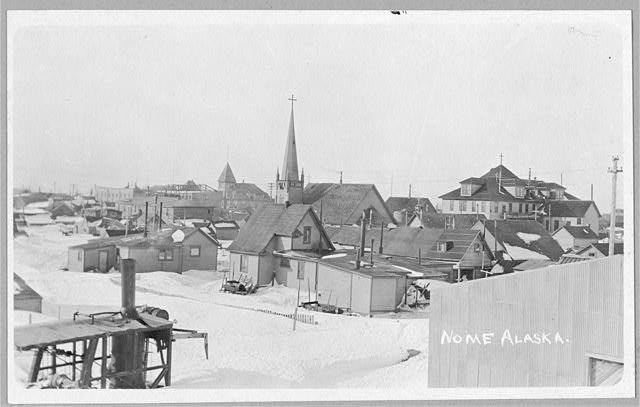
Established as a Gold Rush town in the late 1800s, Nome, Alaska was home to roughly 1,800 people in 1925.1 E. D. Stokes, “The Race for Life,” Public Health Reports 111, no. 3 (1996): 272, accessed March 18, 2026, https://www.jstor.org/stable/4598014.
Only one of them was a physician. Dr. Curtis Welch first encountered a suspected childhood diphtheria case in October of 1924, however since no one else in the child’s family was exhibiting symptoms of the highly contagious respiratory disease he dismissed it as a cold. The child died two days later, a tragedy Welch ascribed to malnutrition. On January 20th, however, he officially diagnosed a seven year old Indigenous child with diphtheria after noticing the distinctive smell of the disease. The only antitoxin serum Welch had on hand had expired five years earlier. Realizing that the child was unlikely to recover, he risked administering the expired serum. Welch did not observe any negative reaction to the antitoxin. However, his attempt at treatment was too late, and the child passed away. By this point, Welch was able to conclude that the expired serum, while not harmful, would not be effective enough to fight off an epidemic. He immediately notified the mayor of Nome and they formed an emergency Board of Health to enforce a town-wide quarantine.2 Curtis Welch, “Nome’s Solitary Physician Tells Gripping Story of Diphtheria Epidemic,” The Times (Trenton, NJ), Feb. 8, 1925.
The Call for Help
Welch sent a telegram asking for help from the Public Health Service in Washington, D. C. The group was able to quickly locate 300,000 units of antitoxin in Anchorage, but they immediately ran into the issue of transportation. There were two small planes in Anchorage, however they had been disassembled for the winter. Even if they were functional, they would have likely been useless in the below freezing temperatures and 60 to 70 mile per hour winds of the Alaskan winter.3 Stokes, “The Race for Life,” 272-73. Instead, the Board of Health and territorial Governor Scott Bone chose to transport the serum via dog sled along the Alaskan Mail Route, also called the Iditarod Trail.4 Kenneth A Ungermann, The Race to Nome: The Story of the Heroic Alaskan Dog Teams That Rushed Diphtheria Serum to Stricken Nome in 1925 (Harper & Row, 1963), 18-21, 43. This route normally took 20 days for one team to complete, but this would have been far too long for Nome to wait. Instead, they decided on a relay team of mushers and their dog teams. With the help of the United States Signal Corps, which operated the Alaskan telegraph system, the Board of Health contacted 20 men who agreed to transport the antitoxin to Nome.5 Associated Press, “Diphtheria Rages at Nome, Alaska,” Olean Evening Herald (Olean, NY), Jan. 28, 1925. On January 27th, the serum was delivered by train from Anchorage to Nenana. There, 674 miles away from Nome, the race began.6 Stokes, “The Race for Life,” 273.
The Great Race for Mercy
From the station at Nenana, William “Wild Bill” Shannon and his team took off towards Tolovana. The 52 miles he covered marked the first leg of the serum run. The race involved 20 men and over 150 dogs in total.7 Anna Alger, “100 Years After the Great Serum Run, Balto’s Legacy Endures,” Cleveland Museum of Natural History, January 23, 2025, accessed March 18, 2026, https://www.cmnh.org/learn/science-blog/2025/01/23/100-years-after-the-great-serum-run-baltos-legacy-endures. These teams travelled in blizzard conditions, and one musher, Charlie Evans, later claimed that he ran through -64 degree weather during his leg of the trip.8 Ungermann, The Race to Nome, 80-1. There was a great amount of diversity amongst the mushers, with many European immigrants, native born white Americans, members of Indigenous Athabascan tribes, and men of blended ancestry running on the trail. Details about individual mushers and their experiences during the serum run can be found in the map below.
The Eyes of the Nation
The diphtheria epidemic and the serum run itself became sources of national interest. Newspapers across the country, from Hawai’i to Maine, covered the efforts to save Nome. People eagerly followed the plight in Alaska, and newspaper companies attempted to reach Welch for comment. He later told the Surgeon General that he destroyed all the wires sent to him by the press, saying “I am a physician, not a press agent.”9 William H. Wilson, “The Serum Dash to Nome, 1925,” Alaska Journal 16 (1986): 255. Still, the newspapers continued to allow people from every state to follow what was happening in the farthest reaches of the American territory. All of this took place in a decade that saw an uptick in interest in national news.
Leonhard Seppala and Togo
In an effort to quicken the relay, Nome’s Board of Health decided to add more mushers to the trip after it had already begun. Leonhard Seppala, a Norwegian immigrant and famed dog sled racer, had already been sent from Nome to Nulato to pick up the serum. He had no way of knowing that more teams had been added or that the serum had actually passed through Nulato already. His trip to Nulato wound up being very fortunate, however, as Henry Ivanoff’s dogs picked up the scent of reindeer only half a mile outside of Shaktoolik. The dogs refused to return to the trail, so upon seeing Seppala Ivanoff waved him down and transferred the serum to him. Seppala, whose team was led by the famous Siberian Husky Togo, headed towards Golovin in Ivanoff’s place.10 Ungermann, The Race to Nome, 101-02, 110-12. .
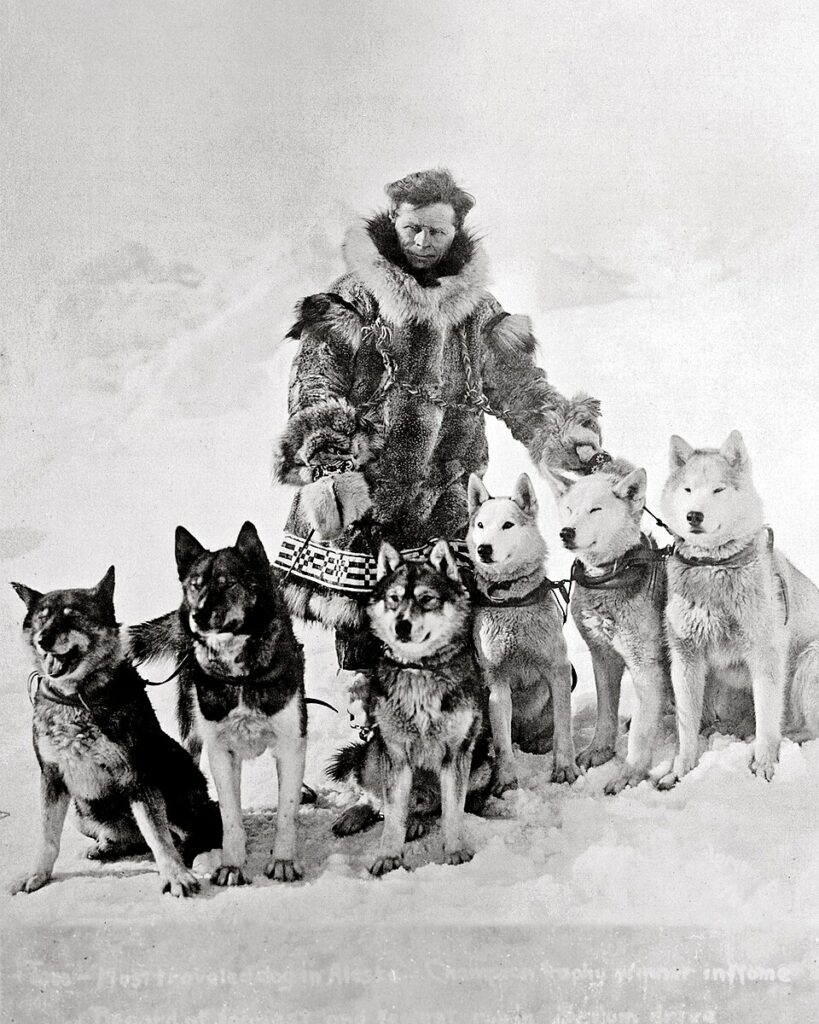
On his way to Golovin, Seppala had to choose between travelling along the coastline of Norton Bay, adding hours to the run, or cutting 20 miles across the frozen Bay itself. The ice could crack at any time, potentially stranding him and his team on an ice drift. Worse, they could be plunged into the icy sea. Seppala, whose daughter Seigrid had contracted and recovered from diphtheria a few years earlier, decided to cut across the Bay.11 Ungermann, The Race to Nome, 120-21.
Togo led Seppala’s team in a straight line across Norton Bay. All the while, the man himself listened carefully for the sound of cracking ice, though he could not be sure it was not covered by the howling wind. At one point, the strong gusts blew the sled sideways, taking the dogs with it. Seppala righted them and moved on. Finally, late in the evening, he and his dogs arrived at the shore of Norton Bay. They had successfully crossed the frozen sea. Seppala and his team stopped to rest in the shelter of his friend’s igloo overnight. A few short hours after the team came ashore, the ice of the bay they had just run across began to break. 12 Ungermann, The Race to Nome, 122-23, 128.
Seppala and his team left the next morning. When they finally arrived in Golovin, they had travelled over 91 miles on the serum run.13 Ungermann, The Race to Nome, 131. This was the longest distance covered by any individual team. While this remains the official length credited to Seppala’s team, it does not include the trip they took from Nome to Shaktoolik. In total, the dogs had actually run 268 miles within two days.14 Stokes, “The Race for Life,” 275.
Gunnar Kaasen and Balto
Seppala transferred the serum to Charlie Olson in Golovin, who then travelled 25 miles to Bluff. There, he handed it off to Norwegian-born musher Gunnar Kaasen and his team, led by the Siberian Husky Balto. The vsibility was so poor that Kaasen nearly directed his team to run straight through a river. He was stopped only by Balto’s refusal to move forward. Not long after they rerouted around the river, Seppala and his team came to Topkop Hill. With a 600-foot summit and no path around it, all mushers dreaded the landmark. Seppala had to get out of his sled and push it from behind while his team pulled it up the hill. During this process Kaasen completely lost sensation in his face.15 Ungermann, The Race to Nome, 145-48.
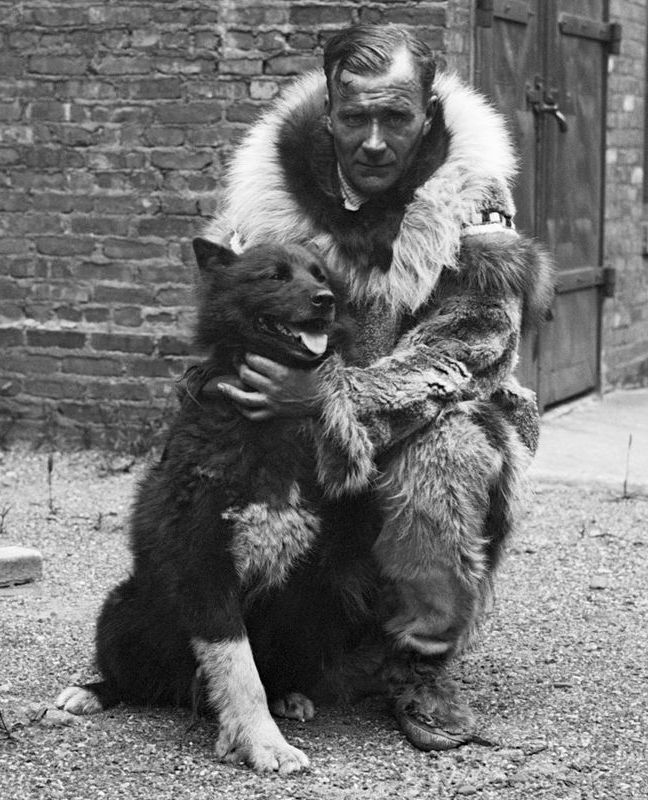
After climbing up and subsequently sledding down Topkop Hill, Kaasen and his team continued on towards Point Safety. However, while passing through Bonanza flats, the intense winds flipped over Kaasen’s sled and pulled several of his dogs with it. After righting the sled, he realized that the serum had been knocked off in the crash. In the low visibility Kaasen had to remove his mittens and search through the snow with his bare hands. Eventually, he was able to find the package and secure it to the sled once more.16 Ungermann, The Race to Nome, 149-52.
Kaasen had initially been instructed to stop at Point Safety and transfer the antitoxin to Ed Rohn, who was chosen to run it the rest of the way to Nome. When he arrived, he noticed that the lights were out in the cabin. He realized that Rohn, who was not expecting Kaasen until the next morning, had gone to sleep. Kaasen debated waking Rohn to give him the serum. After considering how long it would take Rohn to prepare his team, and recognizing the dire conditions in Nome, Kaasen decided to bring the serum the final stretch himself.17 Ungermann, The Race to Nome, 153.
Arrival and Aftermath
Kaasen arrived in Nome at 5:30 in the morning on February 2nd, 1925. He knocked on Welch’s front door, waking him up while his dogs finally took a break. In five and a half days, 20 men and their dogs had covered 674 miles in blizzard conditions and delivered life-saving diphtheria antitoxin to a town on the verge of an epidemic.18 Ungermann, The Race to Nome, 156.
When Welch opened the package he was horrified to find that the 300,000 units of antitoxin were frozen solid. After radiogramming the Public Health Service, however, he was assured that it could be thawed and used effectively. He began treating victims immediately and on February 21st the epidemic was declared over and the quarantine lifted. It had been just over a month since Welch diagnosed the first case of diphtheria.19 Ungermann, The Race to Nome, 157-58. The serum run had been successful, and Welch and his staff were able to effectively treat the disease.
The crisis faced in Nome spurred the government into action. The Public Health Service shipped a second batch of 1,100,000 antitoxin to Seward, Alaska on the S. S. Alameda. They were taken to Nenana by train, and from there they were transported to Nome by yet another dogsled relay. Many of the mushers that participated in the first serum run likely took part in the second, however because the country’s fascination with Nome died out after Kaasen’s arrival, their names were not recorded. In addition to the new shipment of serum, the epidemic pushed the Post Office to begin planning for an effective airmail service in Alaska. 20 Ungermann, The Race to Nome, 159-60. The diphtheria epidemic and the subsequent relay race to Nome sparked fundamental changes in how Alaska was connected to the contiguous United States.
The mushers themselves were rewarded for their efforts, with each one receiving $18.66 from a public donation fund. Additionally, the Territory of Alaska paid them $25 for each day that they were on the trail. Finally, the H. K. Mulford Company, the producer of the antitoxin, sent each of the mushers a medal and sent Gunnar Kaasen an additional $1,000.21 Ungermann, The Race to Nome, 159. However, this reward, along with Kaasen’s overall involvement in the race, proved to be controversial.
The Battle for Credit
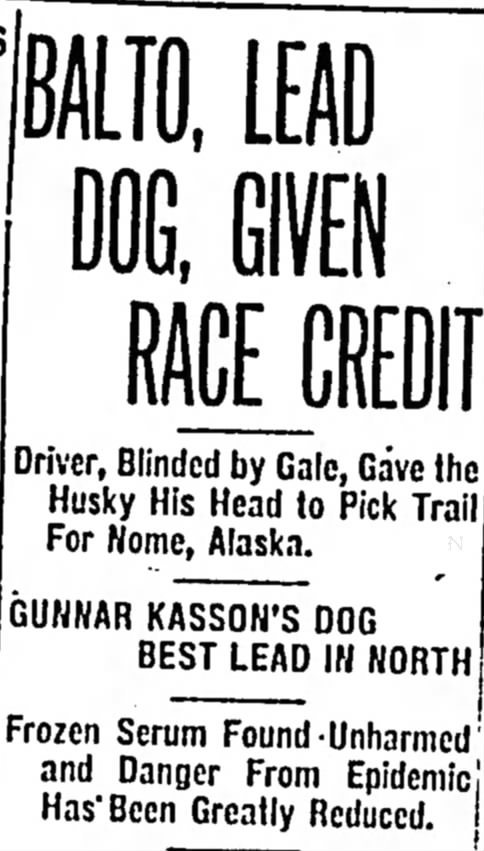
Kaasen’s decision to bypass Ed Rohn and deliver the serum himself is still debated. He claimed that he made this choice in order to get the serum to Nome as fast as possible, however Rohn, Leonhard Seppala, and some Nome residents felt that he wanted to earn the good publicity that came with his delivery. The $1,000 he received for his efforts did not help his case.22 Ungermann, The Race to Nome, 161. What may have been more damaging, however, was the movie deal he signed by the end of the month.
At a time when movies were just beginning to become popular in America, Kaasen and Balto travelled to the contiguous United States on a press tour for their film. At the end of the tour they saw the dedication of the famed Balto statue erected in Central Park. Many claim that this is evidence of Kaasen’s desire for glory, however due to his introverted nature both at home and along the press tour, some argue that the Mayor of Nome may have pressured him into accepting the deal.23 Gay Salisbury and Laney Salisbury, The Cruelest Miles: The Heroic Story of Dogs and Men in a Race Against an Epidemic (W. W. Norton & Company, 2003), 246-47. Regardless, Kaasen’s decision to take the serum to Nome himself and the lasting debate surrounding it demonstrate the questions surrounding glory in the race.
One man who always questioned Kaasen’s decision was Leonhard Seppala. For years, he remained angry that Balto was given the credit he felt belonged to his dog, Togo. After all, Togo and his team had covered more distance than any other team that participated in the run, including their treacherous trip across Norton Bay. Seppala was particularly upset when some newspapers falsely attributed Togo’s impressive run to Balto. In his memoir, Seppala wrote that:
“I hope I shall never be the man to take away credit from any dog or driver who participated in that run. We all did our best. But when the country was roused to enthusiasm over the serum run driver, I resented the statue to Balto, for if any dog deserved a special mention it was Togo.”
Salisbury, The Cruelest Miles, 248-249.
Significance
The Failures of Technology
The Nome serum run took place during a time of great technological improvements. Lynn Dumenil’s book The Modern Temper demonstrates this, including the 64% increase in industrialization over the decade as a whole. Both the chemical and automobile industries played a role in the technological boom of the 1920s.24 Lynn Dumenil, The Modern Temper: American Culture and Society in the 1920s (New York, NY: Hill and Wang, 1995), 58. The former had an important impact on the serum run, particularly because the H. K. Mulford Company manufactured the diphtheria antitoxin.25 Wilson, “The Serum Dash to Nome,” 257. However, the transportation advancements that were dispersing throughout the mainland United States at this time, for example paved roads and cars, were not yet available in the more rural areas of the country. The serum run to Nome shows that in spite of recent improvements in transportation technology, these developments were not yet able to help those outside of the increasingly urban contiguous United States.
The Success of Syndicated News
While transportation improvements proved unable to affect the Nome serum run, improvements in newspaper technology drew people from all parts of the nation into following the race to Nome. Dumenil writes that “because of developments in technology and distribution, [newspapers] increasingly consisted of syndicated news information and photographs.”26 Dumenil, The Modern Temper, 72. This system consisted of a single news story being written and distributed to papers across the country. Dr. Welch’s account of the diphtheria epidemic, written a week after the serum arrived, is one example of this. He wrote an article for United Press that was sent to and published by newspapers all the way from Nebraska to New Jersey. This followed weeks of news coverage detailing Nome’s struggles, as newspapers from all 48 of the recognized states at that time, plus the territories of Alaska and Hawai’i, published stories about the dog sled relay. In addition to the increase in syndicated news, this shows the uptick in national news coverage that people were consuming during the 1920s.27 Dumenil, The Modern Temper, 58. People in every part of the country followed the serum run, regardless of how far they were from Alaska. Overall, in spite of transportation technology’s inability to assist in the race itself, advancements in newspaper technology during the 1920s allowed Americans to track what was happening in Nome.
Citations
Bibliography
- Alger, Anna. “100 Years After the Great Serum Run, Balto’s Legacy Endures.” Cleveland Museum of Natural History. January 23, 2025. Accessed March 18, 2026. https://www.cmnh.org/learn/science-blog/2025/01/23/100-years-after-the-great-serum-run-baltos-legacy-endures.
- Associated Press. “Diphtheria Rages at Nome, Alaska.” Olean Evening Herald (Olean, NY), January 28, 1925.
- Dumenil, Lynn. The Modern Temper: American Culture and Society in the 1920s. New York: Hill and Wang. 1995.
- Salisbury, Gay and Laney Salisbury. The Cruelest Miles: The Heroic Story of Dogs and Men in a Race Against an Epidemic. New York: W. W. Norton & Company. 2003.
- Stokes, E. D. “The Race for Life.” Public Health Reports 111, no. 3. (1996): 272-275. Accessed March 18, 2026. https://www.jstor.org/stable/4598014.
- Ungermann, Kenneth A. The Race to Nome: The Story of the Heroic Alaskan Dog Teams That Rushed Diphtheria Serum to Stricken Nome in 1925. New York: Harper & Row. 1963.
- Wilson, William H. “The Serum Dash to Nome, 1925.” Alaska Journal 16 (1986): 250-259.
- Welch, Curtis. “Nome’s Solitary Physician Tells Gripping Story of Diphtheria Epidemic.” The Times (Trenton, NJ) February 8, 1925.
Suggested Resources
- Rozell, Ned. “Sled Dogs Were Lifesavers in the Serum.” Geophysical Institute, University of Alaska Fairbanks. Accessed March 19, 2026. https://www.gi.alaska.edu/alaska-science-forum/sled-dogs-were-lifesavers-serum-run.
- “Serum Run of 1925.” Alaska State Archives. Accessed March 19, 2026. https://archives.alaska.gov/education/serum.html.
- “Serum Run Resources.” University of Alaska Fairbanks. Accessed March 29, 2026. https://library.uaf.edu/aprca/research-guides/serum-run.

Grace Martinez is a Ramapo college history major with a minor in museum & exhibition studies.
- 1E. D. Stokes, “The Race for Life,” Public Health Reports 111, no. 3 (1996): 272, accessed March 18, 2026, https://www.jstor.org/stable/4598014.
- 2Curtis Welch, “Nome’s Solitary Physician Tells Gripping Story of Diphtheria Epidemic,” The Times (Trenton, NJ), Feb. 8, 1925.
- 3Stokes, “The Race for Life,” 272-73.
- 4Kenneth A Ungermann, The Race to Nome: The Story of the Heroic Alaskan Dog Teams That Rushed Diphtheria Serum to Stricken Nome in 1925 (Harper & Row, 1963), 18-21, 43.
- 5Associated Press, “Diphtheria Rages at Nome, Alaska,” Olean Evening Herald (Olean, NY), Jan. 28, 1925.
- 6Stokes, “The Race for Life,” 273.
- 7Anna Alger, “100 Years After the Great Serum Run, Balto’s Legacy Endures,” Cleveland Museum of Natural History, January 23, 2025, accessed March 18, 2026, https://www.cmnh.org/learn/science-blog/2025/01/23/100-years-after-the-great-serum-run-baltos-legacy-endures.
- 8Ungermann, The Race to Nome, 80-1.
- 9William H. Wilson, “The Serum Dash to Nome, 1925,” Alaska Journal 16 (1986): 255.
- 10Ungermann, The Race to Nome, 101-02, 110-12.
- 11Ungermann, The Race to Nome, 120-21.
- 12Ungermann, The Race to Nome, 122-23, 128.
- 13Ungermann, The Race to Nome, 131.
- 14Stokes, “The Race for Life,” 275.
- 15Ungermann, The Race to Nome, 145-48.
- 16Ungermann, The Race to Nome, 149-52.
- 17Ungermann, The Race to Nome, 153.
- 18Ungermann, The Race to Nome, 156.
- 19Ungermann, The Race to Nome, 157-58.
- 20Ungermann, The Race to Nome, 159-60.
- 21Ungermann, The Race to Nome, 159.
- 22Ungermann, The Race to Nome, 161.
- 23Gay Salisbury and Laney Salisbury, The Cruelest Miles: The Heroic Story of Dogs and Men in a Race Against an Epidemic (W. W. Norton & Company, 2003), 246-47.
- 24Lynn Dumenil, The Modern Temper: American Culture and Society in the 1920s (New York, NY: Hill and Wang, 1995), 58.
- 25Wilson, “The Serum Dash to Nome,” 257.
- 26Dumenil, The Modern Temper, 72.
- 27Dumenil, The Modern Temper, 58.
