Day: February 18, 2020

Sweatshops are referred to as a place of work, typically a factory or clothing production company, that abuses their workers by placing them in inhuman working conditions for very long hours with very little pay. While sweatshops were typically more common in less developed countries many years ago, suspicion has led to the investigation of big companies today, such as Nike, for making their factories into sweatshops. Being that Nike operates their production in about 41 countries, some being less developed countries such as Bangladesh and Cambodia, Nike has been accused of operating sweatshops in these smaller regions. Research from

Cartoon illustration of Nike sweatshop    treatment.

WHO shows that Nike workers in Cambodia, since the year 2000, have complained of working in small buildings in which temperatures went as high as 37 degrees Celsius (98.6 degrees Fahrenheit) and earned wages of approximately fourteen cents and hour.  While Nike has covered its tracks in recent years and have begun to include sustainability and women’s/LBGTQ+/minority group empowerment in their campaigns, it is unsure if the working conditions have entirely approved as Nike claims that they are not all responsible because those factories are subcontracted.

Sweatshops have been historically shown to provide employment for foreign immigrants and individuals expected not to work, such as women. In the years 1880-1940, the United States population grew by approximately 26 million people through immigration according to Smithsonian records. Being that so many immigrants traveled to the United Sates to start a new life with new opportunities, it was often hard to find employment. Sweatshops would become rather popular in the US at this time as they allowed a countless number of employees as the work environment was often overcrowded and it was cheap labor. Often, sweatshops were located in larger factory buildings to ensure the most amount of labor could be fit and used, however, sweatshops were also found in many tenement apartments.

The third, factory room of a tenement apartment in which the family business would be run in.

Tenement apartments were typically three room apartments that would house families with any number of members; in this time period, families sizes were around five to nine members. The first room would be a bedroom in which the bed took up predominantly the entire room; some families would fit a much smaller futon-like piece of furniture in this room to maximize sleeping space. The second room in the apartment also contained at least one other bed while the rest of the space was the kitchen. Most apartments contained a stove and sink area although running water was not always running throughout the building, rather it was just outside and families would fill buckets up and bring them to their rooms. The third room was the sweatshop/factory space. This room, unless your family worked in a factory located outside of your home, would consist of sewing machines and fabrics as the father, possibly other families members, and outside workers would work long days constructing clothing. Many workers would fit in the rather tight space to complete their work tasks and pay levels were never that high.

Sweatshops were very commonly linked to immigration as they were the easiest form of employment to obtain and their were always open positions. While conditions were not always the best, immigrants would take these jobs because it was better than being unemployed and gave them a chance to provide income to the family. Containing a factory setup in a tenement apartment also allowed families to work longer hours and be in the environment of their own home and family. Sweatshops were very common at this time, however, they quickly grew out of business once labor laws begun to be implemented and workers were provided better working conditions.


I was amazed walking through the tenement house, seeing how small the apartments were and finding out how many people lived in each; it was surprising to me that an eight-person family would have had to make due living and sometimes working in a space that small. Learning about two particular immigrant families touched me since each had their own story and way of life that were both similar to and different from each other. Learning about the garment factories that families ran in their own homes as well as the larger sweatshop factories that were established was an additional eye-opening experience for me. I remember learning about the sweatshop factories in middle school and high school, but to be put in the immigrants’ shoes by touring a legitimate tenement house, seeing printed government census reports as well as images of these families, of Orchard Street, and of the sweatshop factories impacted me.

I learned at the museum that mostly women worked in the sweatshops and they were paid very low wages, following the gender roles of the time. The health conditions were fatal, especially because of all the fabric dust they would inhale from the air. Additionally, they worked very long hours, ranging from fifty to close to one hundred hours per week. The larger sweatshop factories resembled a high school cafeteria; they were very crowded spaces with little to no sanitation. Unfortunately, immigrants had to deal with these conditions because they had just moved to a new country where they were unfamiliar with the language and had no idea where to start; they were desperate to find a job to start rebuilding their lives and to support their families. However, many joined labor unions and went on strikes, but this did not bring positive results. I believe sweatshops can be a good thing for immigrants to an extent, that being that they were at least employed and were paid. It is difficult for foreigners who have no idea how society runs in a country other than their own to find a job, and other jobs that do not require one to speak a certain language or to have a specific skill set, such as various housekeeping jobs, would have had equally unfair working traditions. Employers took advantage of the immigrants’ desperation to find a job, and found no shame in treating them unjustly.

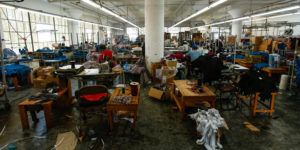
This is a picture taken from an article published by the LA Times of a present-day sweatshop factory of Forever 21 located in Los Angeles, California.
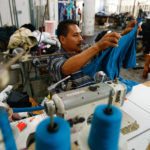
This is a picture of an immigrant worker at a sweatshop. This photo is borrowed from the same LA Times article the other photo was borrowed from.

According to Benjamin Powell, the author of the article Meet the Old Sweatshops: Same as the New, the conditions in the sweatshops of the past were worse than those in many currently operating sweatshops. Child labor was very common back then and the cities were dangerously swelling with people and disease.[1] However, an article published by Los Angeles Times about the factory workers for Forever 21 proves the unfortunate fact that sweatshops still persist today in America and that many of the unsanitary conditions in the early sweatshops exist in those of today. The claims made in this article parallel those made on our tour in the city. It is distressing to think that many of the articles of clothing we wear, even those that are sold to us at a high price, are made by laborers who work about 10 hours a day and are paid a few dollars an hour. As said in the article, these factories are “stifling” and “sweltering” and consist of only “one-room workshops” where workers sit “behind a sewing machine,” similar to those of the past. Additionally, the factories in America such as the one located in Los Angeles where the workers produce the clothing for the brand Forever 21, aim to keep the prices low so they hire immigrants, many of them undocumented, who are willing to work for below minimum wage.[2]

After the field trip to the museum and reading these two articles, my eyes have been opened and I have become more sensitive and curious about the past in relation to the present as well as about the stories of different immigrants.

Bibliography

[1] Powell, Benjamin. “Meet the Old Sweatshops: Same as the New.” The Independent Review, v. 19, n. 1, Summer 2014, ISSN 1086–1653, 2014, pp. 109–122.https://www.independent.org/pdf/tir/tir_19_01_08_powell.pdf

[2] Kitroeff, Natalie, and Victoria Kim. “Behind a $13 Shirt, a $6-an-Hour Worker.” Los Angeles Times. Los Angeles Times, August 31, 2017. https://www.latimes.com/projects/la-fi-forever-21-factory-workers/.


css.php