
The Osage Murders: A Reign of Terror and the 1920s
The 1920s are known for their glamour and fast-paced cultural changes in the United States. When we think of the time, we imagine flappers, jazz clubs, booming cities, transportation, travel, and new technology. Yet beneath this surface of excitement and booming progress, the decade was also marked by social issues such as racial violence, corruption, and struggles over America’s growing wealth. One of the clearest examples of this dark reality was the Osage murders. This terror was found in a series of murders that targeted the Native American Osage Nation in Oklahoma between 1921 and 1926. These horrific mass killings were driven by nothing other than greed. These horrific acts revealed to the world just how the 1920s were not only a time of innovation and progress, but it was a time negatively impacted by racism, exploitation, and corruption. Understanding the circumstances surrounding the Osage Murders helps us see the decade in a more honest way by focusing on the tragedies as well as the successes.
The Reign of Terror Began
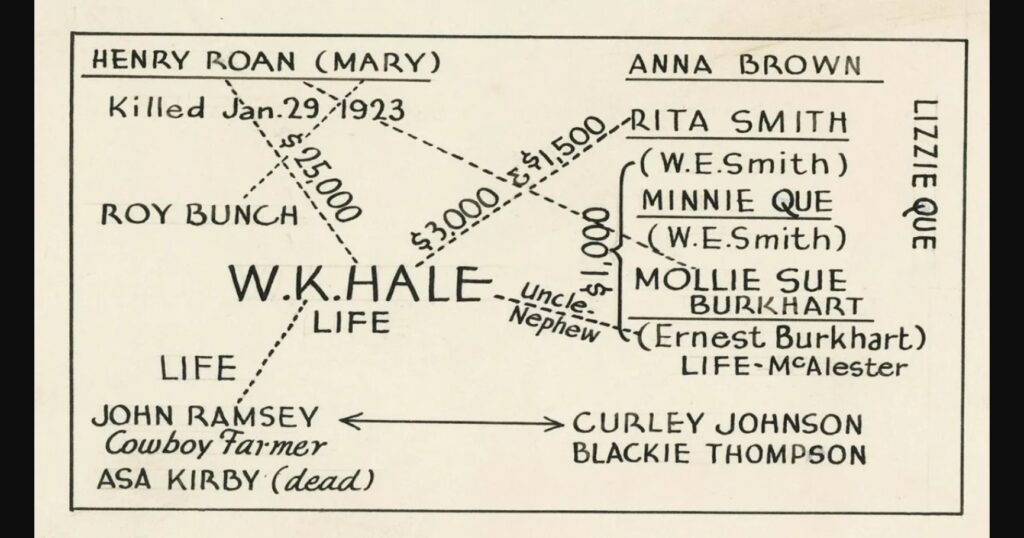
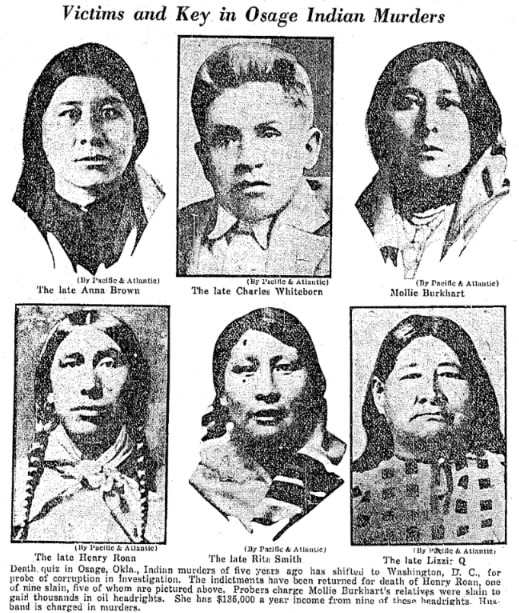
On May 14, 1921, Minnie Smith, the sister of Mollie Burkhart, died of a peculiar illness. Only eight days later, on May 22, 1921, Anna Brown, another sister of Mollie, was murdered. Photo from the Oklahoman Collection at the Oklahoma
Historical Society. Home | Oklahoma Historical Society
This photo was used during the Hale Murder Trial.
The body of Anna Brown was found in a ravine with a gunshot wound to the back of the head. Only two months later, Anna and Mollie’s mother, Lizzie Q. Kyle, died in July 1921 after a long, mysterious illness. William Stepson, a 29-year-old Osage man, died in February 1922 of poisoning. While seeking help from the federal government, Barney McBride was stabbed to death in August 1922. Two other Osage members, Joe Greyhorse and Anna Sandford, were found murdered in January 1923. Only a month later, on February 6, 1923, Henry Roan was found shot to death from the rear of his car. Family members of Mollie Burkhart, Rita Smith, Bill Smith, and Nettie Brookshire were killed in an explosion at their home on March 10, 1923. On June 14, 1923, Henry Grammer died in a car accident after his brakes were compromised.
Osage Tribal Headrights
To understand the reason for this reign of terror on the Native American Tribe, it is important to know how the Osage Nation became one of the wealthiest groups of people in the United States during the early 1920s. The Osage people had been forced from their native lands many times during the 1800s. Eventually, they made their way to open land in what is now known as Oklahoma. Unlike other tribes, the Osage people were forced to buy their reservation land, which gave them legal control over it. When a huge wealth of oil was discovered beneath their land in the early 1900s, the Osage tribe created a system of wealth giving each member a share of the profits from the oil. This share was called a “headright.” By the 1920s, these headrights were generating enormous amounts of money. Some Osage families earned hundreds of thousands of dollars every year. Newspapers at the time often described the Osage as “the richest people per capita in the world.” Their wealth allowed them to buy cars, hire servants, build large homes, and send their children to good schools. But this prosperity also attracted the attention of corrupt white settlers, businessmen, and criminals who believed that the Native Americans did not deserve wealth, and they were determined to take it for themselves.
1920s Racial Prejudice and Discrimination
The Osage wealth existed in a decade shaped by racial prejudice and discrimination. Although the 1920s are sometimes portrayed as a new age modern era, it was also a time when the Ku Klux Klan grew, segregation remained, and many Americans believed in racist ideas about Native Americans, African Americans, immigrants, and other minority groups. These attitudes influenced how white society viewed the Osage. Many white residents of Oklahoma believed that the Native Americans would not be smart enough to manage their profits and that they needed white “guardians” to oversee their finances. Under federal law, many Osage adults were actually declared “incompetent” for the simple reason that they were Native American. This meant that white guardians had to be appointed to control their money. These guardians were often local businessmen, lawyers, or local ranchers. They frequently stole from the Osage, they overcharged them for goods and services, and they manipulated them into giving away property. This system created an environment where exploitation was easy and very common. It also set the stage for something even more evil: murder for profit.
William Hale and Ernest Burkhart
At first, the deaths seemed isolated, but then one Osage woman, Anna Brown, was found fatally shot in the head and left in a ravine to die. Then a family member of hers was killed by poison. Shortly after that, more of her family members were murdered in their home. Over time, it became clear that these were not accidents or unrelated murders. These killings were part of a murder plot to wipe out an entire family line. There was a close connection to the victims who clearly benefited from the deaths, William Hale and his nephew, Ernest Burkhart. Hale was a very wealthy white rancher known as the “King of Osage Hills.” One method used by Hale and his nephew was manipulation. They successfully manipulated several Osage women into marrying white men. This method allowed the white husbands to inherit the headrights after the death of their wives. Other victims were targeted because they were next in line to inherit wealth from relatives who had already been killed. Once the family line was taken out, the plot began to reveal itself, and the motive was clear. The local law enforcement did not come to help the Osage people because most of them were somehow connected to the same white businessmen who were benefiting from the murders. It was later discovered that some of the local law enforcement and officials were bribed to look the other way, while others simply did not care about crimes committed against Native American people. This action allowed the killings to continue unsolved for many years.
The Federal Bureau of Investigation
The failure of local authorities eventually forced the Osage Nation to seek help from the federal government. In 1923, they traveled to Washington, D.C., and demanded an investigation. Their request reached the newly formed FBI. At the time, the FBI was small and its new director, J. Edgar Hoover, saw this case as an opportunity to show the country just how effective the new FBI could be. In an effort to solve his first official investigation, J. Edgar Hoover assigned a former Texas Ranger, Tom White, to lead this investigation. White and his team used undercover agents, conducted interviews, and applied forensic techniques to uncover the truth. Once all information was collected, Hale’s elaborate plot was revealed. It was Hale’s nephew, Ernest Burkhart, who married the Osage woman named Mollie Kyle. Shortly after their marriage, the members of Mollie’s family were murdered one by one. This allowed Burkhart and Hale to inherit the victim’s valuable headrights. In 1926, Hale, Burkhart, and several accomplices were arrested and eventually convicted. Their trials exposed the corruption and racism that had allowed the murders to continue for so long. Although the convictions brought some justice, many other murders remained unsolved.
The Climate of the 1920s
The 1920s brought economic expansion, a new excitement for transportation, and the development of a consumer culture. This created new opportunities for wealth across America. These new opportunities brought about a new enemy: greed and corruption. The driving force of the Osage Reign of Terror was profit and greed. The lives of the Osage people were simply obstacles for the corrupt murderers. This greed and corruption also brought about financial schemes and unethical business practices, which later became increasingly common. Another defining feature of the 1920s was the overwhelming racial discrimination. This allowed the Osage to be targeted specifically because they were Native Americans. Many white Americans believed they had the right to control the Native American land and resources. This right led to the creation of a guardianship system where Native American adults were treated like children who were not to be trusted with their own money. This system reflected the racist beliefs of a decade full of cultural conflict. In the 1920s, common traditional values conflicted with new ideas about gender, race, science, and modern life. The attack on the Osage people occurred in a region where many white settlers believed in those traditional, old‑fashioned racial hierarchies and resisted the idea of Native people having wealth or independence. Their violent response to Osage prosperity and growth reflected the cultural conflict and the tensions of a time when many traditional Americans struggled to adapt to a rapidly changing society. The 1920s also saw widespread corruption in government and law enforcement. Prohibition, for example, led to the rise of organized crime and bribery of police officers. In the Osage case, it was reported that many local officials ignored or covered up murders because they knew or were connected to the criminals responsible. This failure of justice was not unusual for the decade. It shows just how easily local powerful individuals could manipulate the system for their own benefit. This local corruption highlights the need for the involvement of the federal government. The Bureau of Investigation’s involvement marked one of the first major cases in which the federal government stepped in to solve crimes that local authorities could not—or would not—handle. This shift reflected a broader trend in the decade, as the federal government began taking on more responsibility for regulating business, enforcing laws, and protecting citizens.
The Trauma and the aftermath
While the Osage murders reveal important historical themes, it is essential to remember that they were also a human tragedy. Dozens of men, women, and children were killed. Families were destroyed and wiped out. Survivors lived in fear, and many suffered long‑term trauma. This trauma is still felt in the Osage community today. The story of Mollie Burkhart is especially heartbreaking because she lost her sister, her mother, and other relatives in such a short period of time. She later discovered that her own husband had been responsible for the plot to kill her family members when he confessed. Her experience symbolizes the betrayal and suffering that many of her people endured. It is not just a story about the past because it raises many important questions that are relevant today. How do racism and prejudice shape who has access to wealth and power? How can legal systems fail to protect vulnerable communities? What happens when greed becomes more important than human life? All of these questions must be answered honestly.
Justice and the Future
In recent years, the Osage Reign of Terror has received renewed attention through books, documentaries, and films. This renewed interest has helped bring the story into public awareness and has encouraged more people to learn about Native American history. It has also sparked conversations about justice, historical memory, and the need to acknowledge the darker parts of American history. These darker parts reveal a side of the 1920s that is often overlooked. The side that is marked by racism, corruption, and violence. While the 1920s are frequently remembered as a time of progress and excitement, this story reminds us that not everyone shared in the decade’s prosperity. For the Osage Nation, the 1920s were a time of fear, loss, and betrayal. This shows us how economic growth could coexist with exploitation, how modern institutions could fail to protect people, and how racism could shape the lives of entire communities. Most importantly, we honor the memory of the Osage victims by acknowledging their story and recognizing its significance in American history.
Bibliography
Grann, David. Killers of the Flower Moon: The Osage Murders and the Birth of the FBI. New York: Doubleday, 2017
Osage murders case | Federal Bureau of Investigation, n.d.
“The FBI’s First Big Case: The Osage Murders.” History.com, May 28, 2025. https://www.history.com/articles/the-fbis-first-big-case-the-osage-murders.
