
The Mount Rushmore National Memorial Act
February 29, 1929
Planning and Funding the Construction of Mount Rushmore
The construction of Mount Rushmore is one of the most ambitious public art projects in United States history. The massive undertaking required a mix of artistic vision, political lobbying, and persistent fundraising efforts. The monument today is an iconic symbol of American nationalism carved into the granite of South Dakota’s Black Hills. This significance drove the hearts and minds of those involved in the project to keep pushing forward despite many obstacles. The planning and funding of Mount Rushmore is a story of local ambition, federal intervention, economic hardship, and the complex conflict between art and politics in the 1920s. The idea for Mount Rushmore was developed by South Dakota’s state historian, Doane Robinson. In 1923, Robinson wanted to bring tourists to the State so that they could experience the natural beauty. South Dakota was not a popular destination in the American West, so Robinson was determined to make a change. His initial thoughts on the project were to have western heroes like Lewis and Clark or Buffalo Bill carved into the mountains. He contacted the famous sculptor Gutzon Borglum to begin the project. When Borglum visited the Black Hills, he became inspired to expand Robinson’s ideas and create a national monument. Borglum felt that the expression of American patriotism would bring about broader support and ultimately federal funding.
The Artist
Gutzon Borglum chose Mount Rushmore, a 6,000 foot high mountain, because it had great natural lighting and a 300 foot high area for carving. Initially, he had planned to carve local historical figures representing the great history of South Dakota in an effort to bring tourism and travel to the area. He later decided to expand this project to a national significance. This was to become a celebration of our country and its national history. This nationalist project came about at a time after World War I, when there was a very narrow view of what it meant to be American. Also, there was a growing intolerance of foreigners, and the evils of racial discrimination were experienced across the country. It was common for white Protestant men to show hostility toward all marginalized groups, which included Asians, African Americans, Catholics, and Jews. In 1924, Congress passed the National Origins Act, limiting the immigration of certain groups of people. The Act included a provision stopping the immigration of all Asians. The rise of the Ku Klux Klan during this time was also no surprise. This climate explains the challenges Borglum experienced when he decided to construct the monument on land that was sacred to the Lakota Indians. The customs and beliefs of the Lakota Indians were bypassed, and the land was ultimately taken from them. Borglum pushed ahead with his plans and ultimately dedicated the rest of his life to this project.
The Significance
In his planning of the monument, Borglum called Mount Rushmore a tribute to “the spirit of a people’s Government.” This phrase showed his belief that the monument reflected the values of the Progressive movement, which Borglum viewed as distinctly American. He believed that the monument symbolized America’s achievements, particularly those connected to the expansion of the national domain. He included figures like George Washington, Thomas Jefferson, Abraham Lincoln, and Theodore Roosevelt because they represent the story of American history. He saw this monument as a picture of American values and accomplishments and compared its significance to the Pyramids of ancient Egypt.
Funding the Project
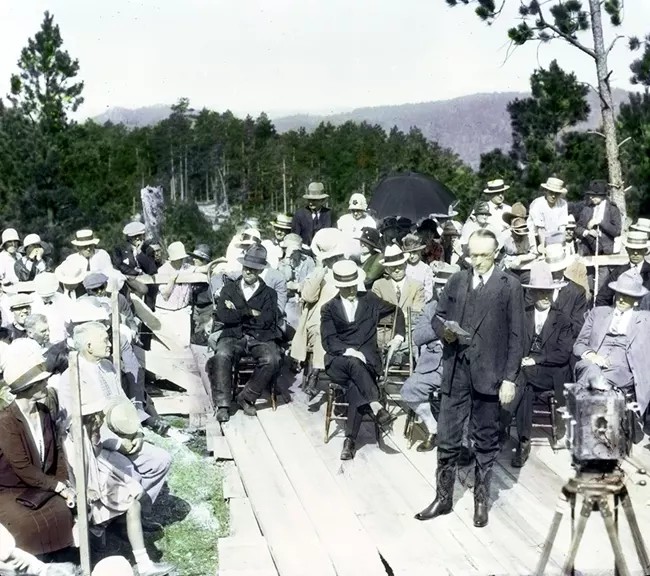
Funding the project proved impossible from the start. Borglum initially promised that private donors would contribute heavily, but these donors never provided enough funds for the massive project. Early fundraising efforts in South Dakota also fell short. In an effort to fund the massive project, the South Dakota legislature was approached. Initially, the legislature refused to provide any public funds, so private investors were sought out. This was a problem because the funds needed for the project were great and significant. The cost estimates were somewhere between $400,000 and $800,000. It was extremely difficult to raise such an astronomical amount of money, leading to serious financial roadblocks. These roadblocks threatened to end the project before it even began. Borglum however, was hopeful and continued to hold ceremonies and give speeches where he invited many political leaders to attend. These efforts would attract support and hopefully donors, but the donations were too small to get the project up and running. Borglum realized that the only way to fix this problem was to seek out federal funding. A turning point came about when President Calvin Coolidge was on vacation in the Black Hills in 1927. This was the opportunity Borglum needed to secure federal support, and he was not going to pass up the chance. The President was invited to attend the project’s dedication ceremony and see the significance of the planned project for himself. At this ceremony, the President publicly endorsed the project and promised federal funding. At a later date, the Treasury Secretary Andrew Mellon agreed with the President and backed the federal funding bill. This was a win for Borglum and South Dakota Senator Norbeck as they were now able to drive the project forward. The support of the Federal Government was necessary and the only thing that would allow this project to continue. President Calvin Coolidge believed in the project and promised federal funding to support its completion.
.
The Mount Rushmore National Memorial Act
The Act authorized the U.S. government to provide funds up to $250,000. It also created a commission of 12 members to be appointed by the President of the United States. This commission would oversee the projects, planning, and construction. Although South Dakota had already passed legislation authorizing the carving of a national memorial in the Harney National Forest, the federal Act provided the legal and financial authority necessary for a project of national scale. The earlier state bill had authorized the Mount Harney Memorial Association to select the site, design, and name of the memorial, but it lacked the resources to complete a project of this scale. In February of 1929, the President continued his support when he signed the bill establishing the Mount Rushmore National Memorial Commission and allocated $250,000 toward its completion. At the end of Coolidge’s presidency, President Herbert Hoover took over the organization of the commission. The support of the President and Congress for the Rushmore bill displays the progression and optimism of the 1920s. This was a time when prosperity and expansion were very possible. Even after the stock market crash of 1929 and the Great Depression, the project remained a priority as it created many jobs for workers who would have otherwise been unemployed. The Mount Rushmore National Memorial Act transformed the project from a statewide tourist attraction to a national project displaying national American pride. The efforts of Gutzon Borglum and the South Dakota State Senator Norbeck secured the support of the Treasury Secretary and President Coolidge.
Timeline of Events
To fully understand how Mount Rushmore grew from a local idea to bring about tourism to a national monument supported by the federal government, it is useful to show this massive development through a chronological timeline. The table below highlights the major milestones in planning, funding, political support, and construction.
| 1923 | Doane Robinson proposes idea of developing a monument in the mountains to boost South Dakota tourism. |
| 1924 | Robinson approaches sculptor Gutzon Borglum and Borglum visits the Black Hills and selects Mount Rushmore as the carving site. |
| 1925 | Federal and state authorization was required so Congress and the South Dakota Legislature approve the memorial and create oversight bodies. |
| 1927 (Summer) | President Calvin Coolidge visits the site and endorses the project. Coolidge’s public support boosts national visibility and federal funding prospects. |
| Oct 4, 1927 | Carving officially begins — Borglum and workers start blasting and shaping the mountain. |
| 1928–1929 | Private fundraising struggles — Donations fall short; Borglum intensifies lobbying in Washington. |
| 1929 | Andrew Mellon backs federal funding — Treasury Secretary Mellon supports federal appropriations after meeting Borglum. |
| February 1929 | Mount Rushmore National Memorial Act — Congress passes the act establishing the Mount Rushmore National Memorial Commission and authorizing up to $250,000 in federal matching funds. |
The 1920s
The planning and funding of Mount Rushmore reveal a complex story of local ambition, federal intervention, economic hardship, and the merging of art, politics, and the cultural climate of the 1920s. The 20s was a decade where the conflicts and cultural climate shaped the path of this project. The original idea for Mount Rushmore came about during the Roaring Twenties, a time in history when economic expansion, mass consumer culture, and a national fascination with all things modern were booming. The 1920s were also a period when states and cities across the country sought to attract tourists, investment, and national attention. South Dakota was no exception. The 1920s also brought about a feeling of American patriotism because in the aftermath of World War I, the interest in national identity was intense. Americans everywhere idolized the Founding Fathers, and past presidents were huge symbols of patriotism and national unity. Borglum’s choice to depict Washington, Jefferson, Lincoln, and Theodore Roosevelt fit right in with the cultural moment of the 20s. The political landscape of the 1920s also shaped the project’s early development because the Republican administrations during this time supported business enterprise and national pride. The decade was dominated by Harding, Coolidge, and Hoover, all known for their support of limited federal intervention, tourism, and the celebration of American ideals and patriotic display. These priorities were seen in Borglum’s vision of a monument celebrating American greatness. During the 1920s, states often began ambitious projects celebrating the country on a national scale. Rural states like South Dakota did not benefit much from the economic boom, which made tourism development even more of a priority. The development of Mount Rushmore came at a time when there was an agricultural depression that hit the Midwest just years before the 1929 crash.
Construction
Borglum’s original artistic vision was a moment of presidential torsos, inscriptions, and an elaborate “Hall of Records” behind the monument. Funding limitations quickly downgraded his plans to a less ambitious design. The construction of the monument was extremely dangerous and technically difficult. The work crews used dynamite, jackhammers, and hand tools to carve away nearly 450,000 tons of rock. With all of the danger and dynamite, it was truly shocking that not one worker died during the construction. The funding problems stopped the construction at times, and Borglum himself spent a lot of his time lobbying Congress and pushing for funding so that he could return to supervising the carving.
Conclusion
The planning and funding of Mount Rushmore reveal a story far more complex than the noble faces carved into the mountain display. What began as a struggle to bring about state tourism developed into a federally supported national monument. The merging of artistic ambition, political strategy, and relentless advocacy was necessary to complete the project. The monument’s completion required an extreme amount of navigation through legislative hurdles, financial shortfalls, and adapting the grand artistic visions to the reality of resources available. Mount Rushmore today stands not only as a symbol of American presidents but also honors the collaborative effort at a time when nationalism was important to Americans. Its history shows us how monuments are shaped by politics and the economy just as much as they are shaped by the tools of a talented sculptor.
Bibliography
Biome, Albert. “Patriarchy Fixed in Stone: Gutzon Borglum’s ‘Mount Rushmore.’”
American Art 5, no. 1/2 (1991): 143–67.
Fite, Gilbert C. “Gutzon Borglum Mercurial Master of Colossal Art.” Montana: The
Magazine of Western History 25, no. 2 (1975): 2–19.
Glass, Matthew. “Producing Patriotic Inspiration at Mount Rushmore.” Journal of the
American Academy of Religion 62, no. 2 (1994): 265–83.
Rood, John. Review of Giants in Stone, by Gilbert C. Fite. Minnesota History 33, no. 2
(1952): 86–87.
Rumble, Walker. “Gutzon Borglum: Mount Rushmore and the American Tradition.” The
Pacific Northwest Quarterly 59, no. 3 (1968): 121–27.
- Featured Image: August 10, 1927 Mount Rushmore dedication ceremony where President Coolidge promised funding for the project. Memorial History – Mount Rushmore National Memorial (U.S. National Park Service)
