
The historiography of the 1920s explained through American History Textbooks
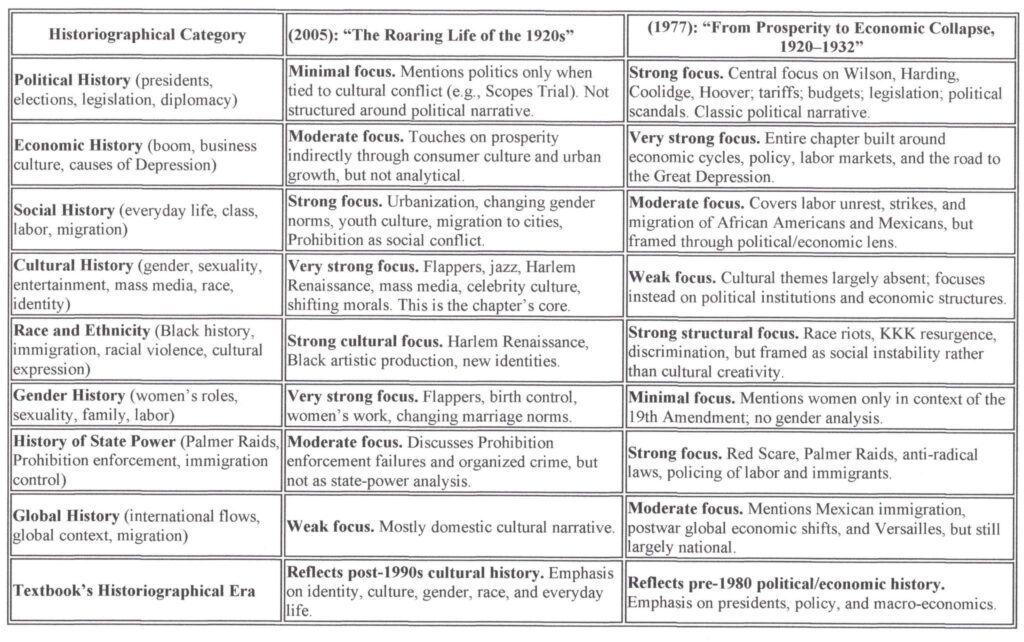
An interesting method of considering the historiography of the 1920s is to consider how history was taught to students throughout the decades. Comparing and contrasting two textbook chapters from two very different periods of time brought to life the focus and themes of 1920s historiography. The 2005 textbook chapter, “The Roaring Life of the 1920s,” and the 1977 textbook chapter, “From Prosperity to Economic Collapse, 1920–1932,” certainly reflect very distinct historiographical traditions, emphasizing the themes and beliefs of the time. In Jennifer Fronc’s article, “The 1920s: A Historiographical Survey,” the author clearly details the 1920s themes to consider. Knowing when these textbooks were written truly assists us in evaluating why each chapter emphasizes certain themes and omits others. Together, the chapters illustrate both the evolution of historical interpretation and the limitations of textbook narratives shaped by the priorities of their decade.
In Fronc’s article, the author notes that the 1920s themes that dominated the 1930s through the mid-20th century focus heavily on political leadership, economic policy, and the origins of the Great Depression. This older tradition framed the decade as a prelude to economic disaster, emphasizing Republican governance, laissez‑faire ideology, and structural weaknesses in the economy.[1] The 1977 textbook chapter fits neatly within this framework. It centers on presidential administrations, tariffs, budget policy, labor unrest, and the eventual collapse of prosperity. The chapter’s attention to Harding’s scandals, Coolidge’s conservatism, and Hoover’s economic challenges mirrors the political‑economic emphasis of mid‑century historians who viewed the 1920s primarily through the lens of governance and economic instability. Its publication date clearly matters because it was written before the development of cultural history, which was experienced more in the 1980s and 1990s. The textbook chapter reflects 1970s priorities as a period where political and economic themes still dominated history education.
By contrast, the 2005 textbook chapter takes a very different approach. It teaches the history of the 1920s through a social and cultural lens. As Fronc explains in her article, this new perspective shifts the focus away from presidents and policies and toward urbanization, gender, sexuality, race, consumer culture, and modern ideas. The 2005 chapter highlights flappers, Prohibition, the Scopes Trial, the Harlem Renaissance, and mass entertainment, illustrating this new cultural-history approach. This approach considers the cultural identity of the time rather than merely focusing on an economic boom before its collapse. By 2005 in America, cultural history had become the dominant mode of interpreting the 1920s. Textbooks during the early 2000s increased their content of issues like gender, race, popular culture, and everyday life.
Throughout the decades, textbook treatment of the 1920s failed to show the complexity of the decade as we understand it today. In her article, Jennifer Fronc describes the treatment of the 1920s as a “dual historiographical tradition.” The older tradition of a political/economic narrative and the newer tradition of a social/cultural narrative.[2] The 1977 chapter discusses the Red Scare and the Palmer Raids, framing them as political overreach rather than part of a broader history of state repression and the expansion of federal policing power.[3] Similarly, the 2005 chapter celebrates the Harlem Renaissance, but does not discuss the deeper issues of housing segregation, racialized policing, or economic exclusion.[4] Today’s textbooks present the 1920s as a complex decade of conflict and growth from many different cultural perspectives. This method has grown from the older traditions of the 1970s and early 2000s.
[1] Fronc, Jennifer. “The 1920s—A Historiographical Survey,” in The Routledge History of the United States, ed., Routledge, 2018.
[2] Fronc, Jennifer. “The 1920s—A Historiographical Survey,”
[3] “Chapter 33: From Prosperity to Economic Collapse, 1920-1932” in Rise of the American Nation by Todd, Lewis Paul, 544-588. Harcourt Brace Jovanovich, 1977.
[4] “Chapter 21: Roaring Life of the 1920s” in The Americans: History of the United States by Kennedy, David M. 638-667. New York: W. W. Norton & Company, 2005.
