
The decade of the twenties is known by many hisotrians to be one of the most pivotal in our nations history. However historians throughout different decades have had a wide arrange of perspectives about what elements of the decade were most important. Traditionally the twenties was viewed through the lense of political history. Overtime hisotrians view of the decade expanded to view the decade from a social history perspective as well.Chapters that show the differing view of the twenties over time are “The United States” (1964) and “American Pageant” (1998). An article that does this is “Rethinking the 1920s: Historians and Changing Perspectives” (2007)
The first chapter has a heavy focus on economic and political history. Economically the chapter focuses heavily on the great depression and business. Politically the chapter had a big focus on President Coolidge, States, and War. The chapter is geared towards great man history although it does focus on the issues of common people. The chapter ideology wise can be described as traditional. For one it disapproves of modern cultural trends associated with the twenties. This is clear as it uses the word “disillusion” and says that old traditions were “under attack”. The chapters conservatism was also shown as it was not found of Marxism. 1 Wesley M. Gewehr, ed., “Political Problems of the 1920’s,” in The United States: A History of Democracy, 2nd ed. (New York: McGraw-Hill, 1964), 659 .
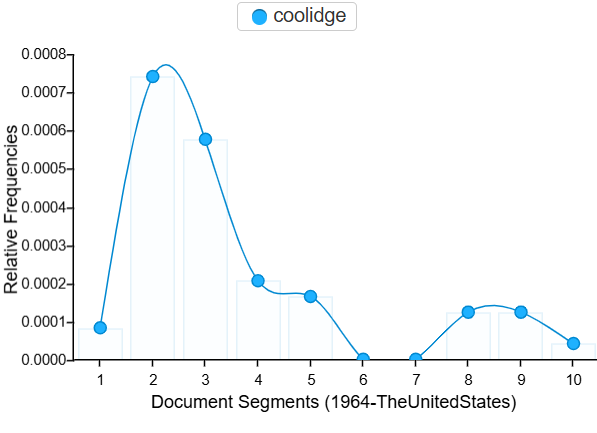
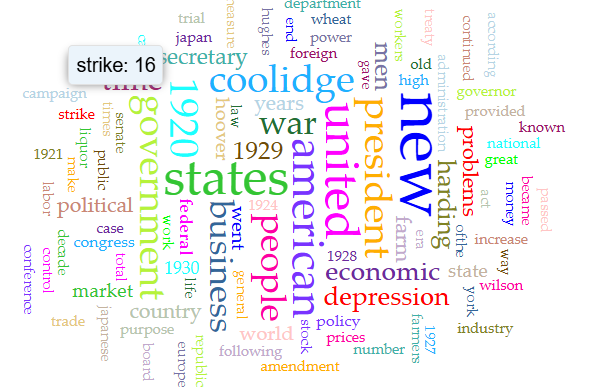
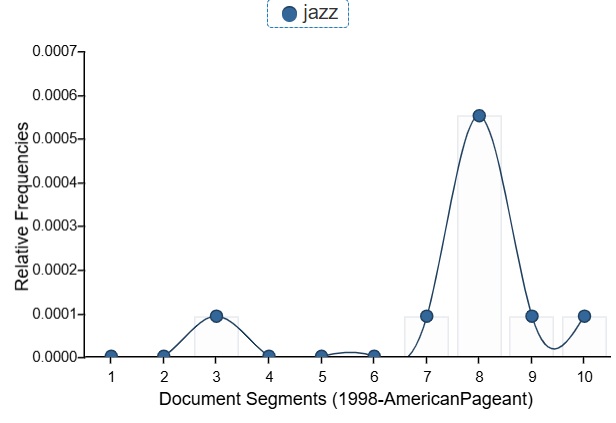
While a lot was covered in “TheUnitedStates” (1964) importent parts of the twenties recivied little attention. The rise of black culture through jazz was one these ways. The chapter neglects to talk about African American intelcualsim, that was a importent part of the Harelem rensiance that occured during the decade. The evoultion of female culture during the decade was downplayed as the chapter said very little about how flappers changed gender norms. The social aspect of immigration also was scarcely mentioned. Staying within the world of immigration the chatper also did not mention the Scopes trial.
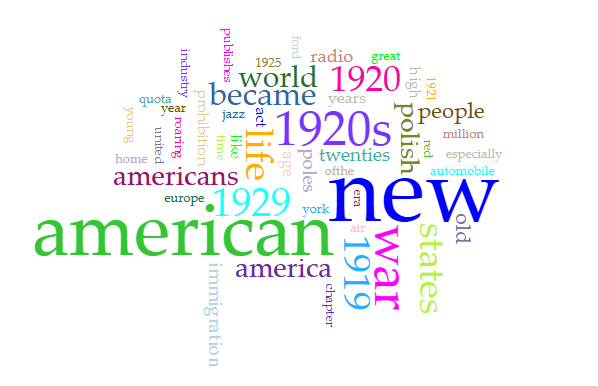
The second chapter was more diverse in regards to its content. While politics and great men were still mentioned social history was also prevelent. The top terms that represented social history were immigration and Jazz. The top terms politically were war and states. Economics were less of a factor in this chapter as none of the top words were directly related to it. Ideologically the chapter chapter was less conservative and more liberal. For one the KKK within it were describes as “Hooded Hoodlums” and the Scopes the result of the scopes trial was described as “judicial lynching”. A large portion of the chapter also featured the Harlem Renaissance and the culturally of the younger generation. This cultural was featured through the discussion of flappers and bootleg culture. Immigration wise the chapter focused on how immigrants dealt with discrimination through nativism, and on how they helped build the nation.2 Thomas A. Bailey and David M. Kennedy, “American Life in the ‘Roaring Twenties,’ 1919–1929,” in The American Pageant, 11th ed. (Boston: Houghton Mifflin, 1998), 746. 2 Thomas A. Bailey and David M. Kennedy, “American Life in the ‘Roaring Twenties,’ 1919–1929,” in The American Pageant, 11th ed. (Boston: Houghton Mifflin, 1998), 746 .
The articles general point that history of the decade has become more inclusive over time was true. Economically this was evident as the best book “The Dollar Decade: Business Ideas in the 1920s” on traditional business history was from 1954. However not all books followed the general trends of their era. This was clear as the article mentioned a work called “The lean years: “A History of the American Worker, 1920-1933” from 1960 that focused on the decline of the labor movement during the twenties. The article also featured a social vs more traditional approach in regards to more overtly political topics. The focuses of these topics evolved as The KKK was one of such topics. This is evident as the book “Women of the Klan: Racism and Gender in the 1920s” (1991) which was featured, focused on progressive aspects of the Klan, while “Hooded Americanism: The History of the Ku Klux Klan” (1964) takes a more holistic approach.3 David J. Goldberg, “Rethinking the 1920s: Historians and Changing Perspectives,” OAH Magazine of History 21, no. 3 (July 2007): 7 . 4 Wesley M. Gewehr, ed., “Political Problems of the 1920’s,” in The United States: A History of Democracy, 2nd ed. (New York: McGraw-Hill, 1964), 659 . 5 Thomas A. Bailey and David M. Kennedy, “American Life in the ‘Roaring Twenties,’ 1919–1929,” in The American Pageant, 11th ed. (Boston: Houghton Mifflin, 1998), 746 .
Understanding the differences of how history is written throughout different times is important This is because it provides context for why people saw things that way they did. The history that we read today gives us this context also. The historiography today is more inclusive overall to people but it cannot be defined as more professional as modern historians have great bias as well.
- 1Wesley M. Gewehr, ed., “Political Problems of the 1920’s,” in The United States: A History of Democracy, 2nd ed. (New York: McGraw-Hill, 1964), 659
- 2Thomas A. Bailey and David M. Kennedy, “American Life in the ‘Roaring Twenties,’ 1919–1929,” in The American Pageant, 11th ed. (Boston: Houghton Mifflin, 1998), 746. 2 Thomas A. Bailey and David M. Kennedy, “American Life in the ‘Roaring Twenties,’ 1919–1929,” in The American Pageant, 11th ed. (Boston: Houghton Mifflin, 1998), 746
- 3David J. Goldberg, “Rethinking the 1920s: Historians and Changing Perspectives,” OAH Magazine of History 21, no. 3 (July 2007): 7
- 4Wesley M. Gewehr, ed., “Political Problems of the 1920’s,” in The United States: A History of Democracy, 2nd ed. (New York: McGraw-Hill, 1964), 659
- 5Thomas A. Bailey and David M. Kennedy, “American Life in the ‘Roaring Twenties,’ 1919–1929,” in The American Pageant, 11th ed. (Boston: Houghton Mifflin, 1998), 746
