The 1920s were an era of prosperity, optimism, change, and crime. Mob and gang violence, alcohol smuggling, and robbery were all prevalent in the United States, as well as a much darker, more violent crime: murder. The decade witnessed the St. Valentine’s Day Massacre, The Osage Indian murders, and several more violent crimes. Out of all the homicide cases and murderers, none came close to the level of audacity that Richard Loeb and Nathan Leopold possessed. The ruthless cold blooded murder of 14 year old Bobby Franks on May 21, 1924 shook the country to its core. The case quickly became a nationwide ordeal, changed court sentences, and raised concerns regarding the youth of society.
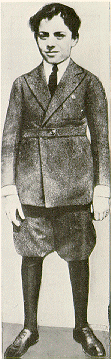
Bobby Franks (Famous Trials)
Background
The entirety of the Leopold and Loeb case was very bizarre from the very beginning. Two teenage boys, Leopold, 19, and Loeb, 18, brutally murdered their young neighbor, seemingly for no reason at all. All three of the boys came from wealthy Jewish families and resided in Chicago’s Kenwood neighborhood within a walking distance from one another. Nathan Leopold and Richard Loeb seemed to have everything in life laid out for them.1 Despite this, the privileged teenage boys threw away their lives through a single act of violence.
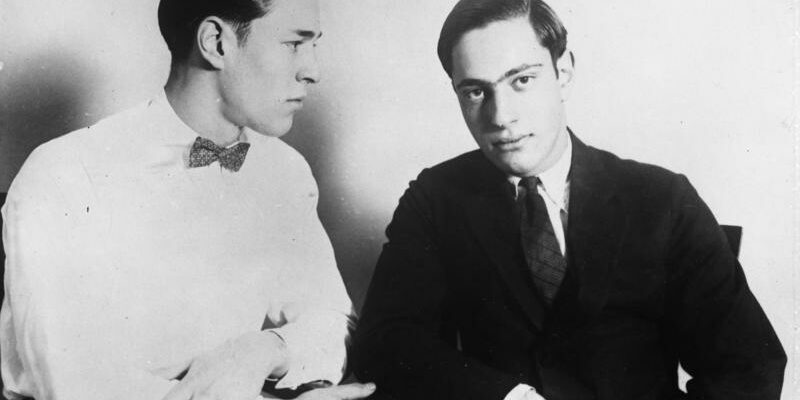
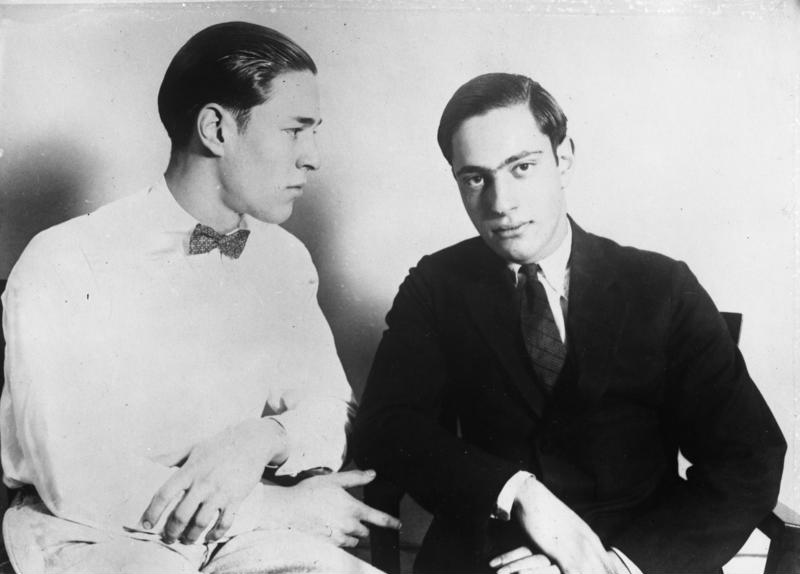
The minds of Leopold and Loeb were complex, revealing, and utterly disturbed. Both boys were excellent scholars, but had something darker residing in their minds. Loeb was popular among his peers, and began studying at the University of Chicago at 14. However, he was also involved with drinking and gambling, and desired to become a “master criminal”.2 Additionally, he had always been obsessed with crime. He “read about crime, he planned crimes, and he committed crimes”, but he had never physically harmed someone.3 Leopold had graduated from the University of Chicago and had plans to attend Harvard Law School. Despite excelling academically, he was described as “arrogant” by people he encountered.4 Aside from law, Leopold was fascinated with psychology, especially with the works of Friedrich Nietzsche.5 Leopold “believed that legal obligations did not apply to those who approached ‘the superman’”, and brought his lover, Richard Loeb, into this mentality.6 In return, Loeb tied up Leopold in his crime schemes. When these two minds were put together, they became deadly. Historian Paula S. Fass asks the question of “why two rich, gifted boys would commit a murder embedded in the form of a ransom kidnapping”; a question that will likely never be fully answered.7
Leopold (right) and Loeb in August 1924 (Wikipedia)
Together, the two boys desired to commit the “perfect crime” and the “crime of the century”. The premeditated murder of a random victim fit this criteria. “The two teenagers spent months discussing and refining a plan that included kidnapping the child of a wealthy parents, demanding a ransom, and collecting the ransom after it was thrown off a moving train as it passed a designated point”, and murder was crucial to get away with the crime.8 If murder was not involved, they risked being identified by their victim. Leopold and Loeb started planning this murder in November 1923, 6 months before it actually took place. They ruled against deciding who their victim would be beforehand, and instead opted to make it spontaneous.9 In the days leading up to the murder, they began to get their supplies together, including a chisel, which would be the murder weapon.10 Their last step was to rent a car the morning of the murder.
Kidnapping and Murder
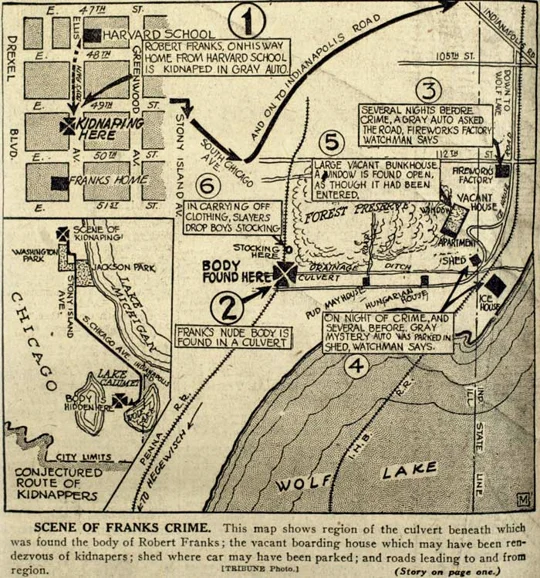
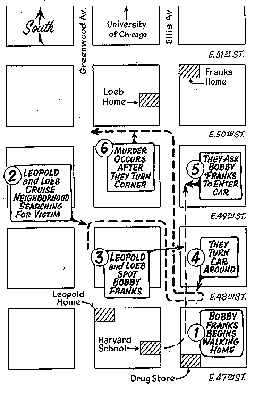
Map featured in newspaper (Hyde Park Herald)“Map of the Scene of the Kidnapping and Murder of Bobby Franks” (Famous Trials).
Bobby Franks was walking home from Harvard School for Boys around 5pm on May 21 following a baseball game.11 At the same time, Leopold and Loeb were circling the area hunting for a victim. Leopold, who was driving the rented car, pulled up next to Franks and “asked him to get in the car to discuss a tennis racquet”, to which he complied.12 Loeb, who was in the back seat of the car, grabbed Franks, covered his mouth, and “struck the boy with [sic] several times on his head with a chisel”.13 Loeb then suffocated young Bobby Franks to death.14 Sometime between 5:15 PM and 9:30 PM, the boys drove to the Illinois/Indiana border to dispose of the body.15 Leopold and Loeb shoved Frank’s body into a culvert under a railroad, poured acid on his naked body, and returned to Loeb’s home to burn his clothing.16
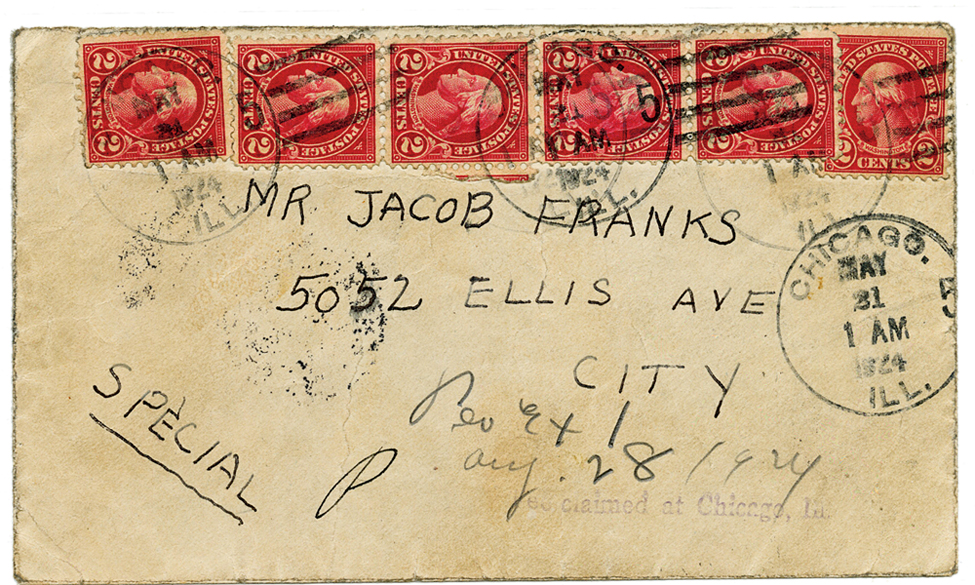
At 9:30 PM, Mrs. Franks received a menacing phone call from a man identifying himself as “George Johnson”.17 “Leopold told Franks that her boy had been kidnapped, but was unharmed, and that she should expect a ransom note soon”; the family received the note the next morning.18 The note reads:
Dear Sir:
As you no doubt know by this time, your son has been kidnapped. Allow us to assure you that he is at present well and safe. You need fear no physical harm for him, provided you live up carefully to the following instructions and to such others as you will receive future communication. Should you, however, disobey any of our instructions, even slightly, his death will be the penalty.
1. For obvious reasons make absolutely no attempt to communicate with either the police authorities or any private agency. Should you already have communicated with the police, allow them to continue their investigation, but do not mention this letter.
2. Secure before noon today ten thousand dollars. This money must be composed entirely of old bills of the following denominations:
Two thousand dollars in twenty dollar bills, eight thousand dollars in fifty dollar bills. The money must be old. An attempt to include new or marked bills will render the entire venture futile.
3. The money should be placed in a large cigar box, or if this is impossible, in a heavy cardboard box, securely closed and wrapped in white paper. The wrapping paper should be sealed at all openings with sealing wax.
4. Have the money with you, prepared as directed above, and remain at home after one o’clock P.M. See that the telephone is not in use.
Envelope containing ransom note addressed to Mr. Jacob Franks (Northwestern University).
You will receive a further communication instructing you as to your future course.
As a final word of warning, this is an extremely commercial proposition and we are prepared to put our threat into execution should we have reasonable grounds to believe that you have committed an infraction of the above instructions.
However, should you carefully follow out our instructions to the letter, we can assure you that your son will be safely returned to you within six hours of our receipt of the money.
A second note was to be placed on the train, but Mr. Franks never received this one. The 2nd note reads:
Dear Sir:
Proceed immediately to the back platform of the train. Watch the east side of the track. Have your package ready. Look for the first LARGE, RED, BRICK factory situated immediately adjoining the tracks on the east. On top of this factory is a large, black watertower with the word CHAMPION written on it. Wait until you have COMPLETELY passed the south end of the factory – count five very rapidly and then IMMEDIATELY throw the package as far east as you can. Remember that this is your only chance to recover your son.
At around 12PM the next day, “Leopold (‘George Johnson’) called Jacob Franks, Bobby’s father, shortly before three o’clock to tell him a taxi cab was about to arrive at his home and that he should take it to a specified drugstore in South Chicago”.21 Mr. Franks, of course, refused to do so. A few hours before this call, unbeknownst to the killers or Mr. Franks, a laborer had discovered Bobby’s body.22 Bobby’s uncle went to confirm the identity of the body as soon as he heard the news.23 It was at the location of the body that a clue to the identity of the killer lay.
Linking Leopold and Loeb to the Crime
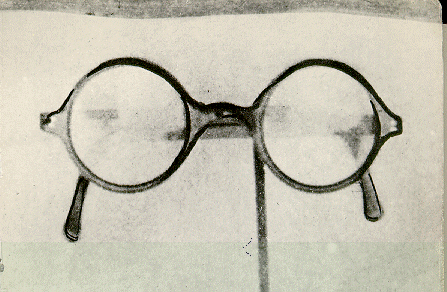
Nathan Leopold’s glasses (Famous Trials)
Little did he know, Nathan Leopold had lost a pair of eyeglasses at the site where he and Richard Loeb had dumped the body. This specific style of glasses “could be traced to a single Chicago optometrist, who had written only three such prescriptions, including the one to Leopold”.24 Investigators began meticulously questioning Nathan Leopold on May 23, and soon after, Richard Loeb.25 They confirmed each other’s alibis of driving girls around in Leopold’s car, but “state’s attorney Robert Crowe, heading the investigation, was skeptical”.26 Upon further investigation and leads from classmates, prosecutors got ahold of a set of notes from a typewriter that belonged to Leopold, and the flaws matched those of the ransom note.27 Leopold’s chauffeur attempted to defend him by saying the car “the boys claimed they had spent the night driving around with girls, had not left the garage on the day of the murder”.28 He had unknowingly destroyed both the boys’ alibis.
On May 30, 1924, Nathan Leopold and Richard Loeb were arrested for the murder of Bobby Franks.29 The following day, they both confessed to the murder, but neither would own up to actually killing Franks.30
Trial
For the trial, “The Loeb and Leopold families hired Clarence Darrow and Benjamin Bachrach to represent the two boys”.31 Clarence Darrow was interested in the case due to the opportunity it gave him to “attack the death penalty, which he had called “an abomination”.32 Darrow had persuaded the boys to plead guilty to potentially avoid the death penalty. Professor Douglas O. Linder explains Darrow’s reasoning:
“It was Darrow’s decision to change the boys’ initial pleas to the charges of murder and kidnapping from “not guilty” (suggesting a traditional insanity defense) to “guilty.” The decision was made primarily to prevent the state from getting two opportunities to get a death sentence. With “not guilty” pleas, the state had planned to try the boys first on one of the two charges, both of which carried the death penalty in Illinois, and if it failed to win a hanging on the first charge, try again on the second. The guilty plea also meant that the sentencing decision would be made by a judge, not by a jury”.33
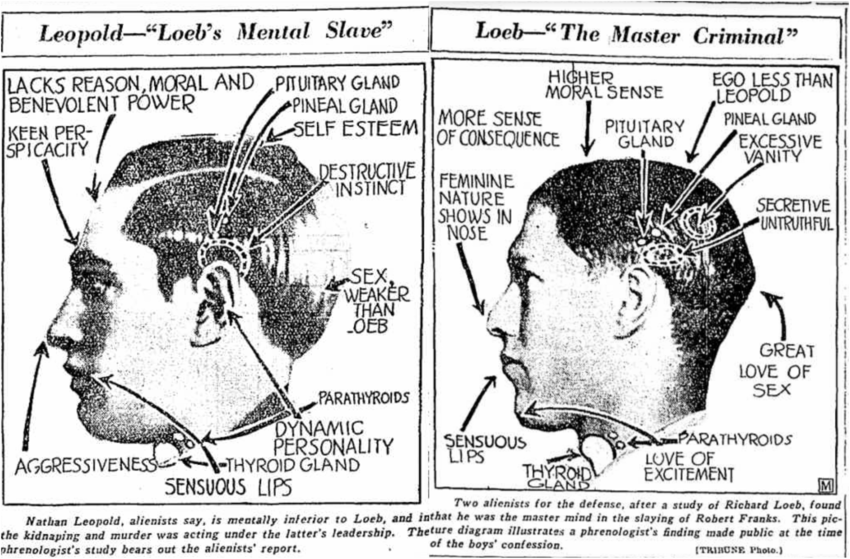
“Psychiatrists’ (“alienists”) phrenological assessments of Mr. Nathan Leopold and Mr. Richard Loeb as they appeared in The Chicago Tribune in the summer of 1924” (ResearchGate).
The defense worked around the testimony of 4 psychiatrists who interviewed the boys.34 The issue was that “the prosecution argued that psychiatric testimony was only admissible if the defendants claimed insanity”, to which the psychiatrists said mental diseases should be considered in the sentencing.35 The judge was convinced and allowed the evidence to be used. The entire trial, which Linder defines as a hearing due to the guilty plea, lasted a little longer than a month.36 The defense claimed that Leopold and Loeb suffered from “emotional immaturity, obsessions with crime and Nietzschean philosophy, alcohol abuse, glandular abnormalities, and sexual longings and insecurities”.37 Leopold was described as paranoid, delusional, and obsessed with Loeb; Loeb was called childish and called out for his lack of judgement.38 Psychiatrist Wiliiam White claimed that “Nathan would never on his own initiative have murdered Bobby Franks. . . And I don’t believe Dickie would have ever functioned to this extent all by himself”, so the two came together to commit the murder.39 The prosecution argued that neither boy was mentally ill.40The Journal of the American Institute of Criminal Law and Criminology highlighted the fact that ”this is probably the first instance of the offer of elaborate psychiatric analyses as the basis for remitting the law’s penalty for a calculated, cold-blooded murder, committed by persons not claimed to be insane or defective in any degree recognized by the law as making them not legally responsible”. This aspect made the case revolutionary when it came to the court becoming less reliant on the death penalty.41
Over the span of 12 hours on August 22, 1924, “Darrow argued that his clients should not bear full responsibility for their crime” due to several external factors.42 The basis of Darrow’s argument was that this murder happened due to “a series of infinite chances”; he claimed the boys were victims of nature.43 Darrow had also attempted to sway the jury away from a death sentence by expressing that the boys were too young to have to sit in jail awaiting execution.44
Attorney Robert Crowe stated “this was a premeditated crime committed by two remorseless defendants, and the appropriate punishment was obvious”, which he believed to be execution.45 After weeks of debating, Nathan Leopold and RIchard Loeb were sentenced to life in prison, mainly due to their age and the inability of the court to determine responsibility.46
Aftermath
The two boys were held in Joliet Penitentiary in Joliet, Illinois. Richard Loeb was killed here in 1936, and Nathan Leopold was released in 1958 due to his excellent behavior.47 Leopold then moved to Puerto Rico, where “he earned a master’s degree, taught mathematics, and worked in hospitals and church missions”.48 He passed away on August 30, 1971 following a heart attack.49
Significance
Newspapers were critical to the entire incident, as well as the 1920s as a whole. Several newspapers provided the public with updated stories about a “sensational kidnap-murder”, provided “the prosecuting attorney with material assistance”, and gathered evidence that helped solve the case.50 James Mulroy and Alvin Goldstein, two journalists for the Chicago Daily News, received and “shared some of the reward money as well as the Pulitzer Prize for helping to connect Nathan Leopold, Jr., and Richard Loeb to the abduction and murder of Bobby Franks”.51 Daily papers ”published the confessions, interviewed the families and friends, and speculated about the nature of the “million-dollar defense” to be mounted by Clarence Darrow and his expensive psychiatric witnesses”; this turned into a type of entertainment for some, and turned this into a nationwide phenomenon.52 In addition to keeping the public updated on the case, the newspapers also did some strange things, which are now seen as immoral. “On May 23, 1924, the day the newspapers reported that Bobby had been kidnapped, they also contained a detailed description of his dead body”.53 To expose people, and potentially children, to such a disturbing scene was very odd. Despite this, the case would not have been solved without the contributions of press workers.
The Leopold and Loeb case related to The Modern Temper by Lynn Dumenil in terms of psychology, beliefs, and human morality. Dumenil touches on the ideas of several individuals, including psychologist John B. Watson. Watson “described humans as hollow shells, formed by their environment, who responded to external stimuli”.54 Leopold and Loeb’s minds and behavior was shaped by the privileged environment that they grew up in, and this led them to believe they could get away with murder. Fiction writer Sherwood Anderson wrote “fashioned dark, brooding stories dealing with marriage, morality, and individuals destroyed by success”.55 It would be plausible to say that Loepold and Loeb were destroyed by the financial success of their parents and their own intellectual success.
The murder of Bobby Franks by Nathan Leopold and Richard Loeb would go down in history as “cautionary story about the dangers of modern youth”.56 The profiles of the killers were vastly different from those of a “typical” murderer. Their portrayals “set them apart and represented them as larger than life”, making the case even more sensational.57
Citations
“The “Perfect Crime”: The Story of Leopold and Loeb and the Murder of Bobby Franks” ↩︎
“The “Perfect Crime”: The Story of Leopold and Loeb and the Murder of Bobby Franks” ↩︎
Dumenil, Lynn. The Modern Temper: American Culture and Society in the 1920s, 1995.
Fass, Paula S. “Making and Remaking an Event: The Leopold and Loeb Case in American Culture.” The Journal of American History 80, no. 3 (1993): 919–51. https://doi.org/10.2307/2080409.
“The Loeb-Leopold Murder of Franks in Chicago, May 21, 1924.” Journal of the American Institute of Criminal Law and Criminology 15, no. 3 (1924): 347–48. https://doi.org/10.2307/1134803.