
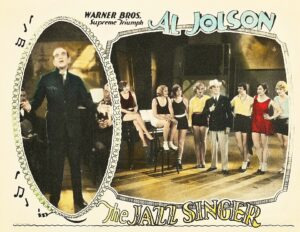
For a second time, The Jazz Singer plays again. There is more to be discussed with this film in terms of the themes of The Modern Temper, as it focuses on secularism. These themes are presented throughout the film, and are important to the message it gives to the audience.
The biggest theme shared with both mediums is the push-and-pull relationship between religion and modernity. Religion became less popular as secularism rose, causing religious groups, like Judaism, attempting to change in order to appeal to the younger generation.
Reform Judaism proposed “Reconstrictionism,” which “[de-emphasized] the belief in the supernatural, the ideas of Jews as a chosen people, and adherence to archaic Jewish law.”1 On the other hand, more traditional sects, “modified the traditional orthodoxy of Southern and Eastern European parents to make it more palatable to modern Americans.”2 As a result, there were people who joined synagogues and contributed to Judaism through donations.
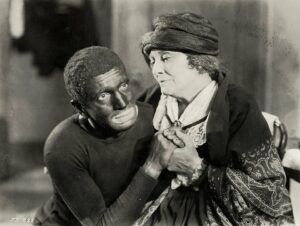
The Modern Temper also discusses how “Jewish identity became for them a semisecularized form of ethnicity,” which does reflect in The Jazz Singer.3 Judaism is a core identity of Jack Robin, the main character, and he does struggle with choosing religion or modernity. In the end, he does choose performing at the synagogue in place of his father over performing on Broadway, reflecting Judaism staying strong in the United States, despite the film ending with him performing on the stage.
Surprisingly, what the film does not touch upon is the rampant anti-Semitism throughout the period. Even before the 1920s, Jewish people were seen as lesser than due to nativism, and their religion and practices were referred to as “alien” and “outlandish.”4 As a result, hostility against Jewish people rose as they were discriminated against socially and economically. Additionally, conspiracy theories against Jews were rampant, such as claims of “most nation-states [being] strongly influenced if not completely controlled by Jews” and the claims of Jewish people controlling the banking system.5
Despite the rampant anti-Semitism, The Jazz Singer doesn’t feature any commentary on it. While it, arguably, would have made the themes of the film slightly convoluted, it wouldn’t be a bad thing. It would have made for a more intriguing story if there were a comment or two of distrust made by one of his peers, making his choice more difficult. It would also give more to discuss about the film in terms of its contemporary look on Jewish people rather than simply a divide between secularization and religion.
Overall, while secularism and religion are the driving themes in The Jazz Singer, there’s not much to the film besides that. The relationship between Jack and his Judaism is shallow, and while Jewish people do have a history with vaudeville, it’s not extremely crazy to say that the story would have been drastically different if the main character were a different religion, such as Catholic.
While it holds up as the first ever film with dialogue, there’s not much more past the conflict of religion, and there are stories created after this film that likely do this plotline better.
Footnotes
- Lynn Dumenil, The Modern Temper, 175. ↩︎
- Dumenil, 176. ↩︎
- Dumenil, 176. ↩︎
- Dumenil, 214. ↩︎
- Dumenil, 216. ↩︎
Bibliography
Dumenil, Lynn. The Modern Temper : American Culture and Society in the 1920s. New York, Ny: Hill and Wang, 2007.

Eryn is a Ramapo College sophomore majoring in History and minoring in Museum Studies.
