
The purging of communist leaders and supporters by the Chinese Nationalist Party in 1927 serves as a grim reminder of the intensity of anti-communist ideology during the 1920s, and the stark discrepancies in how this sentiment impacted different regions of the world. Compared to the execution of Sacco and Vanzetti, which occurred the same year, the Shanghai Massacre represents an entirely different tier of chaos and destruction. Yet due to isolationist attitudes, the violent clash between communists and nationalists in China was treated as generally irrelevant throughout the Western world.
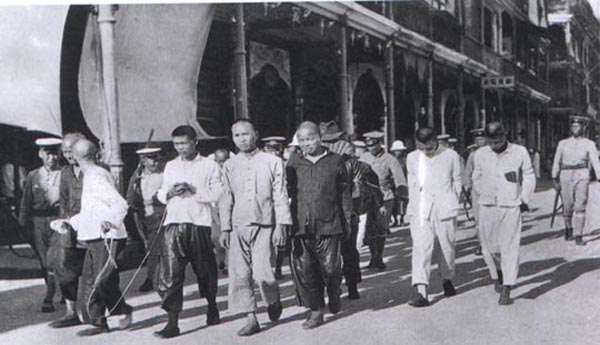
The massacre marked the beginning of a ferocious push by Chinese nationalists to eliminate dissent of any kind, and highlighted the dangers of organizing widespread initiatives for governmental reform. In the context of Chinese history, it set the stage for a bloody conflict between the Communist and Nationalist parties, which would last for many decades. Placed in a global context, the violence in China serves as a reminder that Europe was not the only setting of destructive ideological conflict during the early 20th century.
Particularly in the United States, changing patterns of immigration and the formation of the Soviet Union sparked a Red Scare during the 1920s. This was largely sustained by wealthy, white Protestants, who were desperate to maintain their political and social authority at a time when American isolationism and the internal culture of the country itself were undergoing fundamental evolutions. While this manifested in an “overwhelming insistence upon conformity,”1 in the United States, there is no comparison to the violent suppression of communists in China. Therefore events such as the Shanghai Massacre paint a very different picture of global anti-communist attitudes during the 1920s, than the stories constructed by American businessmen who merely feared losing their fortunes to public ownership.
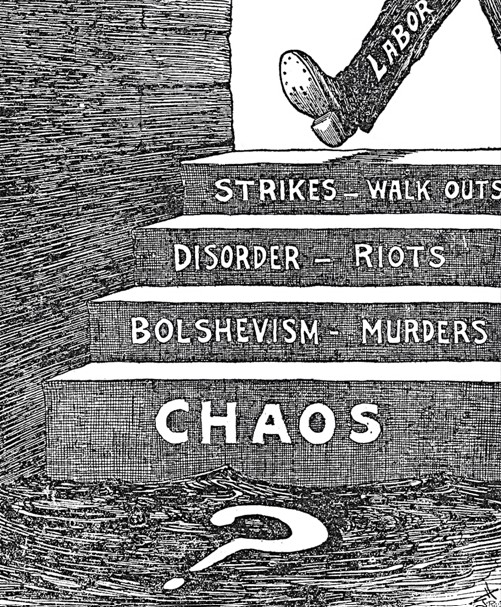
While Lynn Dumenil explains that in the U.S., “The agendas of the business community, voluntary associations, politicians, and the press helped persuade a susceptible public that the Bolshevik menace was a serious one,”2 the Communist Party was by no means a media phantom in China. Influenced by geographical proximity of the Soviet Union combined with countless cultural factors, communism was able to gain traction in China that was simply not achievable in the United States. Therefore conservatives within the Nationalist Party such as Chiang Kai-shek plunged the country into war in an effort to resist the same revolutionary change that Americans feared.
While the conflict between new ideologies and strict nationalism embodied the decade of the 1920s in both countries, the sheer differences in scope of that conflict created drastically different legacies of anti-communist sentiment. As Dumenil notes, the Red Scare in the United States was fueled by a broader resistance to social change, which ultimately ebbed and flowed in relevance depending on contemporary economic conditions.3 However for interwar China, the clash between nationalists and communists set the stage for an extenuating military conflict that would last until 1949, and shape the course of Asian history throughout the entire century. Ultimately, the Red Scare of the 1920s in the United States was largely minimized in history by later clashes with communism, which developed from the aftermath of events like the Shanghai Massacre in China.

- Lynn Dumenil, The Modern Temper: American Culture and Society in the 1920s (New York: Hill and Wang, 1995), 218. ↩︎
- Ibid., 221. ↩︎
- Ibid., 225. ↩︎

A senior at Ramapo College, majoring in American Studies and minoring in Anthropology.
