
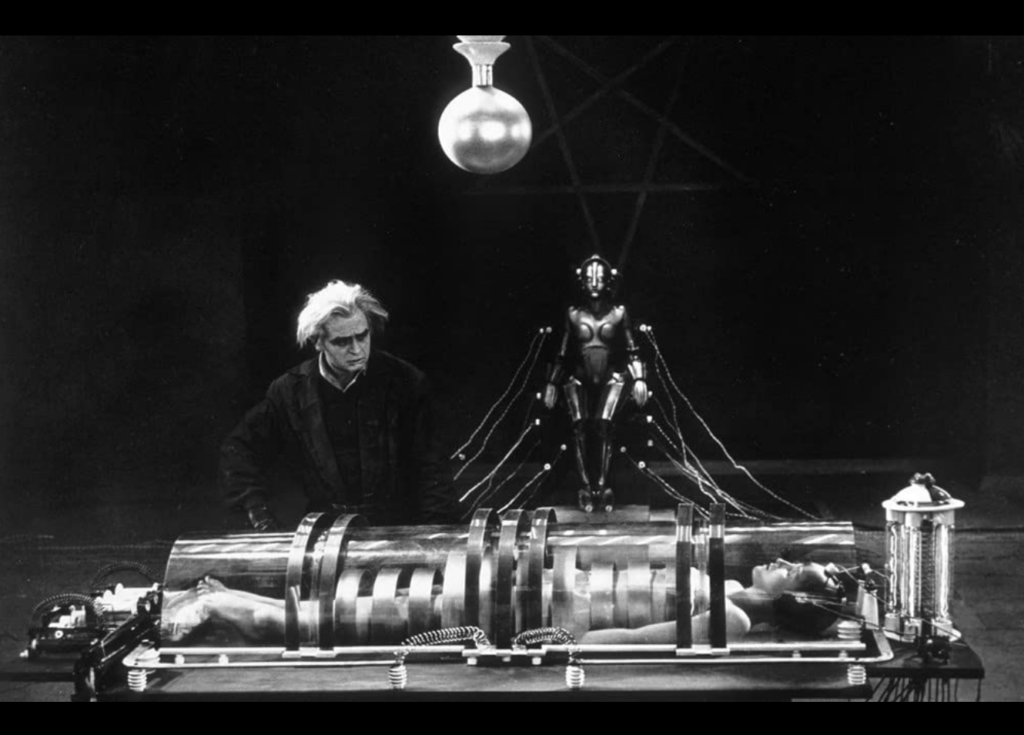
When we think of the 1920s, the first things that come to mind are usually the jazz era, flappers, and the Great Depression. However, for Germany, the 1920s were different. It was an era of extreme contrasts, shifting from post-war hyperinflation and incredible artistic breakthroughs. One of many being Fritz Lang. In 1927, Lang released a silent film named Metropolis, and it’s one of the most popular silent films ever made. The movie was so big and expensive that it nearly bankrupted its studio, UFA (Universum Film AG). The movie is remembered for its large sets, special effects, and “Robot Maria” created by the scientist Rotwang. Today, we view Metropolis as a masterpiece of science fiction, but to truly understand the film, we have to look at it through the lens of someone living in the 1920s. The film reflects the politics, culture, technology, and social changes of the 1920s. The years after World War I were a time of new technology and conflict between the rich and the poor. It wasn’t only a movie about robots; it showcased a dystopian vision of a futuristic city.
Germany In the 1920s
The movie was made in Germany during the era known as the Weimar Republic. This was the government formed after Germany lost World War I. Germany was a mess in the 1920s; they lost the war, they lost land, the economy was terrible, and people were constantly fighting over politics. In the early 1920s, Germany also went through very bad inflation. Prices were rising rapidly, and it seemed like money was losing its value. People often carried large stacks of paper money just to buy food.1 Although by the mid 1920s, Germany started to become a lot more stable. Cities like Berlin were popular for their art, film, and culture. Lots of new industries and buildings were starting to appear, but despite this, there was lots of tension between the rich and the poor. Many workers were mistreated and had to work long and hard hours in factories. Metropolis highlights these tensions throughout the film. The city of Metropolis is divided into two groups: the powerful and wealthy leaders and the workers who live underground. The workers are the backbone of the city as they operate the machines that keep it running, but they don’t even get a fraction of the wealth the rich people get. German film historian and professor Thomas Elsaesser says the film “dramatizes the fear of social conflict between labor and capital that shaped the politics of the Weimar period.2 The city of Metropolis seems beautiful on the outside; it has gorgeous skyscrapers and flying cars, but on the inside, it’s entirely built on exhausted workers.
- 1918 – Germany lost the war and the Weimar Republic Begins.
- 1919-23 – Economic crisis and inflation affect Germany
- 1924 – Cultural growth begins in cities like Berlin.
- 1925 – Fritz lang begins production of Metropolis
- 1927 – Metropolis releases in Germany.
The Rise of Machines
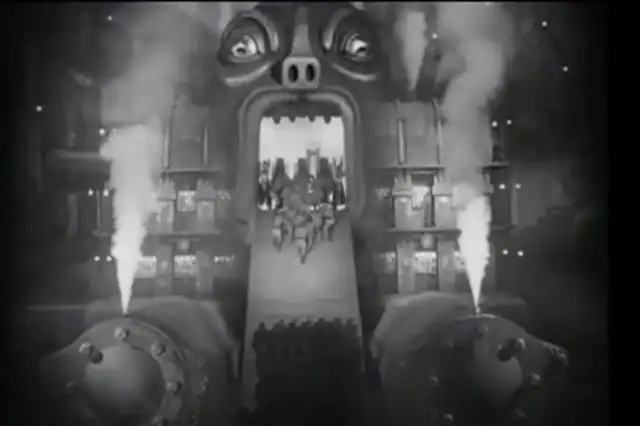
The 1920s were also a time period where machines and industries were very important. Factories, assembly lines, and mass production revolutionized the way people worked. Cities were growing fast, and with the addition of large buildings, bustling streets, and bright lights became common in places like Berlin and New York. While these changes can feel exciting, they can also feel very overwhelming. Metropolis reflects these changes in the city in the film. It features huge skyscrapers, flying cars, and big factory machines. The film also showcases a world where machines control your everyday life, which was actually a common fear among the public in the 1920s. Siegfried Kracauer, a German writer and journalist, wrote that the film’s machines look almost like monsters that control the workers.3 The film features a “Heart Machine,” which is a big engine that keeps the city running smoothly. Although when the main character, Freder, takes a look at the Heart Machine, he hallucinates a monster named Moloch who eats a bunch of workers. This scene represented how industrial labor felt dehumanizing and even dangerous. They felt like they had to overwork themselves in order to keep the economy going. Fritz Lang was criticizing “Taylorism,” which was described as “a method of making factory work as efficient as possible by treating people like parts of a clock.”4 At the same time, the film also appreciates technology during the twenties. The city looks big, powerful, and overwhelming in a good way. This mix of excitement and fear of newer technology was very common in the 1920s.
German Expressionism and Film Style
One of the most prominent parts of the film is its visual style. The film was heavily influenced by the art movement known as German Expressionism. German Expressionist art tried to convey emotion through dramatic shapes, shadows, and designs. Many German films of the 1920s portrayed this style. Metropolis utilized large sets and sharp contrast between light and dark, the upper city, where all the rich people are is open and bright, but the underground, where most of the poor people are is crowded and dark. The film also had special effects that were considered advanced for its time. One of the many techniques they used was called Schüfftan. Believe it or not, Metropolis actually popularized this technique. This technique involved positioning a plate of glass at a 45-degree angle between the camera and the miniatures, outlining the area where actors would be inserted, and transferring this outline to a mirror.5 This helped a lot with creating the city scenes. Given that these techniques were way ahead of their time, the film was very expensive to make, and it was the most pricey film produced by the German studio UFA during the silent era.6
A Divided City
The main conflict of Metropolis is the division between classes. The city is ruled by John Fredersen, a very powerful leader who controls the city from his tower. His very own son, Freder, discovers the harsh reality the workers face and begins to question the system. The workers spend long hours operating machines that control the whole city. They move in strict routines and appear almost like parts of a machine. In Metropolis, the big city divided its citizens into two classes: The thinkers are rich and live in paradise-like skyscrapers. They spend their days enjoying life to the fullest. Then there’s the workers. The workers are the opposite; they’re poor and live deep underground. They walk in straight lines like complete zombies and dress in all black. The workers are shown to pine away in the subterranean machine room, keeping all the giant machines running.7 Throughout the film, Freder falls in love with a kind spiritual leader named Maria. Maria tells the workers, “The Mediator of the head and the hands must be the heart.” The film suggests that the “head” represents the wealthy people, such as John Fredersen, and the “hands” represent the workers. Maria is basically saying the only way to talk to the upper class and the people in power is if someone steps in as a mediator between the two. Someone will come to bring the rich and the poor together. In the late 1920s, people were disillusioned with the chaos democracy was bringing them. They wanted a strong leader who would unite everyone. The idea that a single person could be a “mediator” between the classes was later exploited by political parties trying to gain control over their respective country.8 Some critics believed this message was way too simple for such a serious problem. Film historian Anton Kaes argues that the ending suggests harmony without solving the deeper social issues.9 Despite this, the story reflects the fear of workers starting a rebellion and political conflicts during the 1920s.
The New Woman
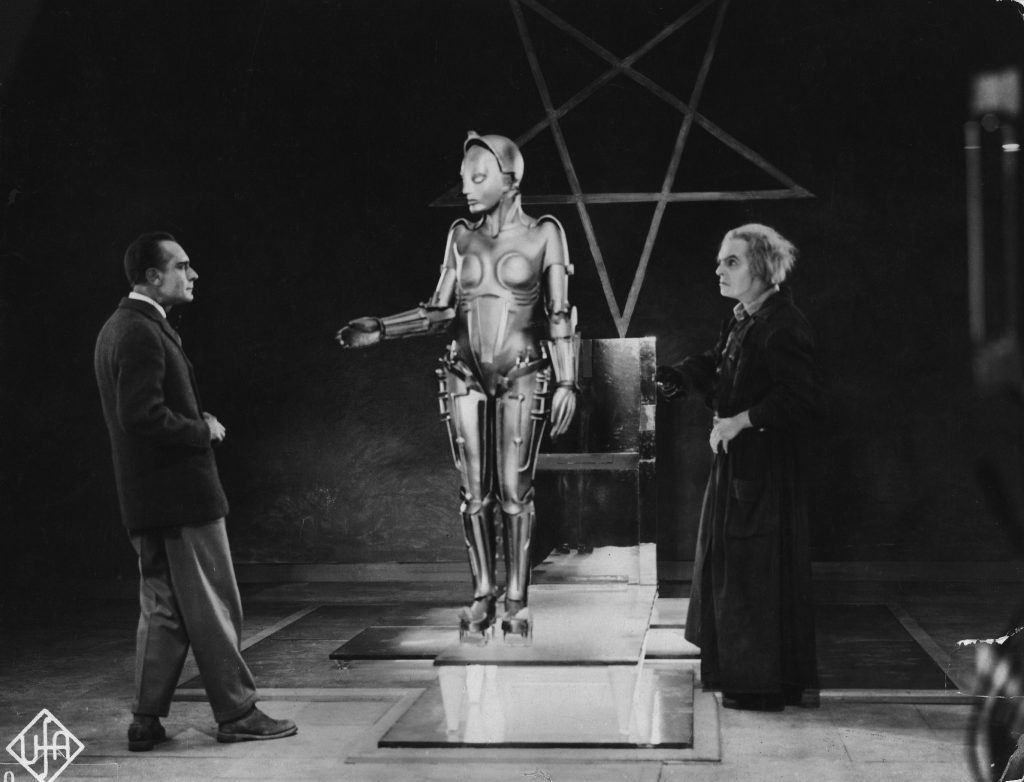
The role of women is also a major plot point in the film. Maria represents kindness and moral guidance. She tries her best to help the workers without encouraging violence. However, the scientist Rotwang creates a robot version of Maira. The robot appropriates Maria’s appearance and begins to disobey her creator’s orders. She instead seduces male workers and tricks them into starting violent riots.10 The robot version of Maria is the complete opposite from the real Maria. Many film scholars define these two versions of Maria as representing the different sides of women in the 1920s. In the 1920s, the “New Woman” was a big thing. In many parts of the world, women started to become more independent, they started getting their own jobs, voting in elections, and completely changing the social norms. While some didn’t mind this change, some traditional men started to become very nervous. When Rotwang decided to create a “bad” version of Maria, who starts riots, the film shows the era’s fear of uncontrolled female power and the way technology could be used to trick or manipulate the public.11 The robot version of Maria reflects these fears from traditional men by showing a modern woman who is chaotic and disrupts social norms.
Is the Film Still Relevant Today?
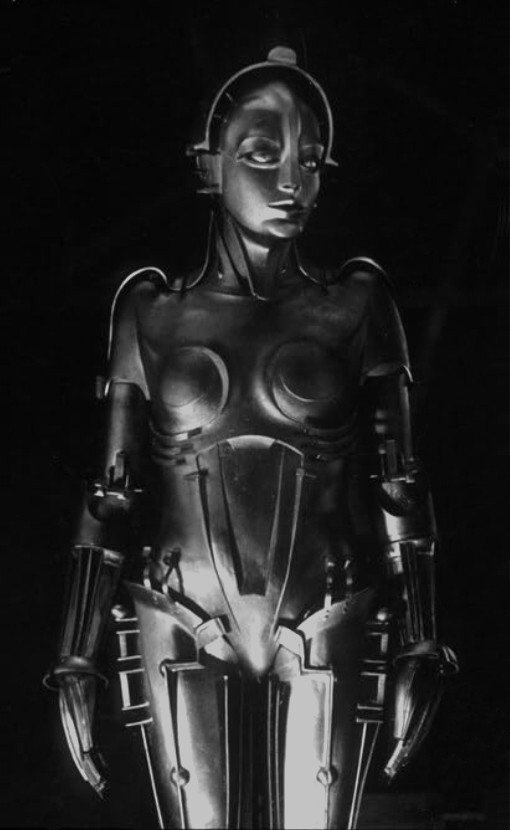
Despite Metropolis being released almost one hundred years ago, the themes and message of the film still remain relevant to this day. Cities are still shaped by technology, there’s still big industries and corporations out there, and economic inequality is still a thing. Instead of being worried about machines replacing workers, people today are worried about AI replacing workers. Metropolis also talks about social systems and different classes, which are still relevant today. American film historian David Brodwell claims that Metropolis remains powerful because it “combines spectacular imagery with deep concerns about modern life.”12 After its initial release, the film was actually shortened and censored in many countries. For many years, people only saw an incomplete version of the film. It wasn’t until 2008 that a completed print of the film was discovered in Argentina. The discovery of the completed version of the film allowed a version that’s closer to the original film to be released.13 Today, we consider Metropolis to be one of the most important movies in film history. It even influenced other science fiction movies such as Star Wars, The Matrix, and Blade Runner. Robot Maria has also become one of the most iconic robotic characters in film history.
Conclusion
Metropolis isn’t just a science fiction movie. It serves as a reflection of the world from the 1920s. This time was filled with rapid changes, new technologies, and social tensions. The film can also be interpreted as a prediction for the future. They wanted these bright and huge cities with lots of technology, but they also feared what would happen if society became too divided between classes. If we look at Metropolis in a historical context, we can understand the film and the time period that influenced the film. Metropolis reminds us that changes such as new technology, social conflict, and inequality aren’t new and have been a part of the modern world for a very long time. I decided to pick this film because I love dystopian movies, and I thought Metropolis would be interesting to research as it’s described as a prophetic dystopian vision. The film fits into the historical context of the 1920s through the fears of the general public throughout the decade. Its deception of social division, fast urbanization, and the fear of technology taking over were things people worried about. The views on this film have also changed drastically over time since the 1920s. The initial reception was mixed; some didn’t like the ending at all and thought the ideas of the film were too silly. The film was also criticized for its heavy political themes and editing style. The views began to shift later in the 20th century when people began to appreciate the film’s influence on the science fiction genre. Metropolis is now regarded as one of the most influential films ever made. Metropolis also complicates our ideas about the 1920s, as it’s an accurate portrayal of the anxieties people had in the 1920s rather than a celebration of new technologies. The divide between the two creates a dystopian vibe for the movie.
- Detlev Peukert, The Weimar Republic: The Crisis of Classical Modernity (New York: Hill and Wang, 1992), 53-55. ↩︎
- Elsasser Thomas, Weimar Cinema and After: Germany’s Historical Imaginary (London; New York: Routledge, 2000), 90. ↩︎
- KRACAUER, SIEGFRIED. From Caligari to Hitler: A Psychological History of the German Film. NED-New edition. Edited by Leonardo Quaresima. Princeton University Press, 2004. ↩︎
- Kanigel, Robert. The One Best Way: Frederick Winslow Taylor and the Enigma of Efficiency. 1997 ↩︎
- “The Schüfftan Process: Why Storytellers Need to Embrace Their Inner Magician.” 2017. ScreenCraft. July 20, 2017. https://screencraft.org/blog/storytellers-embrace-inner-magician-schufftan-process/.
↩︎ - Kaes Anton, Metropolis (London: British Film Institute, 2000), 8-10. ↩︎
- Benesch, Klaus. “Technology, Art, and the Cybernetic Body: The Cyborg as Cultural Other in Fritz Lang’s ‘Metropolis’ and Philip K. Dick’s ‘Do Androids Dream of Electric Sheep?’” Amerikastudien / American Studies 44, no. 3 (1999): 379–92. http://www.jstor.org/stable/41157479. ↩︎
- KRACAUER, SIEGFRIED. From Caligari to Hitler: A Psychological History of the German Film. NED-New edition. Edited by Leonardo Quaresima. Princeton University Press, 2004. https://doi.org/10.2307/j.ctvc77cxj. ↩︎
- Kaes Anton, Metropolis (London: British Film Institute, 2000), 54. ↩︎
- Huyssen, Andreas. “The Vamp and the Machine: Technology and Sexuality in Fritz Lang’s Metropolis.” New German Critique, no. 24/25 (1981): 221–37. https://doi.org/10.2307/488052. ↩︎
- Huyssen, Andreas. “The Vamp and the Machine: Technology and Sexuality in Fritz Lang’s Metropolis.” New German Critique, no. 24/25 (1981): 221–37. https://doi.org/10.2307/488052. ↩︎
- Thompson Kristin and Bordwell David, Film History: An Introduction, 4th edition. (New York: McGraw-Hill, 2018), 148. ↩︎
- Thompson Kristin and Bordwell David, Film History: An Introduction, 4th edition. (New York: McGraw-Hill, 2018), 147 ↩︎
