The Battle of Warsaw was a significant battle during the Soviet-Polish War in August of 1920. The event has some themes that are connected to American 1920’s themes, though the themes don’t line-up nicely with one another. Poland and America were two different countries and had different events affecting their themes during the1920s. The most notable of their connected themes can be found in the book The Modern Temper; Chapter 1: Public vs Private Powers and Chapter 3: New Women. Chapter 1 talks about the Red Scare a little and Chapter 2 talks about the change for women in the 1920s. Both chapters have some connects compared to chapter 2: Commercialism since it’s economic themes does not apply to the battle.
Chapter 1 of The Modern Temper talks about the event leading up to the 1920s and WW1’s affect on the era. One thing that the chapter mentioned was the Red Scare. Historian Lynn states “The optimism of the immediate postwar period did not last long. The Red Scare, with its insistence that Bolshevism posted serious threat to American institution, painted most reform with a radical pigment, and reformers knew early on that they would have to struggle odds to implement their goals”.1 American reformers had to face a uphill battle against being labeled a communist and having their voice squashed. Poland faced a similar issue, but instead of the Bolshevik threat being a political threat, it was an actual military threat. The threat of communism was a danger for both societies, and they both needed to overcome communism in their own way to prevail in their ideas. Poland wanted to govern their own country since the past 100 years someone else ruled the Poles, but the Soviets wanted Poland for their own goals. Poland needed to fight back against the Soviets, not just to preserve their government, but also to be able to have the opportunity to make their own decisions on how their government should run.
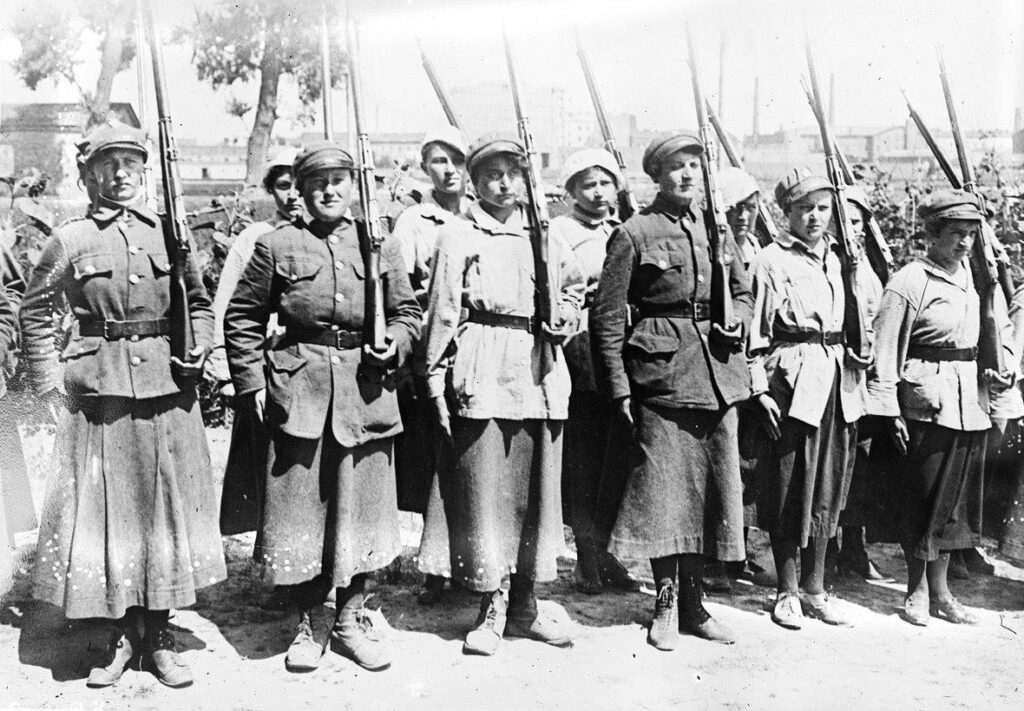
The theme of the New Woman is somewhat connected to the Battle of Warsaw. During the war a new special unit was created known as the Ochotnicza Legia Kobiet(Voluntary legion of Women) or OLK for short. The legion was made up of Polish and Ukrainian women who served as infantry soldiers during the Soviet-Polish War. They helped defend the city of Warsaw during the battle of Warsaw.2 In the Modern Temper, women’s identity changed during the 1920’s. In America, women were redefining how a woman should be, act, and look. Due to World War 1, many women joined male dominated fields like factory workers. After the war, though many women were content going back to normalcy, though some wanted to continue working, and with immigration it was harder to deny women from working in factories.3 In Poland, women were allowed to fight which is different from most of Europe and the United States. Prior to the wars in the 1920’s women were not allowed to fight, but due to the conflict, women were able to fight for their country. Though this battle did not start the era of the New Woman in Poland, without the OLK’s help it would have been a more difficult fight for Poland.
Though Modern Temper mostly discusses the themes that America’s 1920 had, Poland shared some of those changes. Both the United States and Poland faced adversities due to a communist presence. The United States had a new age of feminism, with women being more involved in politics and work, while women in Poland were voluntarily joining the war to defend Poland, just like the men. These few connections brought to light the fact that the 1920’s had greater themes that connected to different countries, even if the themes were slightly different for each country.
- Lynn Dumenil. The Modern Temper, (new York: Hill and Wang, 1995), 22. ↩︎
- Robert M Ponichtera . “Feminists, Nationalists, and Soldiers: Women in the Fight for Polish Independence.” The International History Review 19, no. 1 (1997): 25. ↩︎
- Dumenil. The Modern Temper, 112-113. ↩︎

Josh Pelar is a History student at Ramapo College of New Jersey.
