
The Jazz Singer is one of the most influential films in history due to its use of synchronized sound in a feature-length movie. However, there is much more to unpack when it comes to the film and its various themes, such as how it reflects upon work and consumerism in the 1920s. The book actually touches upon this film, stating it “reflected and reinforced the consumer culture” of the time.1 However, in order to understand what The Modern Temper means by The Jazz Singer being a prime example of consumer culture, we have to understand what consumer culture was like back then.
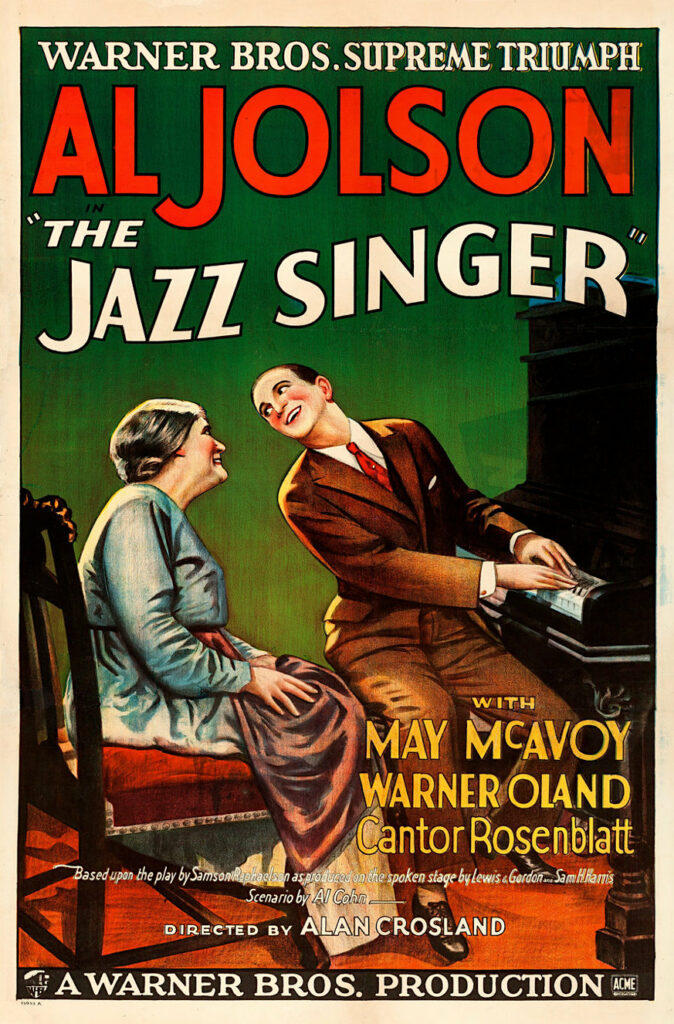
Overall, consumer culture came as a turning point away from “the Victorian “production” ethos of work, restraint, and order.”2 This came as a result of cultural pluralism, commercialization, and changing social values, and with The Jazz Singer, one has to look at how leisure and consumption were practiced, specifically among white-collar workers.
As a result of more material goods being sold to a wider audience, there was a sense of abundance that resonated within the United States. There were also various nightclubs and movies one could go to, along with sports gaining popularity during the 20s.3 This fed the cycle of consumerism, as Americans would spend money and entrepreneurs began to cash in on the various trends of the decade through new establishments and advertisements.
When it came to how the middle class, white-collar workers participated in leisure and consumption, there was a sense of “self-expression and self-realization through consumption and leisure.”4 This meant they could find satisfaction in consumption rather than work, or even religion, leading to money being put towards material goods and entertainment, perpetuating the cycle of consumerism. This is where The Jazz Singer comes in, as it is portrays what made consumer culture into what it was at the time, such as the main character’s job choice of a jazz singer, which correlates with how entertainment was prominent during the 1920s.5 As a result, this film helps encapsulate how leisure was important to society back then, as the audience helped to perpetuate consumerism.

In addition to showing what consumer culture was like back in the 20s, this film shows a change in ideas through the lens of a second-generation Jewish person. Throughout the film, Jack, the main character, wants to become an entertainer, and yet his father, a Jewish cantor, wants him to follow in his footsteps.6 Although not a revolutionary idea to create a movie out of, this helped normalize the idea of immigrants and immigrant stories within the American population. However, it does also call back to older ideas such as blackface, as Jack utilizes it in his performances. This calls back to minstrel shows, which are a product of racism, and the use of blackface only sustains racist stereotypes.
Overall, when looking at The Jazz Singer and its historical context, a viewer can see that the film is not only famous for its use of sounds, but reflects the societal view of leisure and entertainment during the 1920s. The film is a product of its time, and while it’s not as grand as the Stock Market Crash, it still gives insight into the culture of the time.
Footnotes
- Dumenil, Lynn, The Modern Temper: American Culture and Society in the 1920s, 94. ↩︎
- Dumenil, The Modern Temper, 57. ↩︎
- Dumenil, The Modern Temper, 77. ↩︎
- Dumenil, The Modern Temper, 85. ↩︎
- Dumenil, The Modern Temper, 94-95. ↩︎
- Dumenil, The Modern Temper, 94. ↩︎
Bibliography
Dumenil, Lynn. The Modern Temper : American Culture and Society in the 1920s. New York, Ny: Hill and Wang, 2007.

Eryn is a Ramapo College sophomore majoring in History and minoring in Museum Studies.
