
Overview
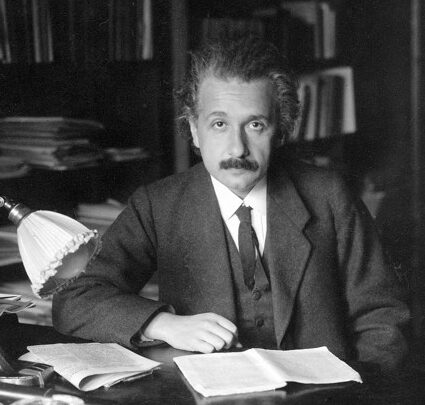
Albert Einstein’s reception of the 1921 Nobel Prize in Physics marked a major turning point for the field of theoretical physics, and in society’s broader struggle to accept increasingly complex scientific discoveries. This event also corresponds with a point in time when Einstein’s reputation in the media was finally being backed by the approval of an organization with global prestige. Thus the impact of the prize upon his fame highlights how science’s place in the public sphere was evolving dramatically during the interwar period. The decade of the 1920s is generally known as a time when traditional outlooks grappled with developments in culture and technology, and Einstein’s experiences with fame and recognition reflect an analogous conflict. From the perspective of the Nobel Committee, which had dismissed his name in the nominations for over a decade, this story reveals the challenge of maintaining authority over the entire academic field, in an age where headlines were gravitating towards entertainment above all else. Immersed in his own personal struggle to justify his controversial theories to both public and private audiences alike, Albert Einstein’s reception of the Nobel Prize in Physics sheds light on the trials and tribulations that come with being the modern world’s first celebrity scientist.
Beginning in the first few years of the 20th century, Albert Einstein made a name for himself as a thinker who would not be bound by classical schools of thought, or by the discouragement of mainstream academic institutions. In 1905, while working as a patent clerk in Switzerland, he published a paper on the photoelectric effect, which would become his gateway into relevance in the scientific community, and ultimately the justification for his reception of the Nobel Prize.1 This paper built upon the work of Einstein’s contemporaries, but added new theories to the mix that would eventually pave the way for technological developments ranging from X-rays to digital camera sensors. His studying of the photoelectric effect was directly cited by the Royal Swedish Academy of Sciences in the awarding of the Nobel Prize not only because it was an exceptionally topical discovery given the expansion of electricity and electrical machinery around the turn of the century, but also because it was far less controversial than his most notable work: the theory of general relativity.2

General relativity, which was first published in May of 1916, stands on par with scientific discoveries such as the debunking of a geocentric understanding of the solar system, or the first analysis of DNA in terms of how much it uprooted scientists’ comprehension of the world. Einstein had proposed such a fundamental shift in perspective that many other physicists were forced to conclude that either much of their own work was irrelevant, or that Einstein himself was merely an extraordinarily imaginative lunatic. Given the resulting uproar from the scientific community, the theory of general relativity posed a tremendous problem to the Nobel Committee and other well-established academic institutions, and to the general public as a whole.
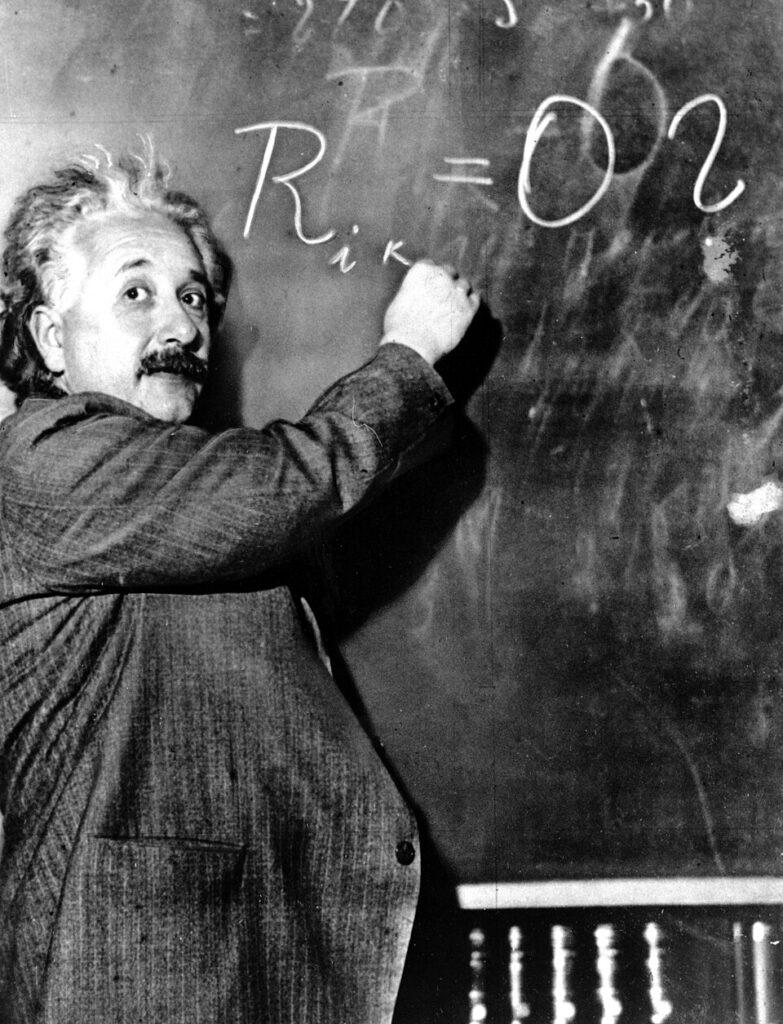
In the world of the early 1920s, physics was not seen as a malleable field to be drastically and sporadically reshaped by the ideas of one lone thinker, it was part of a stable canon of academia, which was only to be gradually developed over time by approved experts. When observations of a solar eclipse in 1919 ultimately proved Einstein’s theories to be accurate, hordes of prestigious scientists were shockingly forced to reevaluate their authority, and the press brought the spectacle to the masses. In the proverbial “blink” of a solar eye, audiences all over the world were reading about how the theories of a largely unknown theoretical physicist had left Western civilization’s most trusted minds in disarray and confusion.
Newspapers were utterly incapable of explaining the machinations of the theory to their readers, yet felt so pressured to assert that humanity’s scientific knowledge had not collapsed completely. One subheading from Pennsylvania even reads, “Men of Science More or Less Agog… Stars Not Where They Seemed or Were Calculated to Be, but Nobody Need Worry.”3 General relativity’s dramatic confirmation and incalculable impact upon intellectual communities created a swirl of public awareness around the name Albert Einstein, which would cement him as one of the only celebrity scientists of the time, and draw increased pressure for a Nobel Prize. However, the committee at the Royal Swedish Academy of Sciences remained wary about recognizing someone who had so consistently failed to play by the rules of academic progress.
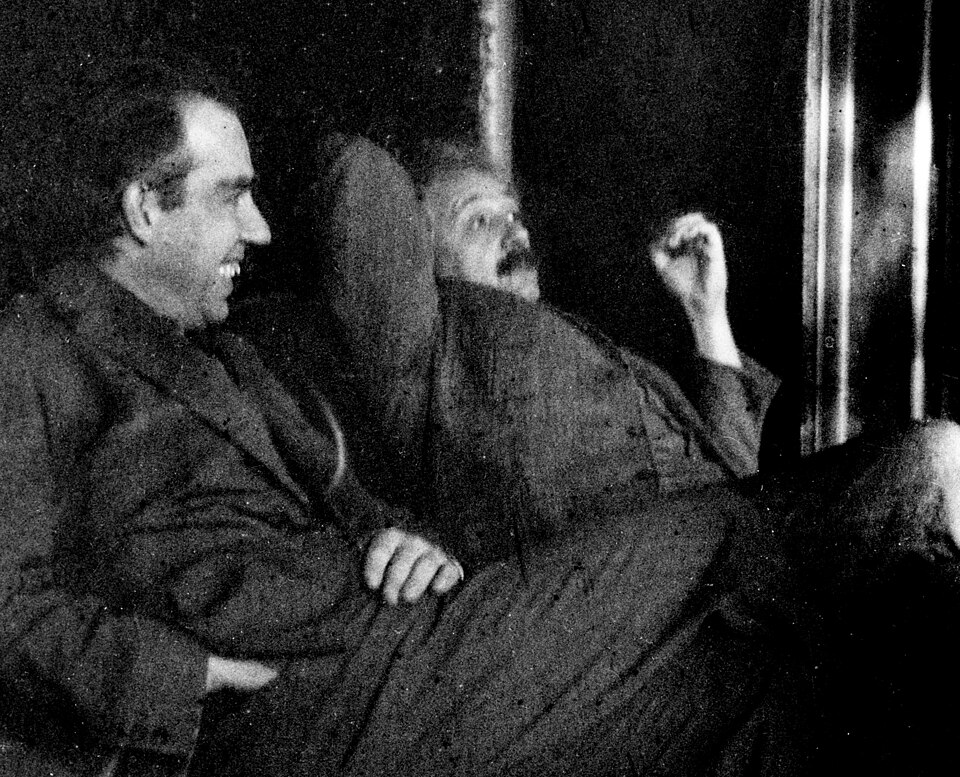
Between 1910 and his eventual reception of the Nobel Prize for 1921, Einstein was nominated by multiple fellow scientists every year except for 1911 and 1915, with many nominations mentioning both his pragmatic work on the photoelectric effect and his theoretical work on relativity. Although public audiences and leaders of mainstream academic institutions were skeptical of general relativity and the evidence of the 1919 eclipse, individuals who had experience proposing seemingly outlandish concepts in scientific fields often rallied behind Einstein, and celebrated the undeniable brilliance of his ideas. By the beginning of the 1920s, many such scientists were even writing letters to the Nobel Committee in support of Einstein’s contributions to the field of physics. While some argued that his earlier work alone should justify a Nobel Prize regardless of whether or not general relativity had been reliably proven, others went as far as to argue that even his more recent, radical work had already been essentially proven, and should thus be recognized as a revolutionary scientific achievement. In support of Einstein for the 1920 Nobel Prize, the prominent Danish physicist Niels Bohr stated that Einstein’s work, and specifically relativity were, “…advances of decisive significance for the development of research in physics.”4
Despite the increased support and respect from countless influential voices, the Nobel Committee repeatedly commissioned additional reports on the merit of general relativity, which deemed it undeserving of a Nobel Prize over and over again. One explanation for this polarization within the scientific community is that many of Einstein’s supporters were also theoretical physicists, and therefore had been more directly exposed to his earlier work, and were fundamentally more accustomed to experimental, imaginative theories. The Nobel Committee on the other hand, appointed people like Allvar Gullstrand to make the aforementioned reports on the reputability of relativity, although Gullstrand had made his name in ophthalmology and medicine. When his report on Einstein’s theory was published in conjunction with his considerations of the various Nobel Prize candidates in 1921, it was the first time Gullstrand had ever technically written on relativity.5
Particularly in 1921, these specially commissioned reports were a hindrance to Einstein’s reception of the prize. While Gullstrand claimed that general relativity was too controversial and untested to be credited with a Nobel Prize, his fellow Nobel Committee member Svante Arrhenius reported that Einstein’s earlier work on the photoelectric effect was not radical enough to be recognized on the global stage. Arrhenius had been tasked with informing the committee on whether or not Einstein’s work on the photoelectric effect alone could be justification for a Nobel Prize, but was personally of the opinion that the 1921 award should be given to an “experimentalist.”6 Caught between the clear internal conflict of the Nobel Committee, both Einstein and the entire scientific community was robbed of commendation that year, with no prize in physics being awarded in 1921.
In 1922, Einstein was obviously nominated once more, and the letters from other scientists flooded in again. However, 1918 Nobel laureate and well-known physicist of the time Max K. Planck took the extra step beyond writing a recommendation letter, and provided the committee with a plan that accorded Einstein proper recognition, while not dismissing the skepticisms of the past years. Planck proposed retroactively giving the 1921 prize to Einstein, and awarding the 1922 prize to Niels Bohr, who had also been nominated multiple times in recent cycles. Again the Nobel Committee conducted additional reports on the merit and scientific significance of both the photoelectric effect and general relativity, and while Gullstrand held fast to his doubtful conclusions, it was not enough to overtake the pressing evidence that Einstein deserved the prize even without taking relativity into account. On November 10, 1922, Albert Einstein was informed of his reception of the 1921 Nobel Prize in Physics, in a note that specifically stated that it was in recognition of his work on the photoelectric effect and not on general relativity.7 In true “Einstein” fashion, he and his wife were halfway around the globe, visiting Japan when the Nobel Prize presentation ceremony occurred.8
Significance
The dichotomy between Albert Einstein’s rise to fame during the early 20th century and the Nobel Committee’s hesitance to award him the Nobel Prize in Physics is emblematic of the widespread conflict of that time between institutionalized knowledge and the common experience. World War I exposed how unabated technological development could just as quickly break civilization down as it could build it up in the first place, and from this phenomena, science and technology became sequestered to an isolated component of society. Whereas the intellectual discoveries that culminated in the invention of electric lights had swiftly altered nearly every corner of the industrialized world, the publishing of general relativity had absolutely no significance to the average person’s life. Yet the scientific community was utterly besides themselves, struggling to rectify how ideas so seemingly outlandish actually redefined their understanding of the mechanics of the universe overnight.
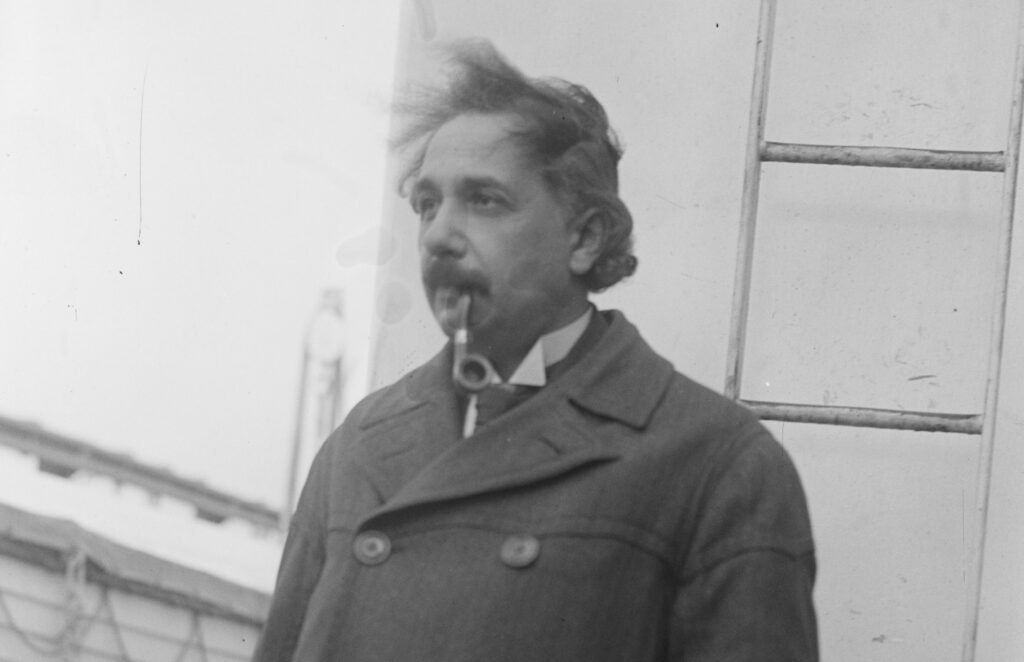
Science may have become more broadly integrated into the public consciousness during the 1920s, but this did not mean that it was becoming more accessible as a field, or even any more practical. Newspapers of the decade loved painting Einstein as the controversial free-spirit of academia precisely because his theories could not be understood or applied to the day-to-day realities of life. Theoretical physics was beginning to explore such otherworldly zones of knowledge, to the point where Einstein’s public persona resembled a mad scientist from a fictional tale, who had been pulled out of literature and dropped into the actual scientific community. Mainstream academic institutions were undoubtedly angered by this, as longstanding conventions dictated that research and discovery was most successful when it was clearly aimed at societal progress. However Einstein himself accepted that his place in the public consciousness, and perhaps also milestones of recognition such as the Nobel Prize, would never fully encapsulate the passion that kept him engaged in his own work. Rather his status as a well-known intellectual during the 1920s bound him to contemporary thinkers by, as Lynn Dumenil phrases it, “their shared consciousness of modern times and their role as interpreters of their culture.”9 With a task as daunting as interpreting quantum mechanics and relativity to mainstream audiences and reporters, it is no surprise that Einstein developed into the whimsical, imaginative presence that he is remembered for to this day.
The publicity surrounding Albert Einstein after his reception of the Nobel Prize in Physics also exposed him to an emerging component of fame: the oversimplification and misinterpretation of one’s identity.10 Since newspapers could not spend columns upon columns explaining mathematical proofs of the theories that had won him the prize, they instead searched for controversy under any rock which could be turned over. This is already obvious in relation to the 1919 eclipse which was claimed to have proven general relativity, for papers immediately covered debates between frustrated scientists, without even being able to explain what was being debated. This type of press continued to become increasingly personal for Einstein throughout the twenties, as his background as a German-born Swiss citizen, who had become widely popular in England and America since roughly the end of World War I, entangled him in the web of geopolitics. Einstein himself was tremendously aware of the media’s ability to influence his public image since he gained global notoriety, stating that:
“Einstein on the Palestine University,” The Denver Jewish News, May 11, 1921, p. 1.“…today in Germany I am called a German man of science, and in England I am represented as a Swiss Jew. If I come to be regarded as a bête noire, the description will be reversed and I shall become a Swiss Jew for the Germans and a German man of science for the English.”
Albert Einstein’s reception of the 1921 Nobel Prize in Physics was a monumental event both for the field of theoretical physics, and for the role of science in popular culture during the early 20th century. Throughout all the turmoil between his supporters and conservative skeptics within the Nobel Committee, the eventual achievement signified a prestigious academic institution’s recognition that they could not forever maintain authority over who became an ambassador of intellectualism. Einstein’s subsequent fame in that role was shaped by the developing celebrity culture of the 1920s, but also serves as an example of someone who did not let fame dictate their work. Nobel Prizes and newspaper headlines alike, what mattered was the sense of discovery and imagination that is still associated with the name: “Einstein.”
Citations
Footnotes
- Jennifer Ouellette, “Einstein and the Photoelectric Effect,” American Physical Association News, January 1, 2005. ↩︎
- Abraham Pais, “How Einstein Got the Nobel Prize,” American Scientist 70, no. 4 (July-August 1982): 358. ↩︎
- “Confusion Regarding Conditions in the Heavenly Power Plants,” Tri-County Independent, November 10, 1919, 7. ↩︎
- Abraham Pais, “How Einstein Got the Nobel Prize,” American Scientist 70, no. 4 (July-August 1982): 363. ↩︎
- Ibid, 363. ↩︎
- Ibid, 363-364. ↩︎
- Ibid, 364. ↩︎
- Jerry Adler, “When Albert Einstein Visited Japan,” Smithsonian Magazine, May 2018. ↩︎
- Lynn Dumenil, The Modern Temper: American Culture and Society in the 1920s (New York: Hill and Wang, 1995), 149. ↩︎
- Ibid, 77-78. ↩︎
Bibliography
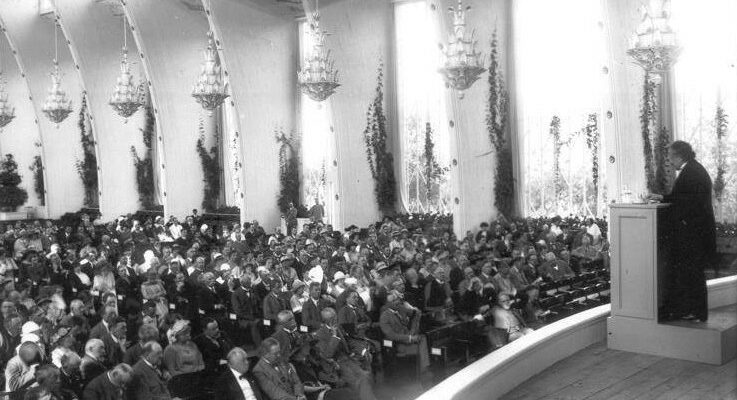
- Featured Image: Karnell, Anders Wilhelm. Einstein speaks in Gothenburg, Sweden 1923. July 11, 1923. Accessed March 16, 2026. https://commons.wikimedia.org/wiki/File:Einstein_foto.gif.
- Adler, Jerry. “When Albert Einstein Visited Japan.” Smithsonian Magazine, May 2018. https://www.smithsonianmag.com/history/albert-einstein-visited-japan-180968737/.
- “Confusion Regarding Conditions in the Heavenly Power Plants.” Tri-County Independent, November 10, 1919, p. 7.
- Dumenil, Lynn. The Modern Temper: American Culture and Society in the 1920s. New York: Hill and Wang, 1995.
- Isaacson, Walter. Einstein: His Life and Universe. New York: Simon & Schuster, 2007.
- Missner, Marshall. “Why Einstein Became Famous in America.” Social Studies of Science 15, no. 2 (May 1985): 267-291. https://www.jstor.org/stable/285389.
- Ouellette, Jennifer. “Einstein and The Photoelectric Effect.” American Physical Society News, January 1, 2005.
- Pais, Abraham. “How Einstein Got the Nobel Prize: Why did the Nobel Committee for Physics wait so long before giving Einstein the Prize, and why did they not award it for relativity?” American Scientist 70, no. 4 (Summer 1982): 358-365. https://www.jstor.org/stable/27851543.
- The Nobel Prize Organization. “Nomination Archive: Albert Einstein.” Accessed March 17, 2026. https://www.nobelprize.org/nomination/archive/show_people.php?id=2728.
- Wazeck, Milena. “Marginalization processes in science: The controversy about the theory of relativity in the 1920s.” Social Studies of Science 43, no. 2 (April 2013): 163-190. https://www.jstor.org/stable/43284178.
More Resources
- Arora, Jagdish Krishanlal. The Nobel Prize and Its Global Influence. Independently Published, 2025.
- Elton, Lewis. “Einstein, General Relativity, and the German Press, 1919-1920.” Isis 77, no. 1 (March 1986): 95-103. https://www.jstor.org/stable/232505.
- Greene, Brian. “Why He Matters.” Scientific American 313, no. 3 (September 2015): 34-37.
- Pais, Abraham. “Knowledge and Belief: The Impact of Einstein’s Relativity Theory.” American Scientist 76, no. 2 (Spring 1988): 154-158. https://www.jstor.org/stable/27855069.

A senior at Ramapo College, majoring in American Studies and minoring in Anthropology.

