
Introduction
The 1920s was a period defined by cultural excess and societal shifts in America. While many associate the decade with the glamour of jazz culture and flappers, a darker aspect of American life dominated the twenties. Fueled by the failures of Prohibition and an influx of organized crime, one of the most infamous events of the twenties was the St. Valentine’s Day Massacre. The massacre served as a violent representation of the nation’s influx of organized crime, corruption, and lawlessness.
February 14, 1929 remains a defining moment in the history of organized crime in America. The St. Valentine’s Day Massacre exposed many of the complexities of the Prohibition era. The mass killing not only changed how law enforcement viewed organized crime but also served as a reminder of the failure of the government. Specifically, the event demonstrated weakness in the government to enforce laws, particularly the 18th Amendment, which prohibited the manufacture, sale, and transportation of alcohol.
The St. Valentine’s Day Massacre
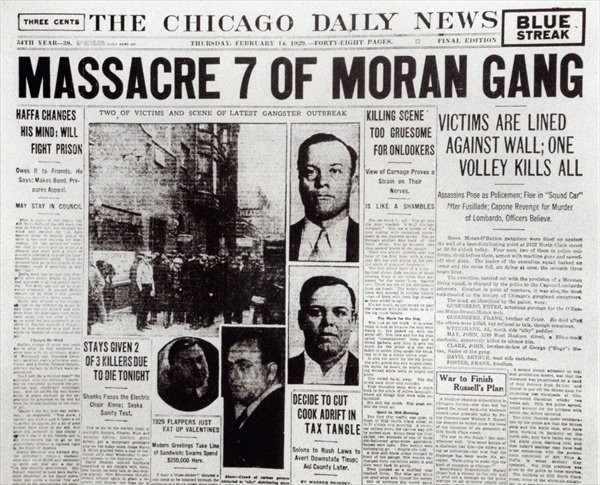
On the morning of February 14, 1929, seven men were shot and killed in a garage at 2122 North Clark Street, Chicago. The victims were members of the North Side Irish gang, which was headed by George “Bugs” Moran, a notorious figure in Chicago’s organized crime scene. The victims were lined up against a wall and shot with Tommy guns, a common weapon used by gangsters during this period.1

The shooters disguised themselves as uniformed policemen. They arrived at the garage in a stolen car and deceived Moran’s men into believing they were law enforcement officers. This disguise allowed them to get close to the gang members without raising suspicion. Once inside the garage, the men opened fire and killed all seven men.2 The brutality of the massacre frightened Americans. The massacre represented a significant increase in the violent gang wars present in major American cities throughout the twentieth century.
Five of the victims were direct members of Moran’s North Side Gang: Moran’s second in command, Albert Kachellek, bookkeeper and business manager Adam Heyer, cleaning operator Albert Weinshank, gang enforcer Frank Gusenberg, and his brother Peter Gusenberg. Two affiliates of the gang were also murdered: Reinhardt H. Schwimmer and John Hay. All men were found dead at the scene except for Frank Gusenberg.3 Law enforcement transported Gusenberg to nearby St. Joseph’s Hospital where they questioned him about the attack. Gusenberg refused to provide any details on the shooters. This was a common practice of organized crime affiliates. Frank Gusenberg later died at St. Joseph’s Hospital from his wounds.
The victims of the massacre were part of Moran’s North Side gang. The gang obtained immense power and wealth from the illegal bootlegging trade during the Prohibition era. They were also involved in a rivalry with the South Side Italian gang led by Al Capone. People widely suspected that Capone orchestrated the hit. Within days of the shooting, the court summoned Al Capone to testify before a grand jury on charges of Prohibition violations seemingly unrelated to the massacre. Capone’s gang was also heavily involved in bootlegging alcohol during this time period. The city would investigate numerous men affiliated with Capone’s South Side Gane, however, the lack of evidence left law enforcement clueless. Despite the growing suspicions, Capone and the South Side Gang were never officially charged or convicted of the hit. The rival gangs were in a constant struggle for control of Chicago’s illegal liquor trade. Thus, many people viewed the St. Valentine’s Day Massacre as an act of violence in relation to the gang war.
While the connections to Capone’s organization seemed obvious, no members of the South Side gang were ever convicted of the murders. Law enforcement questioned several suspects which included Capone and his men, but ultimately the case never closed. Despite never officially convicting anyone of the crime, law enforcement did identify connections to the massacre. On December 14, 1929 almost a year after the massacre, Michigan native Fredrick Dane, shot and killed an officer after a drunken car accident. The murder prompted the search of Dane’s Michigan home where law enforcements found a collection of Tommy guns which they believed to be the guns used in the massacre. Fredrick Dane had loose connections to Al Capone and his affiliates. Through the murder investigation, law enforcement linked Fredrick Dane to the massacre, however, they did not have enough evidence to convict him. Instead they sentenced Dane to life in prison for the murder of Officer Skelly. He served approximately 10 years before he died in 1940. Even with strong connections and links, law enforcement was unable to convict anyone of the crime. This lack of resolution after the massacre only added to the mass hysteria in Chicago and danger surrounding organized crime in the 1920s.

https://www.berriencounty.org/419/Fred-Burke—Charles-Skel
Prohibition’s Impact on Organized Crime
To understand the significance of the St. Valentine’s Day Massacre, it is important to understand the effects of the Prohibition laws. Ratified in 1919, the 18th Amendment to the US Constitution prohibited the manufacture, sale, and transportation of alcoholic beverages. Groups such as the Women’s Christian Temperance Union and the Anti-Saloon League believed alcohol consumption was responsible for the social problems such as domestic violence, crime and poverty which caused them to contribute to the implementation of prohibition laws.4 Through a legal ban of the manufacture or sale of alcohol, many believed “prohibition would re-create a socially ordered community through the establishment of Protestant middle/class values.”5 Prohibition directly impacted the immigrant communities such as the Irish, Italians, and Germans as drinking was deeply ingrained in their culture and traditions. Law enforcement often targeted immigrants as speakeasies and bootlegging operations were frequently associated with their neighborhoods. Prohibition’s restrictive laws fueled resentment and widened cultural divides, reinforcing nativist prejudices. Figures such as Al Capone and George Moran rose to prominence through these large smuggling and distribution operations which further established organized crime within immigrant communities.
Despite its intended goals, Prohibition created a massive black market for alcohol and marked the rise of powerful organized crime groups who profited off the illegal liquor trade. Organized crime figures dominated the lucrative illegal trade which escalated the violent tensions in urban America; “there were fortunes to be made from the illicit trade, and prohibition agents were not up against individual lawbreakers, but faced well-organized and well-mannered gangs.” Figures such as Al Capone and Bugs Moran profited immensely from this bootlegging.6 In addition to these figures, Prohibition led to the rise in underground clubs. Speakeasies became extremely popular across the country. However, this new industry caused even more competition and tension for control of this lucrative market which led to increased violence, corruption, and organized crime schemes.7
The St. Valentine’s Day Massacre was a direct consequence of this struggle for power. Moran’s North Side gang and Capone’s South Side gang fought for dominance in Chicago’s bootlegging operations for years prior to the hit. The gangs were constantly involved in violent situations. A prime example of this tension occurred on the Detroit River. The Detroit River was a major port for smuggling alcohol during Prohibition. One night while Capone and his men attempted to smuggle alcohol, the North Side Gang hijacked the boat and intercepted the alcohol.8 This event allegedly served as a catalyst for the massacre. This story further provides motive and supports the narrative that the massacre was an attempt by Capone’s men to eliminate their rivals and gain full control over the city’s illegal alcohol trade. If orchestrated by Capone, the massacre was not a random act of violence but instead a strategic move to gain power and profit further off the illegal trade market.
Law enforcement’s inability to convict anyone of the violent crime only further highlighted the lack of power the government presented to enforce Prohibition laws. Illegal trade, speakeasies, and violence thrived under Prohibition. The federal government established the Volstead Act to enforce the 18th Amendment. Law enforcement agencies were overwhelmed by the power, size, and violence of the illegal market. The St. Valentine’s Day Massacre continued to serve as a reminder that Prohibition did not lead to a decrease in crime but had instead fueled a violent and lawless culture in the 1920s.
Organized Crime and Government Corruption
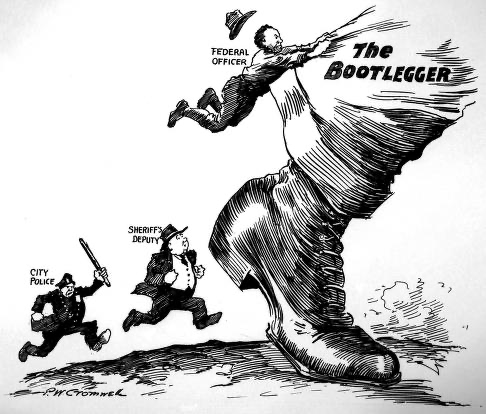
The St. Valentine’s Day Massacre also further revealed the extent to which organized crime infiltrated American society and government. During the 1920s, corruption was rampant among police officers, politicians, judges, and other public officials because many received benefits from the respective gangs. Whether out of fear or financial pressures, many of these public officials were on the books of these criminal organizations and coerced to overlook some of the violent offenses.9 This caused substantial corruption as it was extremely difficult to distinguish between law enforcement and the criminals they were supposed to be policing. These factors created the environment of the St. Valentine’s Day Massacre and allowed organized crime to thrive.
~eng217/student_projects/
nkazmers/index1.html
Al Capone was infamous for his ability to bribe local officials and law enforcement officers to turn a blind eye to his criminal activities. As mentioned, Capone was one of the largest and wealthiest gangsters in America. Capone gained most of his wealth from the bootlegging trade and other illicit trades during Prohibition. The wealth he gained from Prohibition allowed him to gain significant influence over the political and legal systems in Chicago. He was protected not only by his men, but also a large network of corrupt individuals who turned a blind eye to his criminal activities and allowed him to continue to gain massive amounts of wealth and political power.10 Ultimately, through his connections, Al Capone remained one of the most powerful individuals in Chicago even beyond the 1920s.
The inability of the authorities to solve the crime and bring justice further undermined public confidence in the government’s ability to control organized crime. It also undermined the dangerous relationship between organized crime rings and corrupt officials. These connections continued to highlight the relationship between wealth and corruption. The more wealth a person amassed the more power they had to control the system, a common theme throughout the 1920s.
Broader Significance
The St. Valentine’s Day Massacre represented a turning point in the culture of the 1920s. It was not only a violent representation of the tensions between rival gangs, but also an intense representation of the growing corruption and lawlessness in the twenties. While many often remember the 1920s for its culture, jazz, and the rise of consumerism, the massacre demonstrates how it was also a period of intense social and political violence and unrest. The massacre sparked a deep sense of public distrust and disillusionment with the government and its ability to control society. As more Americans understood the negative impacts of Prohibition, particularly the violence it had provoked, there were mass movements that called for the repeal of the 18th Amendment.11 These movements led to the eventual repeal of Prohibition with the ratification of the 21st Amendment in 1933, shortly after the 1920s.12
Conclusion
The St. Valentine’s Day Massacre was not just an isolated event, but part of a broader pattern of increasing gang violence present in the 1920s. It served as a defining moment of the 1920s that highlighted the challenges and contradictions of the decade. The massacre exposed the failures of Prohibition, the violent basis of organized crime competition, and the limits of law enforcement in an era of mass corruption. This massacre emphasized the tensions between rival gangs while fueling public outrage. It effectively demonstrated how prohibition failed as the movement promoted lawlessness and corruption rather than temperance. The massacre also marked a turning point in the way people viewed and trusted the government’s ability to control crime and the growing influence of organized crime. It remains a reminder of the unintended consequences of Prohibition such as escalated violence which led to the rise of organized crime in America. Ultimately, the massacre showcased the weaknesses of American political and legal systems which allowed for the eventual collapse of Prohibition, the only Amendment to ever be repealed.
Footnotes
- “St. Valentine’s Day Massacre Wall.” The Mob Museum, February 10, 2023. https://themobmuseum.org/exhibits/massacre-wall/. ↩︎
- The Mob Museum ↩︎
- The Mob Museum in Downtown Las Vegas. https://themobmuseum.org/wp-content/uploads/2018/12/trio.jpg. ↩︎
- Lynn Dumenil. The Modern Temper: American Culture and Society in the 1920s, ed. Eric Foner (New York, NY: Hill and Wang, 1995) 229. ↩︎
- Lynn Dumenil. The Modern Temper. 228. ↩︎
- Daniel McDonough. “Chicago Press Treatment of the Gangster, 1924-1931.” Illinois Historical Journal 82, no. 1 (1989): 17–32. http://www.jstor.org/stable/40192250. ↩︎
- Jeffrey A. Miron, and Jeffrey Zwiebel. “Alcohol Consumption During Prohibition.” The American Economic Review 81, no. 2 (1991): 242–47. http://www.jstor.org/stable/2006862. ↩︎
- Rumrunning and the Roaring Twenties: Prohibition on the Michigan-Ontario Waterway. Detroit: Wayne State University Press. August 1, 1995. p. 146. ISBN 978-0-8143-2583-4. ↩︎
- Lynn Dumenil. The Modern Temper. 233. ↩︎
- The Mob Museum. ↩︎
- The Mob Museum. ↩︎
- Lynn Dumenil. The Modern Temper. 234. ↩︎
Bibliography
Dumenil, Lynn. The Modern Temper: American Culture and Society in the 1920s, ed. Eric Foner (New York, NY: Hill and Wang, 1995).
Fort Worth Star-Telegram. “Dane Linked in Chicago’s St. Valentine’s Day Massacre of 7.” December 17, 1929, 1.
McDonough, Daniel. “Chicago Press Treatment of the Gangster, 1924-1931.” Illinois Historical Journal 82, no. 1 (1989): 17–32. http://www.jstor.org/stable/40192250.
Miron, Jeffrey A., and Jeffrey Zwiebel. “Alcohol Consumption During Prohibition.” The American Economic Review 81, no. 2 (1991): 242–47. http://www.jstor.org/stable/2006862.
Rumrunning and the Roaring Twenties: Prohibition on the Michigan-Ontario Waterway. Detroit: Wayne State University Press. August 1, 1995. p. 146. ISBN 978-0-8143-2583-4.
“St. Valentine’s Day Massacre Wall.” The Mob Museum, February 10, 2023. https://themobmuseum.org/exhibits/massacre-wall/.
The Mob Museum in downtown Las Vegas. https://themobmuseum.org/wp-content/uploads/2018/12/trio.jpg.

Erin Pryor is a History and Philosophy double major in the Honors Program, graduating with the Class of 2025. She is a writing consultant on campus at the Center for Reading and Writing. She is the president of Phi Alpha Theta history honors society and a member of Phi Alpha Delta pre-law fraternity.
