
Overview
While tension after World War I began to fall slightly, there were still many unresolved issues among countries in Europe. Naturally, this makes sense as World War I was a war the likes of which the world had never seen before, but the attempt at peace after through the Treaty of Versailles would simply be a temporary bandage to these problems. The country that was impacted the most by the Treaty of Versailles was definitely Germany, who had their economy destroyed by the treaty. At the time, Germany was being forced to pay 132 billion gold marks in total ($33 billion) which was an impossible task for them to ask for, especially considering the amount of money they spent on the war.1 The failure to pay said reparations would cause a crisis for the country after France occupied the Ruhr district, one of Germany’s most profitable areas, in hopes of seizing some profit from their coal mines themselves. Enter Charles G. Dawes and Owen D. Young, two lawyers who turned to economics. These two men, along with eight others, were appointed to the Dawes Plan by the Reparations Committee under the League of Nations. The committee was given the task of easing the heavy burden placed on Germany to bring stability to a very unstable Europe. The plan that these ten men came up with would be known as the “Dawes Plan” which would see noticeable success in the year after its enactment.
Treaty of Versailles
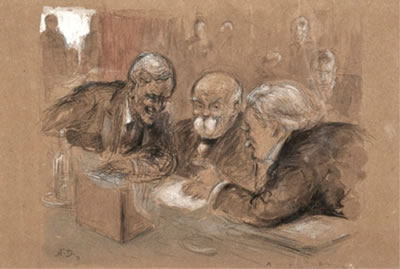
The first major misstep that allowed for the exploitation of Germany during the 1920s was the Treaty of Versailles. As Germany was a part of the Central Powers during World War I, they would be punished by the victors for their actions during the war. The Treaty of Versailles laid the groundwork for an attempt at peace throughout Europe, one that would ultimately prove unsuccessful through certain decisions involving Germany that would lead to the need for the Dawes Plan. While the Treaty of Versailles was very harsh on Germany, it goes without saying that the German narrative complicates the conversation surrounding the success of the treaty. Though there were initial attempts to sign the treaty, they were too disorganized and were not able to make progress in the signing of the treaty. During the creation process, “The Four”, or Woodrow Wilson, David Lloyd George, Georges Clemenceau, and Vittorio Orlando, would come together in an attempt to create peace. In particular, Wilson made his famous “Fourteen Points” in regards to the Treaty of Versailles, which were much too large of an undertaking for Europe, who just came out of a war.3 This lack of unity would allow for unreasonable requirements on the end of Germany to slip through, creating the problem that the Dawes Plan would attempt to fix.
Ruhr District
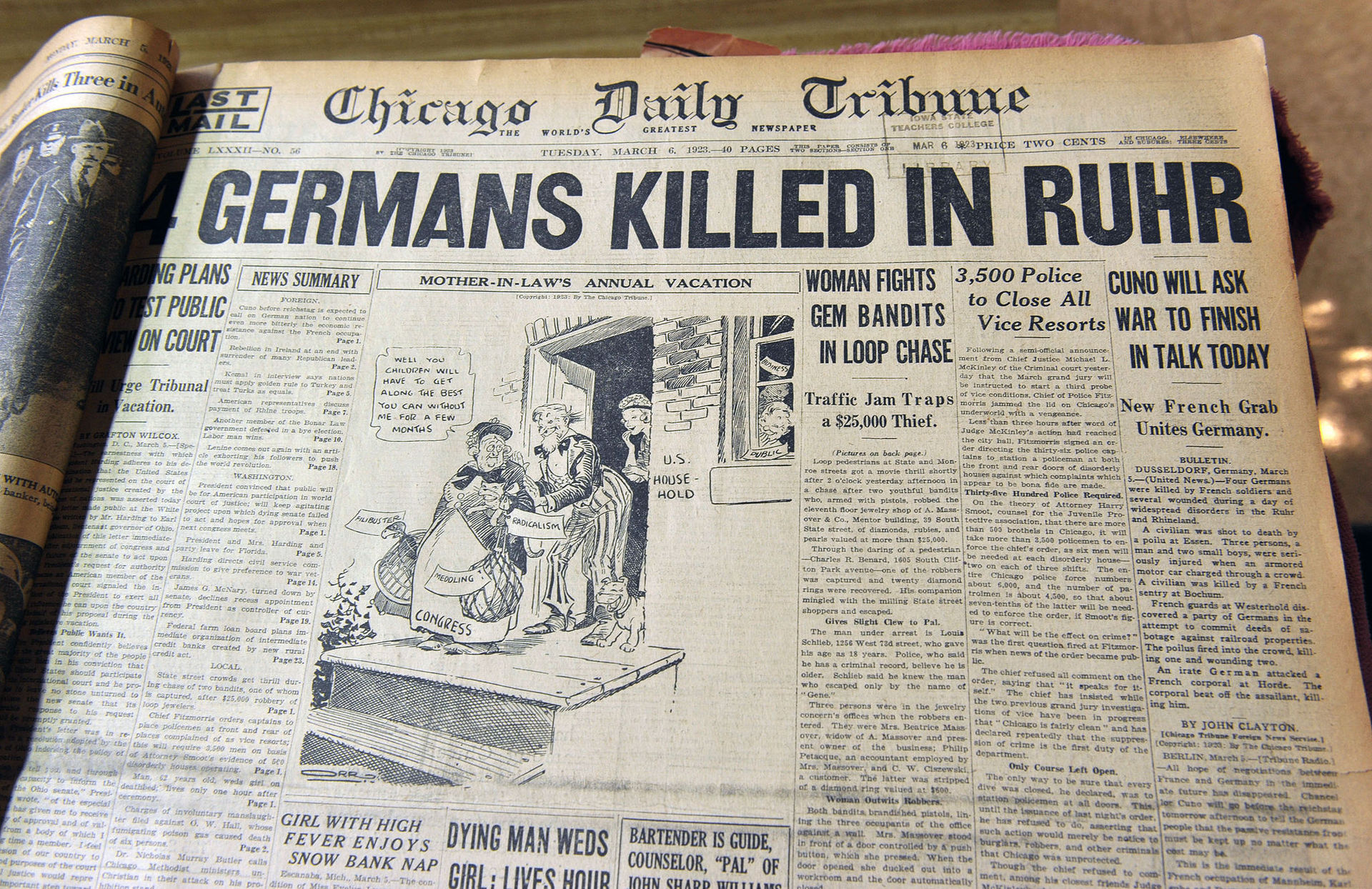
Upon Germany’s failure to pay the reparations placed by the Treaty of Versailles, the first action taken against Germany was by France in the Ruhr District. At the time, coal amounted to 15-16% of the annual obligation according to France, and 11% according to Germany.5 The Ruhr district was easily Germany’s largest producer of coal, which accounted for much of the reparations that Germany was attempting to pay. In response, France and Belgium took matters into their own hands in an attempt to seize control of Germany’s coal production to funnel the reparation funds away from the German economy as punishment.6 Much of this desire to occupy the district for the French was out of stubbornness. The French Premier’s Monsieur Poincare said in a speech where he stated the riches contained in the Ruhr district, including 14,000 coke furnaces that he wanted under French control, as well as saying that France did not want to exploit the district, but rather control it.”7 The actions from the French can be seen as exploitative in a way, but they also represent the greater flaws of the Treaty of Versailles that allowed for French occupation in the first place.
Charles Dawes and His Committee
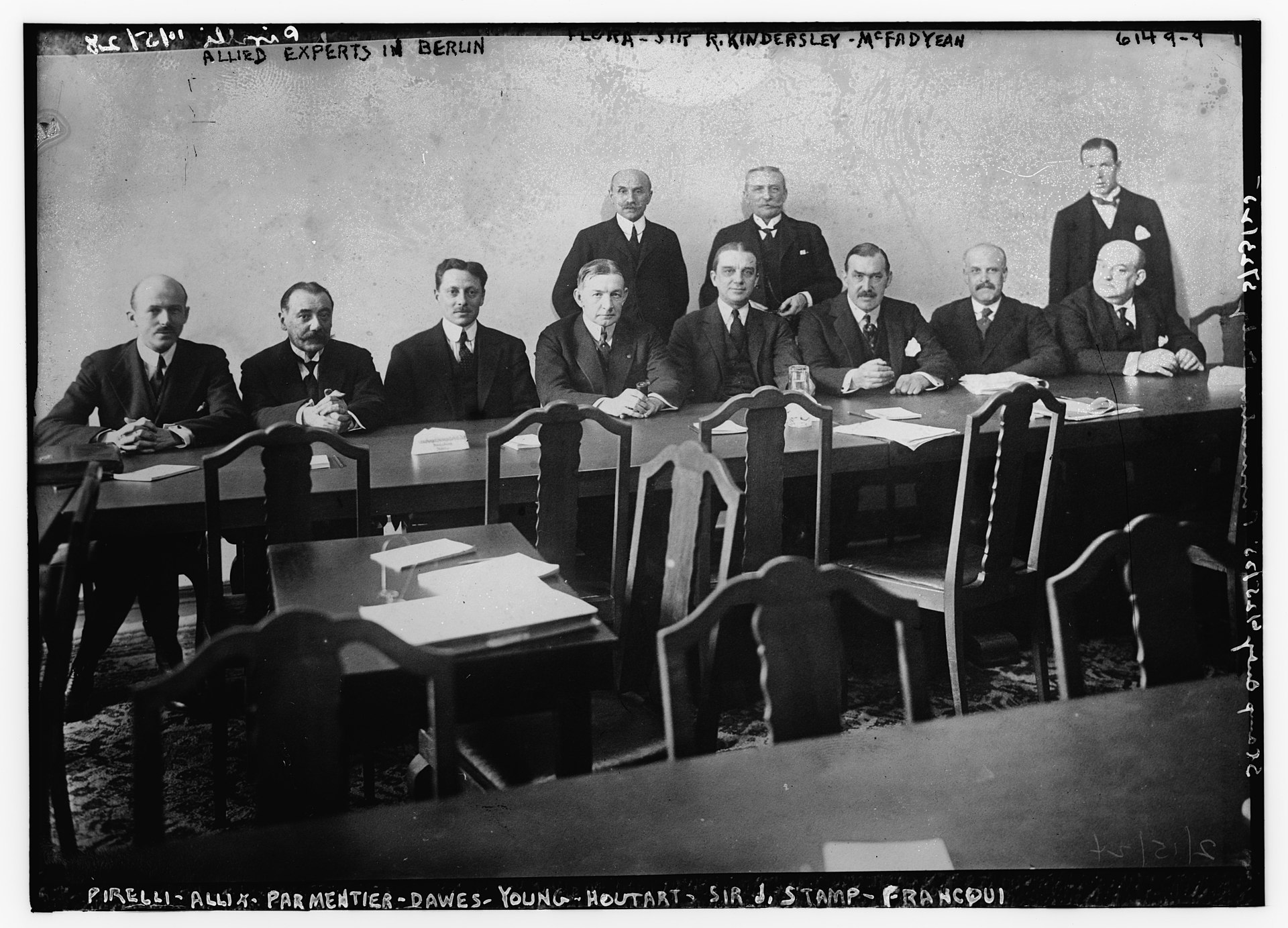
Germany would find a light in the darkness of a recession in the form of Charles Dawes. Dawes, who was appointed to the Director of the Budget three years prior in 1920, would show his hand in efficiency and unity in the budget for the United States. His success in his position was so great that he was invited to a committee by the League of Nations to tackle the problem of German reparations.8 Created by the Reparations Commission in Germany, the Dawes Committee hired ten of the smartest economic minds from the United States, France, Belgium, Great Britain, and Italy, to handle how much money would need to be estimated for Germany to pay back realistically.9 Every member of the committee was paid in full by the Reparations Commission except for the members from the United States, likely due to United States never joining the League of Nations. One of the many goals that the committee aimed to achieve was a “restoration of confidence” in the German nation, allowing it to successfully recuperate into a secure environment in which its economy can grow.10 Another goal of the committee was to prevent Germany from lacking a fallback, considering the impossible amount in reparations it was required to pay. If Germany was unable to successfully manage its reparations after the committee’s work, then Germany would have to fix the problem itself.
The Dawes Plan
When creating the Dawes Plan, there were a few goals and considerations that the ten experts had to work with. The first thing on the agenda for the committee was dealing with France, who were still occupying the Ruhr district of Germany at the time. While in control of the Ruhr district, France saw little increase in profit from their coal mines and instead saw a rise in inflation. This inflation led to a higher cost of living that was damaging the French economy and the franc currency. Dawes and Young planned on using this to their advantage when working out a reparation deal, as Germany was only causing problems for the French economy.12 The other thing that came first on the agenda was ensuring that Germany accept the weight that the Dawes Plan would carry. Much of the plan to turn around Germany’s economy can be credited to Owen Young, the other U.S. member on the committee. Young’s outline of the Dawes Plan was to place reparations on Germany that were comparable to the burdens of England and France from having to pay for the war. This was to ensure that Germany would not fall behind in the economy and cause chaos for the rest of Europe, but also to ensure that Germany did not become a superpower that could control the rest of Europe. Young wanted to ensure that Germany could pay off its reparations and serve as an economic force that England and France would have to trade with to gain access to its funds.13 This served not only as a way to get Germany out of an endless cycle of debt, but also to get the allies to pay back their debt as well. As the plan was officialized, Germany would have a $1.25 billion mark limit on reparations until the Allies drew on a balance, then moving the limit to $5 billion marks. This ensured that Germany would pay and that the Allies would pay into Germany’s economy in a way.
Dawes Plan in Action
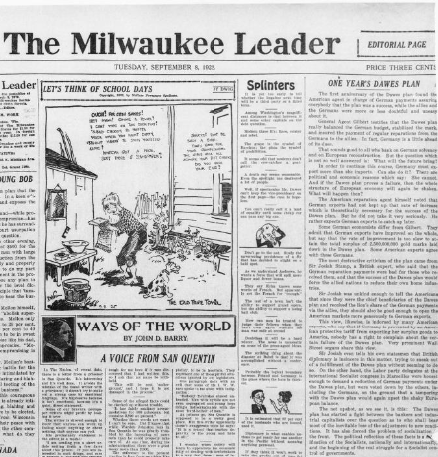
While the process from the rough draft into the Dawes Plan is very important, was it able to actually make an impact on German reparations at the time? The answer is unequivocally yes, though the details of the implementation are also very important. In the very beginning of the plan’s implementation, a loan totaling $200 million would be issued to Germany, $110 million of which was subscribed to by the United States. The German central bank (Reichsbank) would also be reorganized, and the plan would introduce a new monetary unit in the form of the Reichsmark. Possibly the most important action that was initially implemented was the evacuation of the Ruhr District, forcing the French out of the area.15 The immediate and future economic results from the Dawes Plan also show a great improvement to the German economy. German exports increased by twenty percent from the Dawes Plan, but the Allies did not find themselves receiving much of the expected benefits from the plan.16 While there was short-term success with the Dawes Plan, it was only a short-term measure that was attempting to solve a long-term problem for Germany.
Significance
The Dawes Plan is one of the earliest examples of how the relations changed between countries across the world. The Post World-War I environment during the 20s was the first opportunity for globalization to kick off. During the 20s, the success of the United States had the side effect of transforming them into the dominant force of globalization. Prior to World War I, there were many examples of the United States interacting with other countries, but it usually concerned trade or warfare. The 20s represented the first time that the U.S. was ahead of the rest of the world in terms of capital, allowing them to give Europe a helping hand. The Dawes Plan was also a result of a change in culture in the U.S. following World War I. There was disappointment among many Americans as a result of the violation of civil liberties, as well as disappointment over the attempt of peace that was the Treaty of Versailles and the failure of the treaty to meet up to the expectations of Wilson’s Fourteen Points.17 Much of these complaints were what resulted in the decline of pushes for reform, both in and out of the United States. The 20s, however, would change this notion to become more positive. Many aspects of the country would be reconstructed in the new post-war period, as it was seen as “the winning of a new world”.18 This new wave of progress and reform would bring about a new period in the history of the United States that brought it to its most progressive state domestically. Not only did the U.S. break its own mold domestically, but it also participated in foreign aid, something that was uncharacteristic for them to do during the time. As it stands, the Dawes Plan served as a solution that, while temporary, provided Germany with enough footing that it was able to recuperate more than it would have without the plan. While foreign aid towards Germany is the most talked about in the current day, the U.S. also provided aid to other countries such as Austria, Hungary, and Poland. The Dawes Plan is pivotal for understanding the United States’ first attempts at foreign aid and for understanding how foreign policy in the U.S. would change, going into the 20s and onward.
Map
Bibliography
“Charles G. Dawes – Biographical.” NobelPrize.org. Accessed May 3, 2025. https://www.nobelprize.org/prizes/peace/1925/dawes/biographical/.
“THE FRENCH IN THE RUHR.” Advocate of Peace through Justice 85, no. 3 (1923): 111–13. http://www.jstor.org/stable/20660241.
“One Year’s Dawes Plan” The Milwaukee Leader. September 8, 1925
Allied Experts in Berlin — Flora – Sir R. Kindersley – McFadyean – Pirelli – Allix – Parmentier – Dawes – Young – Houtart – Sir J. Stamp. Bain News Service.
Clayton, John. “Germans Killed in Ruhr.” Chicago Daily Tribune. March 6, 1923.
Costigliola, Frank. “The United States and the Reconstruction of Germany in the 1920s.” The Business History Review 50, no. 4 (1976): 477–502. https://doi.org/10.2307/3113137.
Dawes, Rufus C. The Dawes Plan in the Making, 1929.
Dumenil, Lynn. The Modern Temper: American Culture and Society in the 1920s. United States: Hill and Wang, 2024.
Gilbert, S. Parker. “The Meaning of the ‘Dawes Plan.’” Foreign Affairs 4, no. 3 (1926): i–xii. https://doi.org/10.2307/20028477.
Marks, Sally. “Mistakes and Myths: The Allies, Germany, and the Versailles Treaty, 1918–1921.” The Journal of Modern History 85, no. 3 (2013): 632–59. https://doi.org/10.1086/670825.
Noël Dorville. Recueil de 40 Planches de Portraits Dessinés de Sénateurs, 1902-1903.
Patterson, Ernest Minor. “The Dawes Plan in Operation.” The Annals of the American Academy of Political and Social Science 120 (1925): 1–6. http://www.jstor.org/stable/1015627.
Peterecz, Zoltán. “American Foreign Policy and American Financial Controllers in Europe in the 1920s.” Hungarian Journal of English and American Studies (HJEAS) 18, no. 1/2 (2012): 457–85. http://www.jstor.org/stable/43488487.
Schumacher, Hermann. “The Situation in the Ruhr.” The Economic Journal 33, no. 130 (1923): 155–62. https://doi.org/10.2307/2222840.
Additional Resources
Footnotes
- Ernest Minor, Patterson. “The Dawes Plan in Operation.” The Annals of the American Academy of Political and Social Science 120 (1925): 1 ↩︎
- Noël Dorville. Recueil de 40 Planches de Portraits Dessinés de Sénateurs, 1902-1903. ↩︎
- Rufus C, Dawes. The Dawes Plan in the Making, 1929. P. 18-20 ↩︎
- Clayton, John. “Germans Killed in Ruhr.” Chicago Daily Tribune. March 6, 1923. ↩︎
- Schumacher, Hermann. “The Situation in the Ruhr.” The Economic Journal 33, no. 130 (1923): 155 ↩︎
- Schumacher, Hermann. “The Situation in the Ruhr.” The Economic Journal 33, no. 130 (1923): 156 ↩︎
- “THE FRENCH IN THE RUHR.” Advocate of Peace through Justice 85, no. 3 (1923): 111 ↩︎
- “Charles G. Dawes – Biographical.” NobelPrize.org. Accessed May 3, 2025. https://www.nobelprize.org/prizes/peace/1925/dawes/biographical/. ↩︎
- Rufus C, Dawes. The Dawes Plan in the Making, 1929. 18-20 ↩︎
- Parker S, Gilbert. “The Meaning of the ‘Dawes Plan.’” Foreign Affairs 4, no. 3 (1926): vi ↩︎
- Allied Experts in Berlin — Flora – Sir R. Kindersley – McFadyean – Pirelli – Allix – Parmentier – Dawes – Young – Houtart – Sir J. Stamp. Bain News Service. ↩︎
- Frank, Costigliola. “The United States and the Reconstruction of Germany in the 1920s.” The Business History Review 50, no. 4 (1976): 477–502. P. 486 ↩︎
- Frank, Costigliola. “The United States and the Reconstruction of Germany in the 1920s.” The Business History Review 50, no. 4 (1976): 477–502. P. 487 ↩︎
- “One Year’s Dawes Plan” The Milwaukee Leader. September 8, 1925 ↩︎
- Zoltán, Peterecz. “American Foreign Policy and American Financial Controllers in Europe in the 1920s.” Hungarian Journal of English and American Studies (HJEAS) 18, no. 1/2 (2012): 457–85. ↩︎
- Ernest Minor, Patterson. “The Dawes Plan in Operation.” The Annals of the American Academy of Political and Social Science 120 (1925): 3-4 ↩︎
- Lynn, Dumenil. The Modern Temper: American Culture and Society in the 1920s. United States: Hill and Wang, 2024. 21 ↩︎
- Lynn, Dumenil. The Modern Temper: American Culture and Society in the 1920s. United States: Hill and Wang, 2024. 21 ↩︎

Duncan Thomson is a History Major and Museum and Exhibition Studies minor at Ramapo College of New Jersey.
