
Burt’s Start in the Industry
Harry B. Burt (1875-1926) was a confectioner who originally produced candy, but later added ice cream, soda, and even a bakery to further expand his business. However, he is most known for creating the “Good Humor” ice cream bar in 1921 and having the innovation of refrigerated ice cream trucks, revolutionizing the ice cream industry entirely.
Between the years 1893 and 1922, Harry B. Burt lived and worked in Youngstown, Ohio. He came to Youngstown in 1893 when he was eighteen years old. He started out by opening a penny store on South Hazel Street. It was a very small wood frame building that was only a few blocks away from the main streets of the city, Market Street and Federal Street. The Youngstown Vindicator, a local newspaper, stated in a eulogy for Burt that that building was old, with faded wallpaper and a very few amount of furniture. However, it “was so clean—an exception for a confectionery in those days—and everything he sold was so delicious.”
In 1895, he moved closer to the center or the town and business, where he received his best customers, the kids who attended the elementary school one block away from his shop. Between 1898 and 1902, he moved locations another two times, while also having it be the first place in Youngstown to have added a soda fountain to the store, and being remodeled in 1906.
The Ice Cream Bar is Created
In 1921, his most notorious and recognized achievement was complete. Burt experimented with and soon developed a chocolate coating that would be compatible with ice cream. When his children tested the chocolate-covered ice cream, his daughter Ruth stated that the ice cream bar was still too “messy.” Taking a suggestion from his son, Harry, he added a wooden stick to the ice cream bar, similar to a lollipop. The process they developed to do this was to soften the bricks of ice cream to insert the wooden stick, refreeze the ice cream, and then dip the cut bricks into the new chocolate coating. It worked and the process of making, selling, and the entire industry of ice cream changed for years to come, especially for his own business.
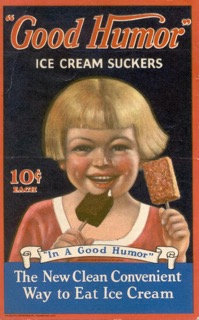
Burt advertised this new ice cream product as a “new clean convenient way to eat ice cream.” He called the new chocolate-coated ice cream bar, “Good Humor”, which refers to the belief that a person’s humor was related to a person’s sense of taste, or the “humor” of someone’s palate. Many of the advertisements for the ice cream car followed this slogan of it being a “clean convenient way to eat ice cream.”
Around the time that Burt invented the “Good Humor” ice cream bar, he wanted to expand his business and move locations once more. This was largely due to the demand for his goods, therefore he needed a bigger site for manufacturing his products including ice cream, candy, and baked goods. In October 1921, he acquired a building in the city’s commercial area on Federal Street. He had contracted with a construction company to renovate the entire building.
On January 30, 1922, Harry Burt applied for a patent for the machinery and process of making the “Good Humor” bar. On October 9, 1923, he received a patent for the process, but not for the product itself. It was not until he traveled to Washinton D.C. with samples of the bar that the patent was granted.
Through his patents, he not only claimed ownership over his own ice cream bar creation, but any frozen treat on a stick. He soon filed lawsuits against two of his competitors: the Citrus Products Company and the Popsicle Corporation. In an issue of The Ice Cream Review in June 1925, Burt stated “[It] is just as much an act of infringement to use a patented process as to make a patented product. The Burt patent is many months ahead of any other patent relating to frozen suckers. Our royalties are small, indeed far less than litigation would cost to be an infringer.” Many negotiations were had over time, but in the end, the lawsuits were dropped.
The Introduction of the Ice Cream Truck
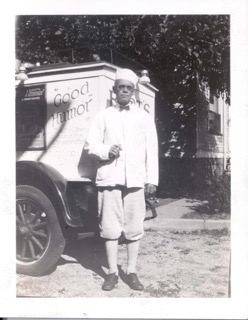
Burt wanted to create a standardized product and brand name that be recognizable by look and taste across all markets. He planned to use the same ingredients and through his manufacturers, would make the ice cream bar from uniform formulas and molds. His marketing not only came from the consistency and recognizablitly of the product, but his distribution or it. Burt purchased twelve refrigerator trucks to distribute the ice cream bars within neighborhoods, not just in his store. The truck drivers, who wore white uniforms, were often referred to as “chauffeurs.”
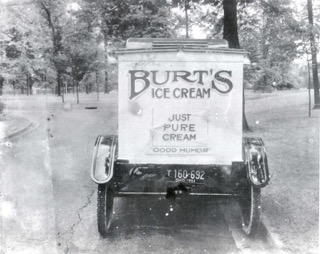
Between 1922 and 1926, the popularity of the Good Humor ice cream bar grew substantially with the two floavors of vanilla and chocolate. The availability of of his products also helped the growth of the business due to the new factory space and the fleet of ice cream trucks. He became the first ice cream vendor to use motorized trucks instead of pushcarts to roam and sell ice cream products. The signature truck not only gave the business more growth and freedom due to availability to people in neighborhoods, but also was more sanitary to previous methods of selling ice cream on the street. Many of the other methods at the time were often the source of food poisioning and had cheap ingredients and quality. The freezer trucks had a refrigeration unit making it much safer and reliable when it came to health concerns. Also, to show customers that there was no cause for concern regarding health and quality, every driver wore a white uniform, similar to those worn in hospitals to show cleanliness.
Conclusion
Harry Burt died in 1926, and his wife Cora took over the company and made it public. She eventually sold the business and the patents to Good Humor Corporation of America in 1928. The new owner she had sold it to, planned to advertise and market the “Good Humor Sucker” on a national scale. The Good Humor Bar and the “Good Humor Man” who drives the ice cream truck would become an iconic staple in marketing, being featured in books, comics, toys, and cartoons. Harry Burt not only had a legacy with his marketing and his innovations of the refrigerated trucks, but on the ice cream industry entirely.
In the Context of the 1920s
In 1919, the Volstead Act was passed, limiting the sale and distribution of alcohol throughout the 1920s. The movement had its origins with Evangelical Christians who felt that the move towards a more sober America was a move towards a more Christian America. The temperance and evangelical movements attempted, among other goals, to strengthen the family (The Modern Temper 226). While this time of prohibition greatly hurt the alcohol industry, it gave way to a rise in popularity in the ice cream industry. According to the U.S. Treasury Department, between 1919 and 1929, the federal tax revenues from alcohol decreased from about $365 million to less than $13 million. The cost of drinking had dramatically increased with the start of prohibition, which in turn went a long way in curbing its use. For example, since 1916 the cost of beer was up 600 percent, gin 520 percent, and whiskey 310 percent”, which is not a price many people were willing to pay when going out (The Modern Temper 233).
While the Volstead Act did work in lowering alcohol consumption by about 30 percent, many people did not have another option for going out drinking, but still had a need for a treat in place of alcohol. There was about a 40 percent growth in ice cream consumption between 1920 and 1929. Prior to prohibition, drinking establishments were social gathering places where people could meet. “As men sought alternatives to having a drink at the local saloon, many ate ice cream more often” (Chocolate, Strawberry, and Vanilla: A History of American Ice Cream, Anne Cooper Funderburg).
Many bars and saloons were converted to soda shops and ice cream parlors. Refrigerators were typically already present in the establishments and converting a tap beer system to a soda stream was not difficult or expensive. Locations began selling ice cream and more of these stores began to show up all over the country. Many of these locations became the new gathering spots for people to socialize and enjoy a sweet treat.
Along with needing alternatives, many groups and organizations that encouraged prohibition supported the industry for dairy products such as ice cream. The Anti-Saloon League, which was formed in 1893 in Ohio, was one of the most well known and influential groups to fight against alcohol and support prohibition. They were a powerful orangazation when it came to lobbying for prohibition. They used flyers, propaganda, and even yearbooks to demonstrate their purpose in limiting alcohol use and have an impact on the change of laws on local, state, and eventually national levels. Due to their influence in the passing of the Volstead Act, they actively supported the dairy industry and therefore the growth of the ice cream industry. In one of the organization’s yearbooks from 1921 it even states that “it is believed that this large increase in ice cream consumption was due in a large degree to the fact that men with a craving for stimulants turned readily to this refreshing and palatable food. The more ice cream that is used, the better it is for the consumers and the producers of milk.”
So while the intentions of this group, along with others were rooted in a change in ideas about the way people lived and acted, with some motivations that were religious or political, it stemmed further into other aspects of people’s lives that supported their goals.
Improvements in technology regarding refrigeration and innovations in ice cream production increased production and brought ice cream treats to a national market. Throughout the 1920s, people were creating their own ways to help make frozen ice cream treats that were less messy and more portable, and overall more accessible to the public with the decrease in alcohol consumption and the increase in ice cream consumption. Countertop freezers allowed to store large amounts of ice cream. However, the process of making it was often labor intensive, creating an incentive to come up with new methods of development. Clarence Vogt, an inventor from Louisville, Kentucky, made it possible to mass produce ice cream on an industrial scale when he created the first continuous process freezer to be used commercially. This opened up the opportunities not only for easier methods of creating ice cream, but also for the mass production of it.
This topic was chosen as not only is it interesting and fun to know the history of such a popular treat such as ice cream, but it is also very relevant in the context of the 1920s. While Prohibtion is a very well known event that is commonly studied, some of the effects of it are less discussed, such as the popularity it gave the ice cream business. The event of Harry Burt inventing the Good Humor bar and revoluntionizing the industry with his fleet of ice cream trucks had an impact not only in the 1920s, but for years to come through the 1960s. Advertisements for Ford trucks even referred to the Good Humor company in the 1950s as they were the trucks that Good Humor reliably used at the time.
Knocking the trend and growth of certain societal aspects and the role it had on other events is extremely important. While most people associate prohibition with activities such as bootlegging and a rise in organized crime, it also led into more positive effects such as this one. Since there is no doubt that the Good Humor bar and Burt’s business as a confectioner would have gained the popularity it did at the time without prohibition, people looking for an alternative to alcohol may change what many people know and that not every effect of the Volstead Act was negative and lead to violence or crime.
Bibliography
- Anne Cooper Funderburg. Chocolate, Strawberry, and Vanilla : A History of American Ice Cream. Bowling Green, Oh, Bowling Green State University Popular Press, 1995.
- “Image 1 of the Book of Ice-Cream,.” The Library of Congress, 2015, www.loc.gov/resource/gdcmassbookdig.bookoficecream00fisk/?st=pdf&pdfPage=292&r=-0.322%2C-0.082%2C1.644%2C1.644%2C0. Accessed 7 May 2025.
- Kelly, Kerry. “The Volstead Act.” National Archives, The U.S. National Archives and Records Administration, 24 Feb. 2017, www.archives.gov/education/lessons/volstead-act.
- “The Frozen Sucker War: Good Humor v. Popsicle.” National Archives, 15 Aug. 2016, www.archives.gov/publications/prologue/2005/spring/popsicle.
- “The Good Humor Story.” Mahoning Valley Historical Society, 3 Aug. 2012, mahoninghistory.org/tyler-history-center/the-good-humor-story/.
- Archives.gov, 2025, catalog.archives.gov/id/5916723. Accessed 7 May 2025.
- Society, Mahoning Valley Historical. “Time Capsule |Harry Burt’s Innovations – Mahoning Valley Historical Society.” Mahoninghistory.org, 29 June 2022, mahoninghistory.org/2022/06/29/time-capsule-july-1-2022harry-burts-innovations/.

Jordyn Baham is a senior at Ramapo College studying Photography with a minor in Museum and Exhibition Studies. She takes the Discovering Digital History class in Spring 2025.
