
The Life of Bessie Coleman
Bessie Coleman was a culmination of ‘firsts’ in one person. She was the first African American to be awarded an international pilot’s license, the first Black woman in the world to fly an airplane, and the first Native American to earn a pilot’s license and fly an airplane.1 She was also likely the first person in her family to attend college for a full semester, and was the key catalyst in helping her family of independent women find their own paths as they moved from Texas to Chicago. Beyond all of these individual achievements, she also served as an inspiration for future women and African Americans who would follow in her footsteps or be the ‘firsts’ of their own professions.
Early Life
Bessie Coleman was born on January 26, 1892 as Elizabeth Coleman. She grew up in Waxahachie, Texas, to a mom who was African-American and a dad who was part African-American and part Native American. In 1901, her father left for Oklahoma, also known as ‘Indian Territory’, in order to find more job opportunities. A few years later, her older brothers also left for Chicago, leaving Bessie as the oldest sibling to her three younger sisters. Even though she loved school and took advantage of the little opportunities presented to her in her one room, segregated schoolhouse, her childhood was filled with the king crop of the time, cotton. Each spring, Bessie’s school would close down for “cotton season” and Bessie, as soon as she was strong enough, had to go with her mother to pick cotton.2 From a young age, Bessie hated the restrictions placed upon her in the South, and would frequently ‘slack off’ during her time working in the fields. She continued her interrupted education, and saved enough money to attend one semester of college at the Oklahoma Colored Agricultural and Normal University. After one semester at the college, her money ran out and she had to go home. But, at 23 years old, having had enough of the segregation and limited opportunities in the South, she decided to join her brothers in Chicago.
Bessie Coleman, like many other Black Americans during the early 20th century, moved from the South to Chicago during the Great Migration. Searching for better job opportunities and an escape from the severity of the Jim Crow South, she was a part of the “burgeoning black population in northern cities [that] had led to the growth of a middle class which seemed to represent the potential of the race.” 3 Because so many Black people were moving from Southern cities to the North, they banded together in ethnic enclaves, similar to many other minority groups and immigrants. In these enclaves, they had better opportunities for work and social mobility than they had in the South with strict Jim Crow laws. Even though Black people in the North faced the same segregation that they faced in the South, the community they built in cities like Chicago and New York City allowed Black migrants the ability to obtain jobs they could not have in the South. This combination of community and pluralistic identity gave the opportunity for a certain level of social mobility that would have been unobtainable for them previously.
In Chicago, Bessie continued to dream of being something more than just a ‘common’ Black worker. Through her work as a manicurist, Bessie met many successful and influential people in Chicago’s Black community. These people further inspired her to want more for her future and her race. Although Chicago was segregated like the South, Bessie saw a flourishing Black community where people of her race could be successful. It was a combination of these successful people, as well as her brother’s experiences abroad, that convinced Bessie to pursue a future in aviation. After trying and failing to find someone to teach her how to fly, Bessie’s brother told her that “You n*gger women ain’t never goin’ to fly…not like those women I saw in France.”4 It was these harsh words from her brother which finally inspired her to go abroad—to France—to obtain her pilot’s license.
Aviation Career
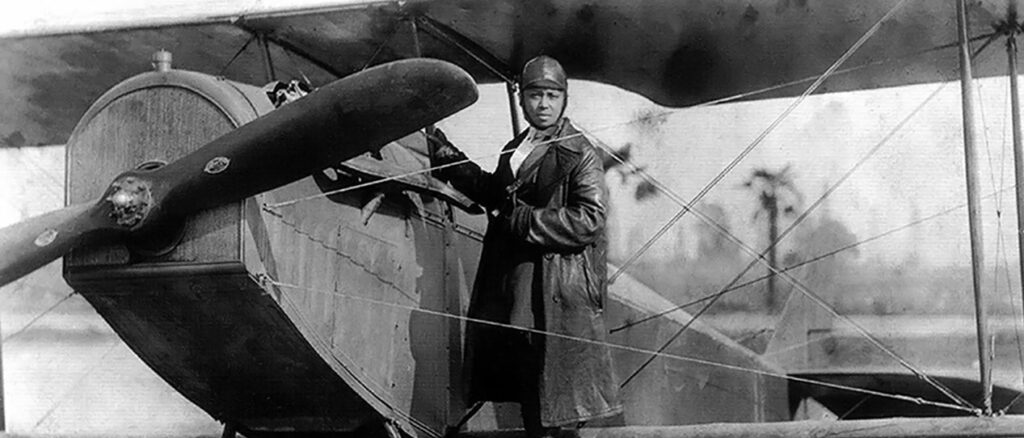
While I outline most of Bessie’s important aviation accomplishments in the timeline below, the start of her aviation career is also important. As Bessie tried to find a school or a pilot to teach her how to fly in America, Bessie was faced with two problems. First, no one wanted to teach a Black aviator, and second, no one wanted to teach a Black girl aviator. So, she turned her visions overseas, to the Ecole d’Aviation des Frères Caudron at Le Crotoy. During her time at Crotoy, she saw a student pilot die in a brutal plane accident, which she explains “was a terrible shock to my nerves, but I never lost them. I kept going.” 5 Bessie obtained her pilot license from the Fédération Aéronautique Internationale (FAI) despite the threat of discrimination, segregation, or death. At the time, the FAI was the only international organization giving people the right to fly anywhere in the world.6 So Bessie returned as an internationally recognized Black woman pilot. She was ready to show the country that anyone who put their mind to it could take to the sky.
As outlined in this timeline, Bessie performed a number of important entertaining shows. First, she performed the first air show performed by a Black woman. Next, she was the first person to offer plane rides to Black people in the South. In one of her shows, she was also the first person to have a Black woman parachutist jump from a plane. While Bessie was always passionate about aviation, her true passion was equality. She even left a movie planning to depict her life because they wanted to present her in “tattered clothing and with a walking stick and a pack on her back.” 7 She continued to emphasize the interconnectedness of her race and her success beyond leaving the racist movie set. She refused to perform at a show in her hometown where Black and White audience members would use segregated entrances. Once they agreed to let everyone use the same entrance, Bessie agreed to give the performance.8
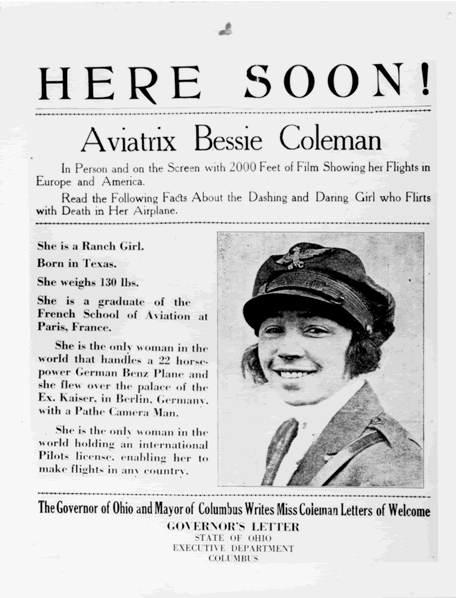
Bessie’s biggest hope for her aviation career was to raise funds in order to open a school to educate future Black pilots. Throughout her career, she dedicated many shows and lectures to fundraising for this cause. She even settled down in Orlando, opening up a beauty school and focusing on lecturing rather than performing stunt shows, to raise more money to create this school for future Black students. In the last weeks of her life, she found her benefactor in Edwin M. Beeman, son of Harry L. Beeman, the creator of Beeman chewing gum. At the same time, she was living with Viola and Hezakiah Keith Hill, who reintroduced her to religion, and encouraged her to stop performing stunt shows and focus on targeting church crowds for funding for her school. Before her final show, she told the Hills that “the time she had spent with them was the happiest she had ever known.” 9
Death
Just as her life was seeming to come together, with funding, found family, and a sense of happiness and religion, Bessie’s life came to a sudden end. Bessie had plans to perform on May 1, 1926, in a stunt show in the Negro Welfare League of Jacksonville’s Field Day. For this show, she was serving as the parachuter herself, with a white pilot, William D. Wills, flying the plane. She used the money from her benefactor Edwin M. Beeman to buy an old “Jenny” which she intended to fly at the Florida show. Wills flew the plane from Dallas, Texas, to Jacksonville and was forced to make two stops due to the poor condition of the plane. Despite the poor condition of the plane, Bessie met Wills and her agent and the promoter of her stunt show, John Betsch, at the field at 7:15am on April 30, to scout the area for where the best spot to jump would be. 10 She was not strapped into the plane, as she was actively searching for somewhere to jump. Suddenly, the plane went from cruising at 80 miles per hour to 110 miles per hour, and nose dived downwards. At 1,000 feet, the plane did a tail spin, and then at 500 feet, it flipped upside down, and Bessie fell out, somersaulting repeatedly until she hit the ground.11 Wills attempted to regain control of the plane, but it crashed into a nearby farm of Mrs. W. L. Meadows, killing him instantly. After the plane crashed in Meadows’ farm, Betsch, came with police to view the remains of the crash. Upon seeing the crash site, he lit a cigarette to calm his nerves. But, when lighting the cigarette, the lighter fluid mixed with the gasoline of the plane, setting everything on fire. He was immediately taken into custody under suspicions of trying to destroy evidence, but he was later released. After the tragic death and fire, the fair and dance in Bessie’s honor that were supposed to be held afterwards were replaced with a memorial service, which over 5,000 people attended.
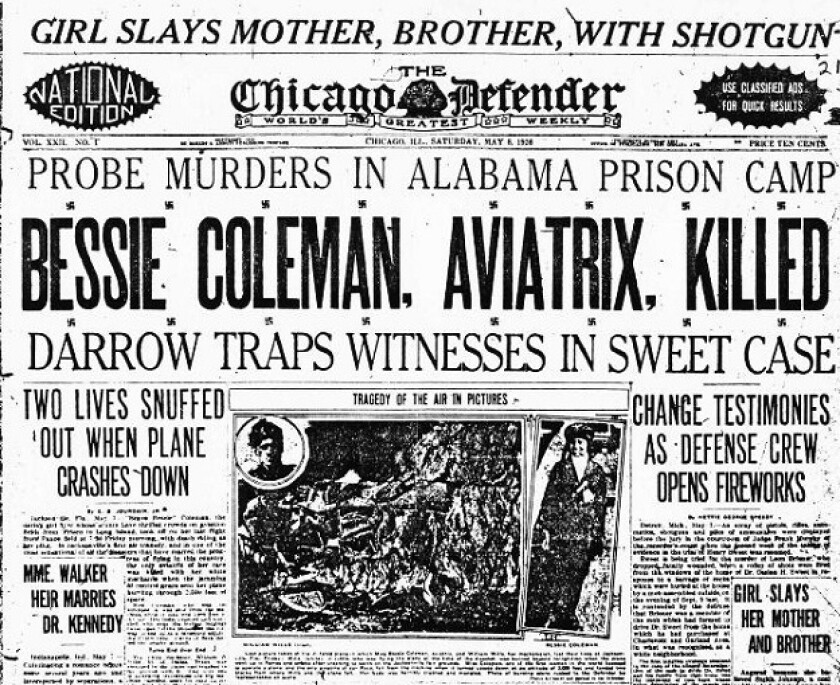
“Bessie Coleman, Aviatrix, Killed” The Chicago Defender, (Chicago, ILL), May 6, 1926, p.1
Aside from her memorial in Jacksonville, Bessie had another memorial in Orlando, organized by Viola and Hezekiah Hill. After this service, Viola Hill and a military escort traveled with her body to Chicago, where over 10,000 people went to pay their respects throughout May 5 and May 6. Her final service, for close friends and family, was held on Friday May 7, and though only 1,500 people could fit inside the church, another 3,500 stood outside on the street.12 The plethora of memorial services and viewing opportunities show just how much of an effect Bessie had on the Black community. Her death even received notice in white newspapers, such as The Morning Press, The Daily News, The Tampa Tribune, The Miami News-Record and many others. 13 While these newspapers had short descriptions and referred to Bessie as a ‘Negress’ or ‘Negro aviatrix,’ many Black newspapers dedicated columns, front pages, and entire sections to her, even days after her death. In the Pittsburgh Courier, a black newspaper, George S. Schuyler wrote a memorial to her, summing up Bessie’s hope for herself and her impression on the black community in a few sentences: “Bessie Coleman wanted to be an aviatrix and would not be frustrated by racial barriers. She succeeded in spite of them. More and more younger Negroes are following in her example. Many more ought to.” 14
Bessie’s Significance in the 1920s and Beyond
Growing up African-American in the early 20th century, Bessie Coleman was a prime example of the struggles of handling a pluralistic identity during the 1920s. As the first Black woman to fly an airplane and the first Black person to hold an international pilot’s license, Bessie Coleman strived to help improve the opinions of Black people in professional fields as she broke the glass ceiling in the aviation field. She had the similar mindset to other Civil Rights activists during the 1920s, which was that the issue of “twoness could be resolved–that they could be both American and black, without sacrificing either.”15 The struggle of handling pluralism and American identity was an obstacle in Bessie’s work as an aviator, but she also used her multiple identities of being Black and a woman to inspire future generations. The discrimination, segregation and limited attention to her achievements and her advancements in women’s working rights all connect Bessie to the larger struggles experienced by minority populations in the 1920s.
Combating Segregation
Bessie’s biggest focus in her aviation career was to establish a school to educate future Black pilots, because of the segregation and discrimination she faced when obtaining her education. Many times throughout her life, she was quoted as saying that “We must have aviators if we are to keep up with the times. I shall never be satisfied until we have men of the Race who can fly.” 16 She wanted others to follow in her footsteps, and show people who believed that African-Americans were not as smart as White Americans that they could succeed just as much when given the opportunity. Her willingness to branch out into a field severely underpopulated with both Black people and women helped inspire future aviators of her race to do the same: “Coleman’s return to the U.S. in 1921 as a fully qualified pilot helped African Americans reclaim some agency in aviation.” 17 Even though a very limited number of Black people had served as pilots in segregated forces in WWI, there was no space for them in the aviation field when they returned to the United States after the war. Further efforts, like refusing to perform at segregated shows in the South, shows her efforts throughout her career to improve the discrimination and segregation that she faced herself.
While Bessie was never able to open her school for Black pilots, she did inspire many future Black pilots with her resilience and determination despite the segregation she faced. Wiliam J. Powell, a famous Black aviator who founded the Bessie Coleman Aero Club in her honor, dedicated his book “Black Wings” to her.18 Powell, like Coleman, pushed for more Black aviators, and built a school for Black pilots and mechanics, as Bessie was unable to. Even though he created this school after her death, Bessie still had a profound impact on Powell and inspired him to continue her work in improving opportunities for Black Americans.
Paving the way for Future Minorities
Through Bessie’s hard work to become a pilot despite the discrimination she faced, she helped pave the way for future women and Black people in fields dominated by white men. In her article on the legacy of Bessie Coleman and Dr. Mae Jemison, Kim Creasman explains that “women like Bessie Coleman, the first African-American female pilot, have shown us that there are many qualified women in our society to take a chance to modify the stereotypes of women and African-Americans.” 19 Even in the present day, Bessie stands as an inspiration for people trying to get involved in fields that are historically exclusionary towards them. As the 1920s, especially in the South, were not only segregated but outright racist and exclusionary to Black professionals, Bessie’s success and mention in a multitude of White newspapers was “sure evidence of the revolutionary change, however slow, subtle, or imperceptible, she was effecting on white attitudes towards blacks, at least in her home state of Texas.” 20 Though the 1920s were still filled with discrimination and lack of opportunities for Black men and women alike, Bessie was one of the many cases of extraordinary women who succeeded despite the lack of opportunities for her, which inspired young minds in the 1920s and beyond.

While she may not have received recognition from white communities during her lifetime, Bessie was an inspiration to black communities and future black aviators alike, like Lieutenant William J Powell. Powell explains how Bessie inspired a future generation because of her willingness to break into a majority-white field: “Because of Bessie Coleman we have overcome that which was much worse than racial barriers. We have overcome the barriers within ourselves and dared to dream.” 21 Just like his Bessie Coleman Aero Club, many other organizations were created after her death to honor her and help financially support Black women and men who wanted to go into aviation or similar fields. Organizations like the Aviation Youth Empowerment Foundation have scholarships honoring Bessie Coleman, presented to women, Black Americans, future aviators and future STEM students who have overcome barriers to obtain their college degrees. In the years after her death, many roads were renamed in her honor. In 1996, the US Post office created a stamp in her honor, as a part of the Black Heritage Stamp Series, as seen to the right. Even though it took many years for Bessie’s death and accomplishments to be fully recognized by the American public, she served as an inspiration to Black Americans and women that they could pursue any career they wanted, as long as they put their mind to it.
Suggested Reading
Cline, P.E. “The Intersection of Race, Gender, and Socio-Economic Status in the Life of Bessie Coleman.” Collegiate Aviation Review International, 2019, 37(2), 133-156. Retrieved from http://ojs.library.okstate.edu/osu/index.php/CARI/article/view/7915/7308
Grossman, Ron. “That Road o’hare Is on? It’s Named for Bessie Coleman, Who 100 Years Ago Became the First Black Woman Pilot in America.” Chicago Tribune, November 24, 2021. https://www.chicagotribune.com/2021/11/24/that-road-ohare-is-on-its-named-for-bessie-coleman-who-100-years-ago-became-the-first-black-woman-pilot-in-america/.
Lebow, Eileen F. Before Amelia: Women Pilots in the Early Days of Aviation. (Washington, D.C.: Potomac Books, 2002).
Mathias, Marisa, and Mariana Brandman. “Biography: Bessie Coleman.” National Women’s History Museum. Accessed April 7, 2025. https://www.womenshistory.org/education-resources/biographies/bessie-coleman.
Bibliography
Bix, Amy Sue. “Beyond Amelia Earhart: Teaching about the History of Women Aviators.” OAH Magazine of History 24, no. 3 (2010): 39–44. http://www.jstor.org/stable/25701421.
“Crash Kills 2 Flyers” The Daily News, (New York, NY), May 1, 1926. p. 5
Creasman, Kim. “Black Birds in the Sky: The Legacies of Bessie Coleman and Dr. Mae Jemison.” The Journal of Negro History 82, no. 1 (1997): 158–68. https://doi.org/10.2307/2717501.
Dumenil, Lynn. The Modern Temper: American Culture and Society in the 1920s. United States: Hill and Wang, 2024.
“Man and Negress Killed in Accident Near Jacksonville” The Tampa Tribune, (Tampa, FL), May 1, 1926, p. 5
“Negro Aviatrix Killed When Plane Falls” Miami News-Record, (Miami, FL), April 30, 1926, p. 1
“Negro Woman Flier and Press Agent Die in Plane Fall” The Morning Press, (Santa Barbara, CA), May 1, 1926. p. 5
Powell, William J. Black Wings. HathiTrust. Originally published 1934. Accessed April 7, 2025. https://babel.hathitrust.org/cgi/pt?id=uc1.b4500439&seq=9&q1=bessie.
Rich, Doris L. Queen Bess: Daredevil Aviator. (Washington, D.C.: Smithsonian Institution Press, 1993.)
Schuyler, George S. “Views and Reviews” Pittsburgh Courier, (Pittsburgh, PA), May 15, 1926, p. 9
Slotnik, Daniel E. “Overlooked No More: Bessie Coleman, Pioneering African-American Aviatrix.” The New York Times, December 11, 2019.
- Daniel E. Slotnik “Overlooked No More: Bessie Coleman, Pioneering African-American Aviatrix.” The New York Times, December 11, 2019. ↩︎
- Rich, Doris L. Queen Bess: Daredevil Aviator. (Washington, D.C.: Smithsonian Institution Press, 1993,) 10. ↩︎
- Dumenil, Lynn. The Modern Temper: American Culture and Society in the 1920s. United States: Hill and Wang, 2024, 286. ↩︎
- Rich, Queen Bess, 1993, 27. ↩︎
- Rich, Queen Bess, 1993, 32. ↩︎
- Rich, Queen Bess, 1993, 34. ↩︎
- Rich, Queen Bess, 1993, 57. ↩︎
- Rich, Queen Bess, 1993, 95. ↩︎
- Rich, Queen Bess, 1993, 105. ↩︎
- Rich, Queen Bess, 1993, 109. ↩︎
- Rich, Queen Bess, 1993, 110. ↩︎
- Rich, Queen Bess, 1993, 113. ↩︎
- While a number of white newspapers reported on Coleman’s death, the ones mentioned here are; “Crash Kills 2 Flyers” The Daily News, (New York, NY), May 1, 1926. p. 5; “Man and Negress Killed in Accident Near Jacksonville” The Tampa Tribune, (Tampa, FL), May 1, 1926, p. 5; “Negro Aviatrix Killed When Plane Falls” Miami News-Record, (Miami, FL), April 30, 1926, p. 1; “Negro Woman Flier and Press Agent Die in Plane Fall” The Morning Press, (Santa Barbara, CA), May 1, 1926. p. 5 ↩︎
- Schuyler, George S. “Views and Reviews” Pittsburgh Courier, (Pittsburgh, PA), May 15, 1926, p. 9 ↩︎
- Dumenil, The Modern Temper, 2024, 294. ↩︎
- Rich, Queen Bess, 1993, 36. ↩︎
- Amy Sue Bix. “Beyond Amelia Earhart: Teaching about the History of Women Aviators.” OAH Magazine of History 24, no. 3 (2010): 41. ↩︎
- Powell, William J. Black Wings. HathiTrust. Originally published 1934. Accessed April 7, 2025, 1. ↩︎
- Kim Creasman. “Black Birds in the Sky: The Legacies of Bessie Coleman and Dr. Mae Jemison.” The Journal of Negro History 82, no. 1 (1997): 158. ↩︎
- Rich, Queen Bess, 1993, 87. ↩︎
- Powell, Black Wings, 1934. ↩︎

Hannah Steinlauf is a senior history major with a minor in museum and exhibition studies at Ramapo College. She is a student research aide for the Jane Addams Papers Project. She is a member of the Ramapo College Dance Company and Tri Sigma. Hannah is going to attend Trinity College Dublin for a masters degree in Public History after graduation.
