
On February 14, 1929, seven men associated with George “Bugs” Moran’s North Side Gang were executed by a group of men posing as police officers. It is widely believed that rival gang leader, Al Capone, orchestrated the hit as a means to to dominate the bootlegging competition. The incident is now commonly remembered as The St. Valentine’s Day Massacre. The massacre served as a prime example of the unintended consequences of Prohibition and the violent lawless culture that ensued as a result in the 1920s.1

The 18th Amendment established Prohibition in 1920. Groups such as the Women’s Christian Temperance Union and the Anti-Saloon League believed alcohol consumption was responsible for the social problems such as domestic violence, crime and poverty which caused them to contribute to the implementation of prohibition laws.2 Through a legal ban of the manufacture or sale of alcohol, many believed “prohibition would re-create a socially ordered community through the establishment of Protestant middle/class values.”3 Prohibition directly impacted the immigrant communities such as the Irish, Italians, and Germans as drinking was deeply ingrained in their culture and traditions. Native born Americans expected immigrants would “conform to the dominant English Protestant culture,” and prohibition attempted to legally enforce this conformity.4 Instead, the immigrant communities tended to oppose the prohibition which further exposed how the movement failed to unite the population through enforcement. Law enforcement often targeted immigrants as speakeasies and bootlegging operations were frequently associated with their neighborhoods. Prohibition’s restrictive laws fueled resentment and widened cultural divides, reinforcing nativist prejudices.5 Figures such as Al Capone and George Moran rose to prominence through these large smuggling and distribution operations which further established organized crime within immigrant communities.
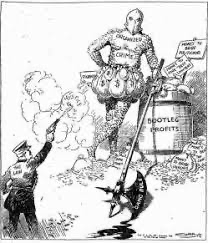
While many viewed Prohibition as a progressive step towards social order and homogeneity, instead it marked the rise of powerful organized crime groups who profited off the illegal liquor trade. These gangs acquired immense wealth and political influence through bribery and coercion; “there were fortunes to be made from the illicit trade, and prohibition agents were not up against individual law breakers, but faced well-organized and well-mannered gangs.”6 Law enforcement and the government were easily persuaded and often turned a blind eye to organized crime activities potentially out of fear or financial pressure. These tactics led to the increase in violence and corruption in both the political and social spheres. These factors created the environment of the St. Valentine’s Day Massacre and allowed organized crime to thrive.
The St. Valentine’s Day Massacre was not just an isolated event, but part of a broader pattern of increasing gang violence present in the 1920s. The massacre exposed the violent basis of organized crime competition and the limits of law enforcement in an era of mass corruption. This Massacre emphasized the tensions between rival gangs while fueling public outrage. It effectively demonstrated how prohibition failed as the movement promoted lawlessness and corruption rather than temperance. Ultimately, the increase in organized crime and violence exposed the failures of Prohibition and contributed to its eventual repeal in 1933.
Citations
Footnotes
- The Mob Museum in downtown Las vegas. Accessed April 2, 2025. https://themobmuseum.org/wp-content/uploads/2018/12/trio.jpg. ↩︎
- Lynn Dumenil, The Modern Temper: American Culture and Society in the 1920s, ed. Eric Foner (New York, NY: Hill and Wang, 1995), 229. ↩︎
- Dumenil, The Modern Temper, 228. ↩︎
- Dumenil, The Modern Temper,204. ↩︎
- Dumenil, The Modern Temper, 230. ↩︎
- Dumenil, The Modern Temper, 233. ↩︎
Bibliography
“Divisions.” Labor & Capital, America in the 1920s, Primary Sources for Teachers, America in Class, National Humanities Center. Accessed April 2, 2025. https://americainclass.org/sources/becomingmodern/divisions/text6/text6.htm.
McDonough, Daniel. “Chicago Press Treatment of the Gangster, 1924-1931.” Illinois Historical Journal 82, no. 1 (1989): 17–32. http://www.jstor.org/stable/40192250.
The Mob Museum in downtown Las vegas. Accessed April 2, 2025. https://themobmuseum.org/wp-content/uploads/2018/12/trio.jpg.

Erin Pryor is a History and Philosophy double major in the Honors Program, graduating with the Class of 2025. She is a writing consultant on campus at the Center for Reading and Writing. She is the president of Phi Alpha Theta history honors society and a member of Phi Alpha Delta pre-law fraternity.
