
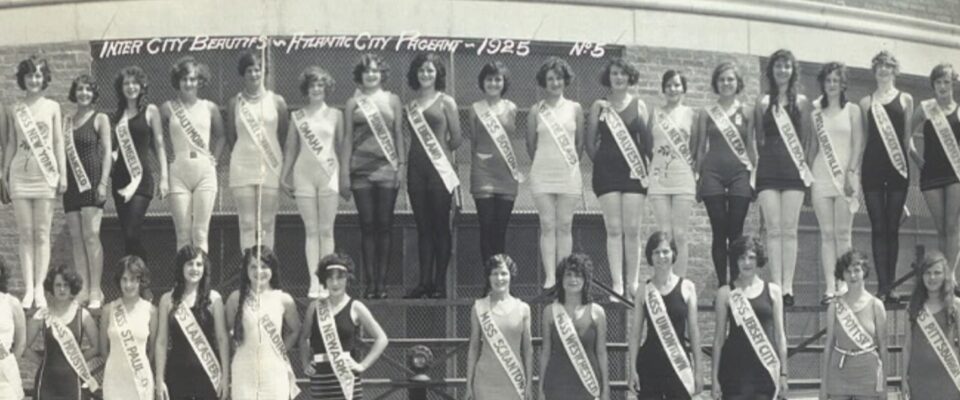

In the 1920s, American culture was increasingly becoming more secularized, creating tensions between modernity and traditional religious values. The first “Miss America” pageants embodied these conflicts, as it became both a target of religious resistance and a reflection of a callback to older ideas. Americans struggled to balance adapting to modernity while preserving their traditional beliefs and values. Religion was losing its influence on Americans with many standards straying away from the strictness of Victorian attitudes. Religion and Protestantism was no longer a dominant force in cultural norms and in efforts to maintain religion, urban churches started programs that created places of worship alongside spaces for social, recreational, and educational purposes. However, many religious leaders, including Protestant ministers and Jewish leaders, faced declining attendance and decreasing support for missionary efforts. These leaders viewed the popular culture of the 1920s, dominated by materialism and the pursuit of wealth, as a decline in religious values. Religious fundamentalists and Evangelical Christians also feared that the country was experiencing a moral and spiritual decline.1 The first “Miss America” pageants of the 1920s serve as an example of an event that religious groups sought to oppose through protests, aiming to dismantle what they considered a moral decline. The “Miss America” pageant included a bathing suit competition, which many religious groups opposed. They sought to combat the rise of swimwear in the 1920s, particularly for women, viewing it as immoral and immodest. Moral outrage from clergymen contributed to the censorship of physical appearances on public beaches, as they insisted that women cover their knees.2 This influenced the “Miss America” pageant because of its emphasis on “bathing beauties”. The pageant was met with further resistance with religious groups claiming it damaged the good choices, reputation, and morals of young women. Groups like Southern Baptists and the “Atlantic County Federation of Church Women”, joined in resistance and protest. Not only did they believe it damaged women’s morals, but they also viewed it as the exploitation of women for financial gain and corrupting them by encouraging rivalry among themselves.3 These protests are credited as having an important role in why the pageant was temporarily paused in 1928 through the early 30s.

Ironically, while traditional religious groups opposed the pageant for being “immoral”, it was an event that eagerly promoted a “traditional” and “conservative” idea of femininity. The “Miss America” pageant aimed to uphold the image of a more traditional woman, distancing itself from the “New Woman,” represented by women in politics and flappers. Before the “Miss America” pageant was established in 1921, suffragettes held suffrage pageants. They dressed up as influential women in history, seeking to raise public awareness and funds for their political efforts.4 However, the “Miss America” pageant focused only on beauty, based on what men and the audience viewed as beautiful. In addition, the pageant strived to distance itself from the flapper image. Flappers were young, single women who strayed away from Victorian constraints by wearing bobbed hair, shorter and less shaped skirts, darker makeup, and smoked. In contrast, the “Miss America” pageant praised “non threatening” women who had conservative hairstyles such as longer hair, were more subservient, viewed beauty as an important goal, and demonstrated capability of being a good wife, homemaker, and mother.5 Contestants who had longer hair were more often praised than those with bobbed or bobbed-like hair. It was an important characteristic for “Miss America” to have, especially in the earlier competitions. Pageant organizers also tried to portray the event as “above alcohol” or other habits such as smoking. Overall, the pageant wished to portray its winners as symbols of what a 1920s American woman “should be and look like”. While religious traditionalists viewed it as immoral, the pageant still sought to revive a more traditional ideal of Victorian-like femininity and virtue.
Bibliography
Dumenil, Lynn. The Modern Temper: American Culture and Society in the 1920s. New York: Hill and Wang, 1995.
Riverol, Armando. Live from Atlantic City: The History of the Miss America Pageant Before, After, and in Spite of Television. Bowling Green, OH: Bowling Green State University Popular Press, 1992.
Latham, Angela J. “Packaging Woman: The Concurrent Rise of Beauty Pageants, Public Bathing, and Other Performances of Female ‘Nudity.'” Journal of Popular Culture 29, no. 3 (1995): 149–67. https://doi.org/10.1111/j.0022-3840.1995.00149.x.
Watson, Elwood, and Darcy Martin. “The Miss America Pageant: Pluralism, Femininity, and Cinderella All in One.” Journal of Popular Culture 34, no. 1 (June 1, 2000): 105–26. doi:10.1111/j.0022-3840.2000.3401_105.x.
Watson, E., ed. “There She Is, Miss America”: The Politics of Sex, Beauty, and Race in America’s Most Famous Pageant. New York: Palgrave Macmillan, 2004.
Bettmann Archive. Policewomen Checking Length Violations. Chicago, Illinois, 1921.
Bettmann Archive. 1924 Miss America from Philadelphia, Pennsylvania, Ruth Malcomson. 1924.
Thomas, Bob. Cinema Personalities, 1923, American Actress Colleen Moore. Popperfoto/Getty Images, 1923.
Featured Photo: Atlantic Foto Service. Contestants of the 1925 Miss America Pageant. Atlantic City, New Jersey, 1925.
Citations
- Lynn Dumenil, The Modern Temper: American Culture and Society in the 1920s (New York: Hill and Wang, 1995), 169-186. ↩︎
- Angela J. Latham, “Packaging Woman: The Concurrent Rise of Beauty Pageants, Public Bathing, and Other Performances of Female ‘Nudity,’” Journal of Popular Culture 29, no. 3 (1995): 158, https://doi.org/10.1111/j.0022-3840.1995.00149.x. ↩︎
- Armando Riverol, Live from Atlantic City: The History of the Miss America Pageant Before, After, and in Spite of Television (Bowling Green, OH: Bowling Green State University Popular Press, 1992), 24. ↩︎
- Elwood Watson, ed., “There She Is, Miss America”: The Politics of Sex, Beauty, and Race in America’s Most Famous Pageant (New York: Palgrave Macmillan, 2004), 28-29. ↩︎
- Watson, “There She Is, Miss America”, 32. ↩︎

Grlynn is a Ramapo College senior majoring in history
