
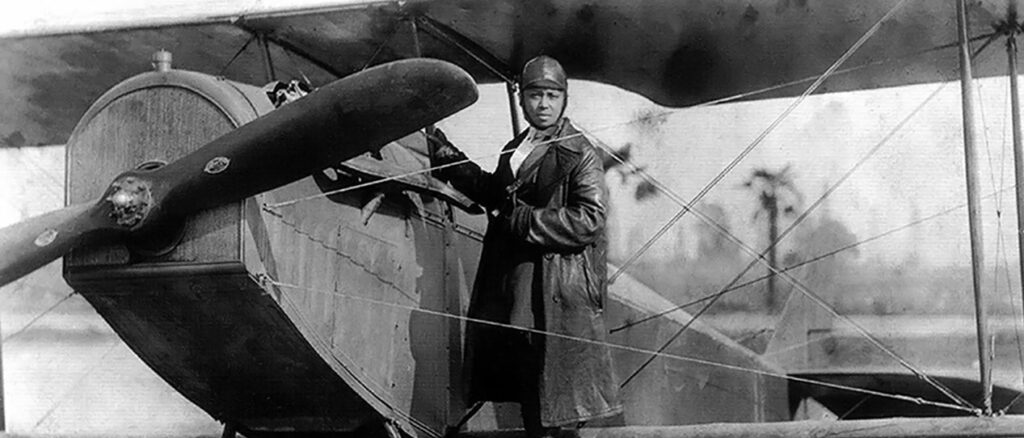
“Elizabeth “Bessie” Coleman poses with her airplane in 1922,” Times Union Archives (Florida).
Growing up as part Native American and part African-American in the early 20th century, Bessie Coleman was a prime example of the struggles of handling a pluralistic identity during the 1920s. During the 1920s, having multiple identities was difficult for people as the public was unable to see people’s multiple identities, like being both Black and American, or German and Jewish, or Chinese and a woman. As the first Black woman to fly an airplane and the first Black person to hold an international pilot’s license, Bessie Coleman strived to help improve the opinions of Black people in professional fields as she broke the glass ceiling in the aviation field.1 She had the similar mindset to other Civil Rights activists during the 1920s, which was that the issue of “twoness could be resolved–that they could be both American and black, without sacrificing either.”2 The struggle of handling pluralism and American identity was apparent throughout the entire decade, as people felt forced to choose between their two identities. But activists like Bessie Coleman fought to minimize that struggle for future generations.
Bessie Coleman, like many other Black Americans during the 1920s, moved from the South to Chicago during the Great Migration. Searching for better job opportunities and an escape from the severity of the Jim Crow South, she was a part of the “burgeoning black population in northern cities [that] had led to the growth of a middle class which seemed to represent the potential of the race.”3 Because so many Black people were moving from Southern cities to the North, they banded together in ethnic enclaves, similar to many other minority groups and immigrants. In these enclaves, they had better opportunities for work and for social mobility than they had in the South with strict Jim Crow laws. Even though Black people in the North faced the same segregation that they faced in the South, the community they built in cities like Chicago and New York City allowed Black migrants the ability to obtain jobs they could not have in the South. This combination of community and pluralistic identity gave the opportunity for a certain level of social mobility that would have been unobtainable for them previously.
Black professionals like Bessie Coleman with her national successes—even if she had to go overseas for her education—inspired other Black professionals to strive for the same level of recognition. Especially when supported by Black Newspapers like the Chicago Defender, which emphasized Black achievements, people within the community could read about others achievements, and recognize, in the words of W. E. B. Du Bois “that African Americans had the capabilities to be educated, and moreover, to be equal citizens.”4 Bessie promoted these same ideals; not only did she refuse to perform at shows where Black people were not allowed admission, but she also “was determined to bolster black pride. She was supported in this by a black press that seized on her image as both role model and grist for editorials promoting black equality.”5 The large number of Black Newspapers that arose during a time in which the Harlem Renaissance was booming and Black culture in general was receiving more recognition not just in black communities but in slowly in white communities as well, shows how there was a small change in beliefs in recognition that Black people could be successful in the arts as well.
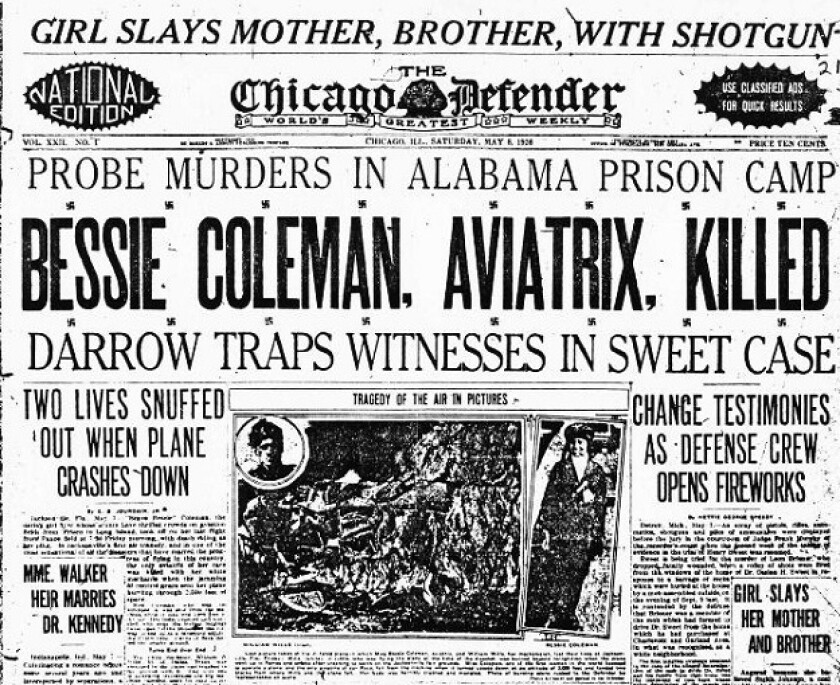
“Bessie Coleman, Aviatrix, Killed” The Chicago Defender, (Chicago, ILL), May 6, 1926, p.1
Bessie Coleman’s life and death fits into the broader historical context of the 1920s because even though she was an extremely successful Black woman, and her death was widely recognized in Black Newspapers, like this Chicago Defender article to the right, and it was generally ignored in White newspapers, or downplayed as the newspaper focused on the death of her younger, less advanced white co-pilot, William Wills.
Similar to other successful Black people during the 1920s, her achievements were not widely recognized until years after her death. And while she struggled to make a name for herself in the white, male-dominated field of aviation, she concurrently worked to ensure that Black patrons had a space at her shows. Bessie carefully balanced her two-fronted fight “in defense of equal rights for blacks in a white-dominated society and equal rights for black women in a male-dominated black society.”6 Similar to other activists during the 1920s like Ida B. Wells or W. E. B. Du Bois, Bessie had to juggle her pluralistic identities and her professional goals. Even though Bessie was a number of “firsts,” she was not the only Black person, or the only Black woman, who was pushing the boundaries during the 1920s and rising above the expectations society had for them. Just like other minorities in the 20th century, Bessie had to work harder than many other white people, and most of her accomplishments were not recognized until after her death. But, she helped pave the way for minorities in the years to follow.
Bibliography
Dumenil, Lynn. The Modern Temper: American Culture and Society in the 1920s. United States: Hill and Wang, 2024.
Rich, Doris L. 1993. Queen Bess: Daredevil Aviator. Smithsonian Institution Press (Washington, D.C.).
Slotnik, Daniel E. “Overlooked No More: Bessie Coleman, Pioneering African-American Aviatrix.” The New York Times, December 11, 2019. https://www.nytimes.com/2019/12/11/obituaries/bessie-coleman-overlooked.html.
- Slotnik, Daniel E. “Overlooked No More: Bessie Coleman, Pioneering African-American Aviatrix.” The New York Times, December 11, 2019. https://www.nytimes.com/2019/12/11/obituaries/bessie-coleman-overlooked.html. ↩︎
- Dumenil, Lynn. The Modern Temper: American Culture and Society in the 1920s. United States:
Hill and Wang, 2024, 294. ↩︎ - Dumenil, 286. ↩︎
- Dumenil, 289. ↩︎
- Rich, Doris L. 1993. Queen Bess: Daredevil Aviator. Smithsonian Institution Press, (Washington, D.C.), 60 ↩︎
- Rich, 60. ↩︎

Hannah Steinlauf is a senior history major with a minor in museum and exhibition studies at Ramapo College. She is a student research aide for the Jane Addams Papers Project. She is a member of the Ramapo College Dance Company and Tri Sigma. Hannah is going to attend Trinity College Dublin for a masters degree in Public History after graduation.
