
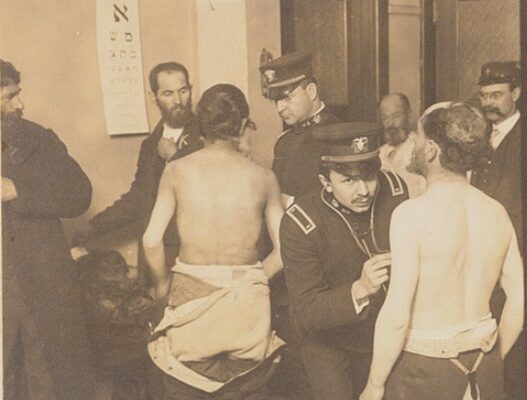
While an anti-immigrant strain ran through politics in the United States since the very founding of the republic, it was only after World War I and the Red Scare of 1919-1920 that nativists acquired enough clout to push through the quota acts of 1921 and 1924. An important element of the anti-immigrant crusade was the persistent association of immigrants with contagious disease, which served to increase anxiety about their bringing with them the unseen germs of deadly epidemics. Activists sent petitions to Congress calling for restrictions on immigration for public health reasons (Markel 1997, 85). As Markel writes, “Not only does the infectious disease become the ‘enemy’ but, so, too do the human beings (and their contacts) who have encountered the microbe in question” (Markel, 185). With the “Spanish Flu” pandemic of 1918 (Barry 2018), as well as smaller outbreaks of typhus in 1892 and 1921 (“Typhus and Immigration” 1892 and “Aliens Infested on Ellis Island” 1921), polio in 1916 (Kraut 1995, 66), and cholera in 1892 (Markel 26-27) still fresh in the minds of the public, nativists pressed for reductions in immigrant numbers, especially of Southern Italians and Eastern European Jews.
These newcomers seeking relief from poverty and persecution had arrived in larger numbers in the previous two decades, and immigration had begun to rise dramatically after the hiatus of World War I. The number of foreigners arriving in New York, for example, would double by the end of June 1921, from the previous fiscal year, increasing from 333,727 to 665,001 (Unrau, Historical Research Study II 1984, 626).
Exclusion of Immigrants with a “Loathsome or Dangerous Contagious Disease”
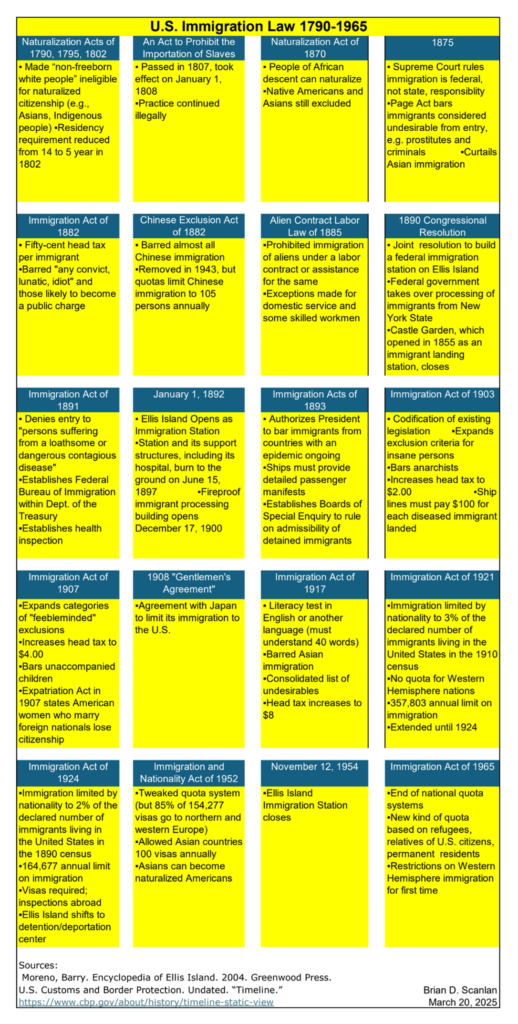
Against this backdrop, early in 1921 the House Committee on Immigration and Naturalization held an extraordinary hearing on the “Physical Examination of Immigrants” (Physical Examination of Immigrants 1921). Publisher, nativist and ardent eugenicist Albert Johnson (R-WA), who would go on to co-write the 1924 quota act, chaired the all-male committee. He invited Joseph Broadman, MD, who had written to him, to discuss his observations of the medical inspection of immigrants at Ellis Island. The Immigration Act of 1893 required the exclusion of immigrants having a “loathsome or dangerous contagious disease,” as well as the physically and mentally handicapped. The U.S. Public Health Service (USPS) physicians were tasked with inspecting immigrants and to identify and medically certify those with such conditions, and the Bureau of Immigration would then make the decision about exclusion in each case. At the port of New York, through which most migrants traveled, USPS doctors inspected steerage class passengers on Ellis Island. Those traveling first and second class were given a cursory inspection on ship and only those sick or with noticeable defects were sent to Ellis Island for follow-up (Moreno 2004, xiii).
The 1921 hearing focused on venereal disease. While the word “loathsome” was not used, of course, in medical diagnosis, certainly “loathsome” (not to mention “dangerous” and “contagious”) fit the bill when discussing venereal disease. Perhaps only leprosy elicits the same sort of public recoil as both are debilitating and disfiguring. Moreover, syphilis can end in insanity. Broadman, editor of “The Modern Health Advocate” magazine, testified about the “lack of precaution” being taken “to prevent the constant and ever-increasing influx of venereal disease into this country” (Physical Examination of Immigrants 3). Being at the intersection of anxiety about both immigration and the loosening of sexual mores at the time, Broadman’s statements at the hearing clearly struck a nerve.
Changes in Women’s Roles in the 1920s
Beginning earlier in the twentieth century and escalating in the 1920s, there were unsettling changes in women’s roles, especially as they became more independent working outside the home. Working-class women sought respite from tedious jobs demanding long hours and found it in unchaperoned visits to amusement parks, dance halls, and cinemas (Dumenil 1995, 131). Many of these women were daughters of immigrants, if not immigrants themselves. A general increase in awareness of women’s sexuality, coupled with the opportunity (including especially the use of the automobile) led to more sexual experimentation (Dumenil 131). Indeed, Broadman’s publishing company, the Physical Culture Corporation, sought to capitalize on these trends, publishing “Intimate Health Talks,” a magazine whose titillating title belied its discussions of proper sexual hygiene (“Intimate Health Talks” 1922, 131). That the hearing focused on venereal disease put it at the nexus of fear about the so-called dilution of white Anglo-Saxon vitality (Immigration and Other Interests of Prescott Farnsworth Hall 1922, 33)[1], unease about the economic and sexual agency of women, fear of deadly disease brought by immigrants, and revulsion of sexually transmitted infections. Indeed, having syphilis or gonorrhea was viewed more as a moral failing than it was a medical condition.
Broadman’s appearance at the hearing may have been a publicity stunt to promote his publications. He criticized the process on Ellis Island as too focused on excluding those with obvious diseases or mental disabilities and not enough on venereal disease. He declared that gonorrhea was “next to measles in frequency” and cited research that 50-60% of adult males in the United States were infected. Broadman stated that “Syphilis and gonorrhea are among the most wide spread of all infectious diseases. Their victims are numbered in many millions, not in hundreds. Not a man or woman lives who does not touch elbows with them daily; whose house has not seen their entry and departure and who may not at any time themselves become afflicted” (Physical Examination 6).
Is Venereal Disease More Prevalent Among Immigrants?
After claiming that venereal diseases could be contracted from toilet seats, or even from a glass of water handed to you by waiter in a restaurant (Physical Examination 6-8), there was this exchange between Broadman and Congressman Harold Knutson (R-MN), who was himself an immigrant from Scandinavia:
Broadman: “…it is found that the better educated people do not have venereal diseases to the same extent that the poorer classes have.”
Knutson: “Isn’t it found more prevalent among the Mediterranean people than among the people of northern Europe?”
Broadman: “Venereal diseases are more prevalent in those countries” (Physical Examination 10).
The testimony underscores the broad medical and public acceptance of the germ theory of the disease, with little understanding or consideration of the theory’s limitations.
The second person to testify at the hearing was Assistant Surgeon General R.H. Creel, who had served on Ellis Island and defended the inspection process of the USPHS. Creel stated that even eliminating every case of immigrant venereal disease, there would still be “two to three million” cases in the country (of a population of about 108 million in 1921). Creel asked if it was worth spending the money ($600,000 for an additional 200 doctors annually), when venereal diseases would not be eliminated, nor even marginally reduced (Physical Examination 15).
Creel cited several studies, including one by the New York City Draft Board, which found only a 2.4% rate of venereal disease among draftees and an Ellis Island study showing the rate among seamen as less than 3%. When Congressman John E. Raker (D-CA) asked Creel about the number of venereal disease cases detected at Ellis Island, Creel apparently provided instead the figures for all immigration to the United States: in the fiscal year ending June 30, 1920, there were 3,869 cases of venereal disease out of a total of 1,537,527 immigrants and seamen examined (.25%, or one-quarter of 1%). Some of these were discovered by ship doctors who reported them to immigration authorities in port. The actual figures for Ellis Island for the fiscal year ending June 30, 1920 were that of 333,727 aliens and 27,341 crew examined, the rates of venereal disease were .04% and 2.21% respectively (Annual Report of the Surgeon-General 1920, 186, 190).
Congressman Riley J. Wilson (D-LA) pressed Creel on what percent of cases would be discovered “if we had proper examination.” Creel believed that “no more than” 1% of immigrants had venereal diseases (Physical Examination 14-16), an estimate he would later lower. Ironically, some of those with venereal diseases were permitted to undergo treatment in a hospital and allowed to enter if cured. The expense of treatment was, by law, paid for by the steamship lines, which were required to do their own inspections to weed out such cases before leaving the port of departure.
USPHS Estimates Venereal Disease Among Immigrants at One-Fifth of One Percent
Creel also referenced an investigation prompted by New York Commissioner William Williams in 1903-1904. For one week, physicians took unmarried male arrivals to a separate examination room and had them strip en masse. They found one case of swollen glands in the groin (a sign of venereal disease or a skin infection) and one case of gonorrhea. Moreover, of the 3,427 aliens sent to Ellis Island Hospital for observation or treatment that fiscal year, only two were found to have syphilis, hardly an epidemic (Annual Report of the Surgeon-General 1904, 194).
Midway through Creel’s testimony, Raker accused Creel of not supporting thorough examinations of all immigrants “because if the immigrants were not permitted to come ashore it would interfere with business and commercial interests.” Creel took great exception to Raker’s comment, as USPHS physicians prided themselves, as a uniformed, commissioned service (much like members of the military), on remaining apolitical and focused on the practice of medicine in a scientific fashion. Creel’s argument was simply that he believed it would not be worth the expense of increasing the number of doctors as well as the space at Ellis Island to thoroughly examine every immigrant, and that ship congestion in the port might result, which “would come right down of the head of the Surgeon General” (Physical Examination 17). Throughout the hearing, there was no discussion at all about how immigrants—most of whom had their initial impressions of American government at Ellis Island and would eventually become citizens–reacted to such invasive examination.
The day after the hearing, Creel wrote to the Committee to augment his testimony. He stated that in 1915, because of greatly reduced immigration owing to the war, “opportunity presented for intensive examination of a considerable number of arriving aliens.” One group of 11,794 immigrants “were striped of clothing and given a thorough examination in a private room.” Comparing this group to those undergoing a more cursory, standard traditional examination, the PHS found that there was “practically no difference” regarding the detection of “dangerous contagious diseases.” Of the 11,794 intensively examined, the data showed only 37, about three-tenths of one percent, had any dangerous contagious disease. Creel lowered his estimate of immigrant venereal disease from the one percent he stated at the hearing to one-fifth of one percent (Physical Examination 26).
1921 Quota Act Passes Just Five Months Later
It’s likely that Committee Chair Johnson had no intention to consider intensifying the medical examination at Ellis Island or any of the other ports of entry. That venereal disease among immigrants was hardly a raging contagion or, in fact, that the rate of infection was actually lower than the existing US population, did not matter. They would reduce the “import” of what tiny amount of venereal disease there was arriving by reducing immigration, and they would do so primarily by restricting it from Eastern and Southern Europe. The 1921 Quota Act, passed overwhelmingly just five months later, limited by nationality immigrants by country to 3% of the declared number of foreign-born living in the United States in the 1910 census, and the total number of immigrants to 355,000 per year (Unrau, Historical Research Study I 1984, 113). The 1924 act would require the use of visas and passports and that immigrants first be processed at overseas consulates (Moreno xviii).
The 1921 act was reauthorized twice to keep it in place for the next two years, but it was deemed insufficient. In 1924, Congress would pass and Calvin Coolidge would sign the most far-reaching immigration restriction law in the nation’s history. The Johnson-Reed Act limited by nationality immigrants by country to 2% of the declared number of foreign-born living in the United States in the 1890 census, and the total number of immigrants to just 164,667 per year. Countries in northern and western Europe received 85.6% of the quotas, while just 12.4% were allotted to southern and eastern Europe. These restrictions would remain in place until 1965 (Moreno 116) and essentially changed the function of Ellis Island from an immigrant processing facility to a deportation center.
The attachment of contagious disease to immigrants did not dissipate with the dramatic reduction in newcomer numbers. As Markel and Stern write, “…the social perception of the threat of the infected immigrant was typically far greater than the actual danger. Indeed, the number of ‘diseased’ immigrants has always been infinitesimal when
compared with the number of newcomers admitted to this country” (Markel and Stern 2002, 758). In the early 1990s, Haitian immigrants were accused of bringing AIDS into the country and were required to undergo blood tests (Kraut 1994, 1-2). Policies of both the Trump and Biden administrations used COVID as a reason to restrict immigration not just from China, where COVID first surfaced, but at the US southern border as well.
In September 2023, presidential candidate Donald Trump declared claimed that illegal immigrants were “poisoning the blood of our country,” a charge that effectively combines the argument of the “dilution” of the hearty American stock of 100 years prior with the fear that immigrants were bringing epidemics. “It’s so bad, and people are coming in with disease. People are coming in with… with every possible thing that you can have,” he said. In May 2024, as the Presidential election moved into full swing, Trump combined the dread of disease with anxiety of terrorism: “Many, many terrorists are coming in, and people are coming in with very contagious disease…. You know, like it’s all of a sudden you see there’s a run on tuberculosis. There’s a run on things that we haven’t talked about for years in this country” (Trayler, “Trump Says” 2024). It wouldn’t be until 2025 that Trump would appointment an anti-vaccine activist as secretary of the U.S. Department of Health and Human Services and that the country would witness not an epidemic of venereal disease among immigrants but the outbreak of measles, whose victims are mostly the native-born living in insular communities (“Texas measles outbreak” 2025).
Bibliography
“Aliens Infested on Ellis Island.” 1921. The New York Times. February 19.
Annual Report of the Surgeon-General of the Public Health and Marine-Hospital Service of the United States for the Fiscal Year 1904. 1904. Government Printing Office.
Annual Report of the Surgeon General of the Public Health Service of the United States for the Fiscal Year 1920. 1920. Government Printing Office.
Barry, John M. 2018. The Great Influenza: The Story of the Deadliest Pandemic in History. Penguin Books.
Dumenil, Lynn. 1995. The Modern Temper: American Culture and Society in the 1920s. Hill and Wang.
Immigration and Other Interests of Prescott Farnsworth Hall. 1922. Compiled by Mrs. Prescott F. Hall. The Knickerbocker Press.
https://ia601308.us.archive.org/21/items/cu31924064104254/cu31924064104254.pdf
“Intimate Health Talks.” [Advertisement.] 1922. Physical Culture. July.
Kraut, Alan M. 1994. Silent Travelers: Germs, Genes, and the “Immigrant Menace.” Basic Books.
Kraut, Alan M. 1995. “Plagues and Prejudice: Nativism’s Construction of Disease in Nineteenth- and Twentieth-Century New York City.” In Hives of Sickness: Public Health and Epidemics in New York City, edited by David Rossner. Rutgers University Press.
Markel, Howard. 1997. Quarantine! East European Jewish Immigrants and the New York City Epidemics of 1892. The Johns Hopkins University Press.
Markel H, Stern AM. 2002. The foreignness of germs: the persistent association of immigrants and disease in American society. Milbank Q 80(4): 757-88.
https://pubmed.ncbi.nlm.nih.gov/12532646
Moreno, Barry. 2004. Encyclopedia of Ellis Island. Greenwood Press.
Physical Examination of Immigrants: Hearings Before the Committee on Immigration and Naturalization. 1921. House of Representatives, Sixty-Sixth Congress, Third Session. Government Printing Office.
https://www.google.com/books/edition/Physical_Examination_of_Immigrants/dXWqbRfc_okC?hl=en
“Texas measles outbreak draws attention to traditionalist Mennonite community.”
Anabaptist World. March 14, 2025.
Traylor, Jake. (2024). “Trump says people crossing the border bring ‘very contagious disease’ with them.” May 22, 2024.
Accessed March 7, 2025
“Typhus and Immigration.” 1892. New York Times. February 13.
Unrau, Harlan D. 1984. Historical Research Study (Historical Component): Ellis Island Statue of Liberty National Historic Monument New York – New Jersey Volume I. U. S. Department of the Interior/National Park Service.
https://www.nps.gov/parkhistory/online_books/stli1/hrs1.pdf
Unrau, Harlan D. 1984. Historical Research Study (Historical Component): Ellis Island Statue of Liberty National Historic Monument New York – New Jersey Volume II. U. S. Department of the Interior/National Park Service.
https://www.nps.gov/parkhistory/online_books/stli1/hrs2.pdf
Resources
Resources listed below were freely accessible at the links shown on March 19, 2025.
A transcript of the 1921 hearing is here:
Physical Examination of Immigrants: Hearings Before the Committee on Immigration and Naturalization. 1921. House of Representatives, Sixty-Sixth Congress, Third Session. Government Printing Office.
Markel H, Stern AM. 2002. The foreignness of germs: the persistent association of immigrants and disease in American society. Milbank Q. 80(4):757-88.
https://pubmed.ncbi.nlm.nih.gov/12532646
This article is a good overview of the perception of immigrants and disease.
Federal historian Harlan D. Unrau wrote this general, three-volume history of Ellis Island:
Unrau, Harlan D. 1984. Historical Research Study (Historical Component): Ellis Island Statue of Liberty National Historic Monument New York – New Jersey Volume I. U. S. Department of the Interior/National Park Service.
https://www.nps.gov/parkhistory/online_books/stli1/hrs1.pdf
Unrau, Harlan D. 1984. Historical Research Study (Historical Component): Ellis Island Statue of Liberty National Historic Monument New York – New Jersey Volume II. U. S. Department of the Interior/National Park Service.
https://www.nps.gov/parkhistory/online_books/stli1/hrs2.pdf
Unrau, Harlan D. 1984. Historical Research Study (Historical Component): Ellis Island Statue of Liberty National Historic Monument New York – New Jersey Volume III. U. S. Department of the Interior/National Park Service.
https://www.nps.gov/parkhistory/online_books/stli1/hrs3.pdf
[1] Hall, co-founder and secretary of the Immigration Restriction League, was enamored of English mathematician and eugenicist Karl Pearson, and a statement attributed to him: “You cannot change the leopard’s spots, and you cannot change bad stock to good; you may dilute it, possibly spread it over a large area, spoiling good stock, but until it ceases to multiply it will not cease to be.”

Brian Scanlan is a former publishing executive with an interests in the history of the immigration and medicine. He has a B.A. in history from Rutgers University.
- 1Hall, co-founder and secretary of the Immigration Restriction League, was enamored of English mathematician and eugenicist Karl Pearson, and a statement attributed to him: "You cannot change the leopard's spots, and you cannot change bad stock to good; you may dilute it, possibly spread it over a large area, spoiling good stock, but until it ceases to multiply it will not cease to be."
