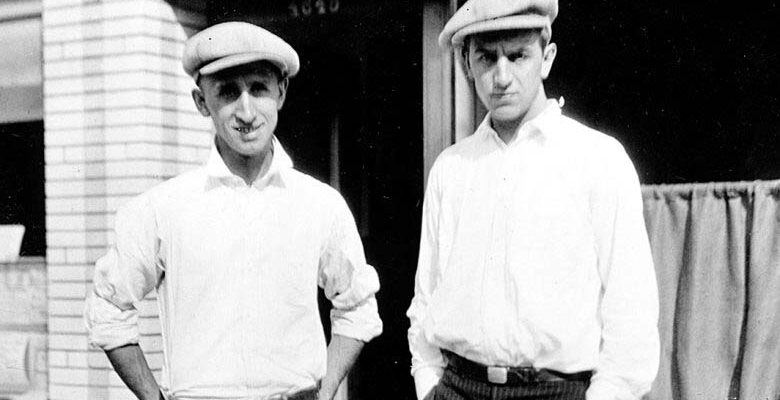
While most people associate the beginnings of Disney with cartoons such as Steamboat Willie, the journey of the studio actually began over 5 years prior to the creation of Mickey Mouse in 1928. It is well known of the founding date of the Disney Brothers Studio on October 16, 1923, but if any person were asked about it, the details of it event and what occurred would be lost. Not only that, but this event’s relation to the entertainment industry in the 1920s plays an important role in the growth of the Disney company far into the future. From technological advancements by combining cartoons and live-action film, the optimism and drive to follow any opportunity that came about, and social details regarding who would be working in the industry at the time, the founding of the Disney company gives more insight into the 1920s than many are aware. Starting in 1923, the road to Disney’s success was just beginning. In the midst of the 1920s with increased production and growth in the entertainment industry, it was almost too perfect of a time for Walt and Roy Disney to start their own studio that would become beloved for years to come.
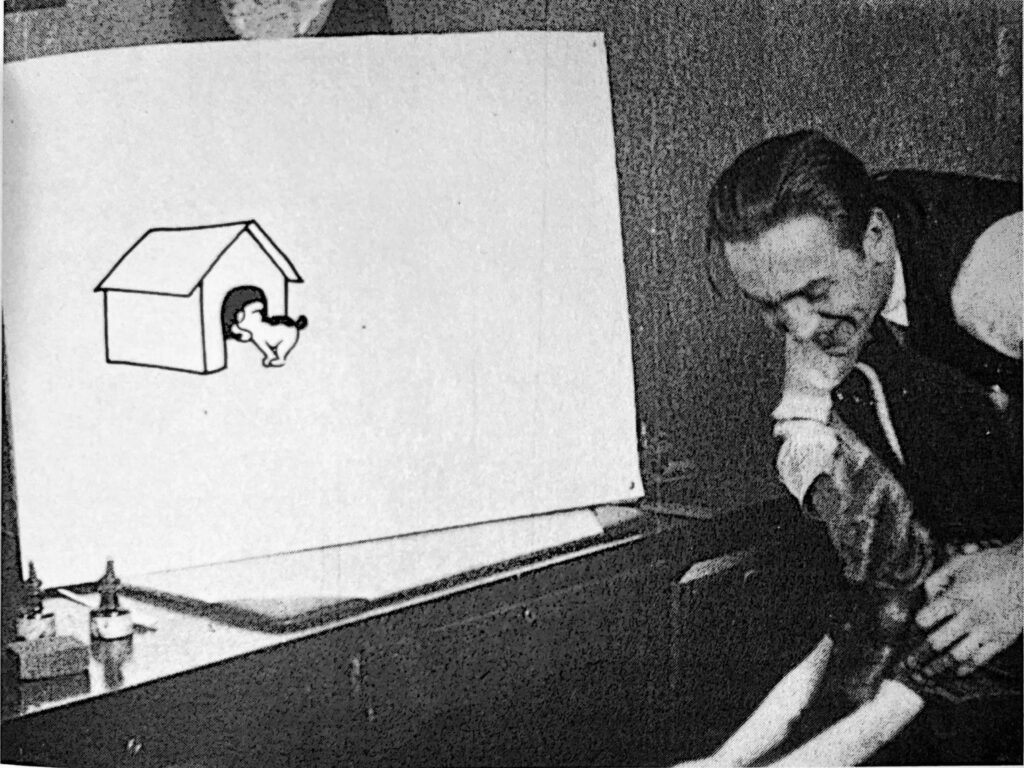
Twenty-one year old Walt and four-year old Virginia Davis in a scene from Alice’s Wonderland in 1923.
While Walt Disney started out by being contracted by others to make cartoons in Kansas City, he was thinking bigger with directing, writing, and animating his own series. On April 13, 1923, Disney signed a contract with four year old Virginia Davis’s parents to appear in his new series Alice’s Comedies. She starred in ads as a model, and after Walt saw one of those ads in a theater, he realized he found the lead actress for his series. His original company that was producing the Alice series, Laugh-O-gram, was beginning to collapse and lose money. With hope that the Alice Comedies would give him the fortune to continue, he began reaching out to various distributors. One of these distributors he wrote to about Alice on May 14, was Margaret J. Winkler, a distributor in New York:
“We have just discovered something new and clever in animated cartoons! The first subject of this distinctly different series is now in production, and will require a few more weeks more for completion. It is a new idea that will appeal to all classes, and is bound to be a winner, because it is a clever combination of live characters and cartoons, not like “Out of the Inkwell” or Earl Hurd’s, but of an entirely different nature, using a cast of live child actors who carry on their action on cartoon scenes with cartoon characters. These new subjects will be a full reel in length, and can be released in regular intervals of two weeks or a month. However, before you go any further into the matter, we desire that you see some of our former work, so you may appreciate the quality the same. We ask that you get in touch with Mr. W.R. Kelly, of Pictorial Clubs Inc., 350 Madison Ave., New York City, and he will gladly screen several of our [Laugh-O-gram fairy tale] subjects for you. We will not try to explain to tell you any more about this new idea; instead, we will send you a print upon completion of the first one, if you so desire.” (Letter from Walt Disney to M.J. Winkler, from Walt Before Mickey, Disney’s Early Years 1919-1928, Timothy S. Susanin)
Margaret J. Winkler, played a key role in the foundation of the Disney company. She started her own company at 26, becoming established in the animation industry and one of very few female film distributors. Winkler handled press releases, promotional campaigns, advertising, and distributing animations. She was an important figure in animation history as the first woman to produce and distribute films.
Despite her initial interest in the animation, Walt pulled back, having not completed the series to send out, and his company struggled even further until it was eventually bankrupt. Nonetheless, the film was completed and ran for twelve minutes and twenty-five seconds.
However, even after completing the film with Virginia Davis, many of the deals and work he was getting kept falling through. It seemed to prove that all the opportunities in Kansas City were exhausted. Even his brother Roy suggested that he move to Los Angeles, and in the summer of 1923, Disney decided to go to Hollywood when he was just twenty-two years old.
Los Angeles
Walt was satisfied with his decision to move to Los Angeles stating that “the pull toward Hollywood became strong. Animation was big there, and if [he] couldn’t be successful at that, [he] wanted to be a director or a writer.”1 L.A. was an obvious choice for opportunities in film and animation as it quickly became the film capital in the United States. After arriving in L.A., Walt did not have his own place to stay and work on his animations. He instead moved in with his uncle, Robert Disney.
By October 8 however, Walt realized that working in his uncle’s garage was not sustainable for the future, so he rented a space in the back of McRae and Abernathy, a real estate company on 4651 Kingswell Ave. He paid $10 a month in rent for what was his makeshift studio. It was only a few blocks away from his uncle’s house and was near a major area of Hollywood that was home to many film companies. This is the location that would be the start of the company.Walt was already corresponding with Margaret Winkler months prior regarding selling her the idea of the Alice Comedies series while he was still in Kansas City. In a letter to her written on August 25, Walt Disney wrote
“In the past, all cartoons combining live characters have been produced in an amateur manner with cartoonists doing the acting, photographing, etc. It is my intention to employ only trained and experienced people for my casts and staff that I may inject quality humor, photography, and detail into these comedies. I would appreciate an interview with your representative here that I may screen several comedies and explain my new idea.” (Letter from Walt Disney to M.J. Winkler, from Walt Before Mickey, Disney’s Early Years 1919-1928, Timothy S. Susanin)
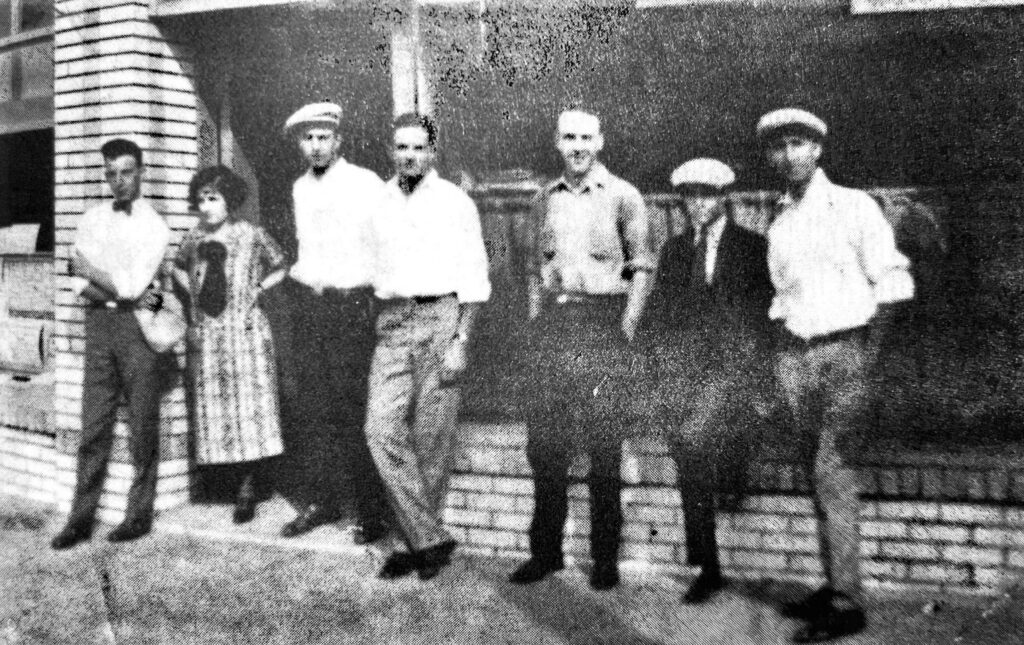
The Staff of Disney Brothers Studio, taken outside the Kingswell Avenue location.
After further negotiation and her seeing his work on Alice, she sent a telegram to Walt on October 15, saying “If your comedies are what you say they are and what I think they should be, we can do business.” 2 Along with this response she offered $1,500 for the first six reels and $1,800 for the second six reels for a total of twelve Alice cartoons that Walt would allow Winkler to distribute.
Walt almost immediately accepted this deal, even reaching out to Margaret Davis, the mother of Virginia Davis, to star her in the series and that it would be an opportunity for her to work in Hollywood. He offered her a one-year contract, one in which she accepted very promptly as she planned to go to Hollywood in the first place for more opportunities for Virginia. The first short produced in Los Angeles was Alice’s Day at Sea in November, shortly after Virginia Davis and her parents made the move to California in 1923.
While his brother Roy did not know anything about the motion picture business according to Walt, they went into a partnership anyway to fill Winkler’s order for the cartoons. They agreed to a 50-50 split with Walt doing the artwork and Roy acting as the business manager. It was on October 16, 1923 that officially became the start date of the Disney company, which was originally named the Disney Brothers Studio. They lacked financing, but they had a series of cartoons that was successfully in the works and an employee, Kathleen G Dollard, hired to ink and paint the cartoon. Walt claimed that with the creation and operation of the Disney Brothers Studio, he and Roy “established the first animated cartoon in Hollywood”. Being optimistic about this new business venture, Walt even told his father that he would “make the name Disney famous around the world.”3
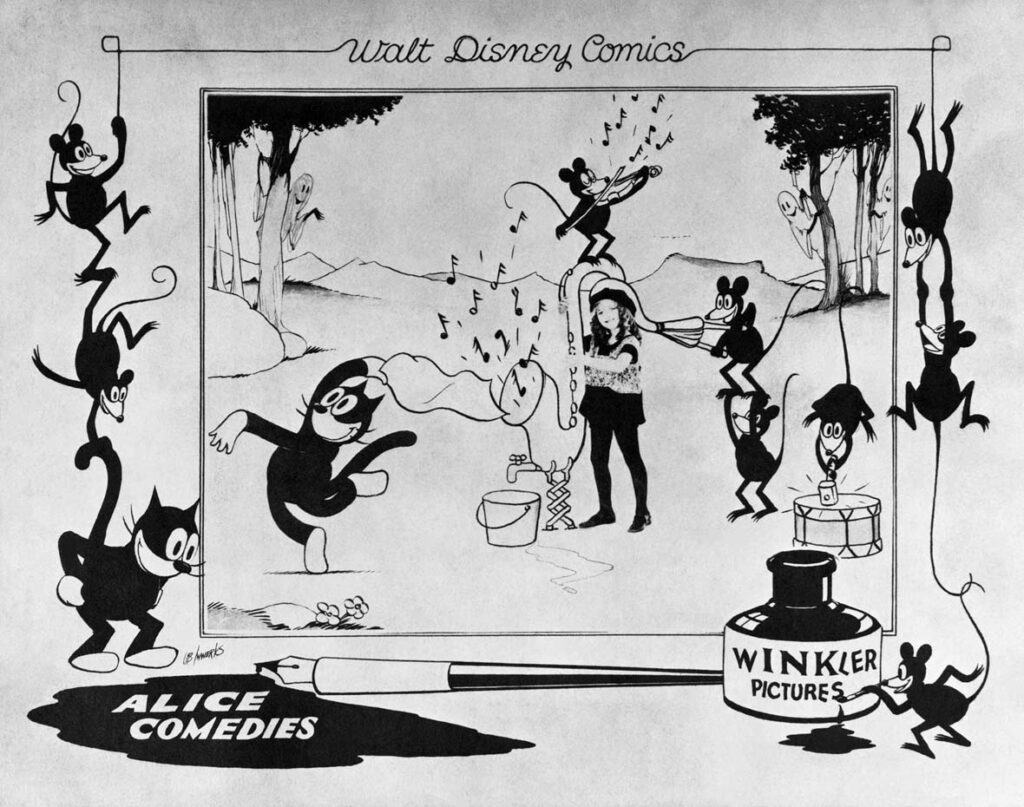
The Alice Comedies after being distributed by Winkler.
Significance in the 1920s
The period of the 1920s had a significant impact on Disney’s studio being established. Around the 1920s animation had many issues with being distributed. Movie theaters were mostly focused on showing live-action films and did not want to spend money on preliminary animations that would be shown before the featured film. The entire film industry in the U.S. was very quickly changing and growing, not just the animation industry. Animation studios primarily stayed in the New York area, but meanwhile the rest of the film industry was moving west towards California, especially Hollywood. Many studios made the move in the early 1900s due to good weather conditions, good natural light, and inexpensive costs. By the 1920s the Hollywood area became the capital of the U.S. film industry. Animation did become a part of the Hollywood film business shortly after though. Walt Disney was not immune to the urge to go to Hollywood with this quick rise in business in California. Especially since at the time, the rise of popularity in leisure and watching movies grew within American culture.
The 1920s show the emergence of America as a consumer culture. It highlights the way in which people turned to leisure and consumption to find satisfaction in life, which included going to see movies in theaters. This turn towards leisure activity is what Walt Disney was also able to capitalize on at the time with starting his business in animation. Hollywood also rapidly turned into a cultural symbol along with being the center of entertainment. It was considered glamorous, exciting, and with new emerging technological advancements in film and animation, was considered the place to go for aspiring directors, writers, and actors. The Alice Comedies series, as a part of Disney’s work at the time, shows not only the progression of technology and entertainment by combining live-action and animation, but also the appeal of said entertainment to the public as it grew in popularity.
Many movies were made to appeal to the general public as an audience, this included animated cartoons and films. Audiences were often made up of both adults and children, and the themes shown in films were aimed at both older and younger viewers. Especially as changes in the film and animation industry shifted as social attitudes, context, and events occurred in the U.S. With societal changes that film themes followed, the workers and distributors behind these films were relevant for the 1920s and Disney’s start. Margaret Winkler, as previously stated, was one of few female distributors and even went on to start her own company. Even after her involvement in her company declined after getting married, she still made important decisions that impacted the development of many animated series. Acceptance of women in this industry was not common and that they were a threat to their positions. As stated by The Boston Traveler, “one of the few remaining fields in which you have not had to face feminine competition is being invaded… by a woman distributor!”4 However Winkler considered the ambitions a woman may have to be in the film industry, the opportunities presented from these ambitions, and that “there is no reason why she shouldn’t be able to conduct business as well as the men.”5 At the time, while women were starting to make up more of the workforce slowly, they still only made up about 20%. Most of the opportunities that women did work were often “feminine”, had lower wages, and less opportunities to grow to a higher position of work. So Margaret Winkler playing such a key role by proposing the contract to Disney to distribute his work as an initial chance in Hollywood, sheds light on one of the women that was part of societal shifts in regards to gender inequality, specifically in the film industry.
Citations
Footnotes
Walt Before Mickey, Disney’s Early Years 1919-1928, Timothy S. Susanin ↩︎
Letter from M.J. Winkler to Walt Disney, from Walt Before Mickey, Disney’s Early Years 1919-1928, Timothy S. Susanin ↩︎
Walt Before Mickey, Disney’s Early Years 1919-1928, Timothy S. Susanin ↩︎
Margaret J. Winkler – Women Film Pioneers Project. ↩︎
Margaret J. Winkler – Women Film Pioneers Project. ↩︎
Bibliography
Arnold, Gordon B. 2017. Animation and the American Imagination : A Brief History. Santa Barbara, California: Praeger.
J Michael Barrier. 2008. The Animated Man : A Life of Walt Disney. Berkeley ; London: University Of California Press.
Susanin, Timothy S. 2014. Walt before Mickey : Disney’s Early Years, 1919-1928. Jackson: University Press Of Mississippi.
Walt Disney Archives. n.d. “Disney History.” D23. Disney. https://d23.com/disney-history/.
Magazine, Smithsonian, and Kat Eschner. n.d. “Walt Disney’s First ‘Princess’ Was a Spunky Four-Year-Old.” Smithsonian Magazine. https://www.smithsonianmag.com/smart-news/walt-disneys-first-princess-was-spunky-four-year-old-1-180967392/.
Dumenil, Lynn. 1995. The Modern Temper : American Culture and Society in the 1920s. New York: Hill And Wang.
“Margaret J. Winkler – Women Film Pioneers Project.” Wfpp.columbia.edu, wfpp.columbia.edu/pioneer/margaret-j-winkler/.
Sohrab. 2023. “Here’s How a Four-Page Contract Started the Walt Disney Company – D23.” D23. October 16, 2023. https://d23.com/heres-how-a-four-page-contract-started-the-walt-disney-company/.
Featured Image: “Take a Look Back at Disney in the Year 1923.” 2014. D23. March 6, 2014. https://d23.com/a-walk-with-walt-disney-1923/.
Jordyn Baham is a senior at Ramapo College studying Photography with a minor in Museum and Exhibition Studies. She takes the Discovering Digital History class in Spring 2025.