
The idea of the “new woman” began on August 18, 1920. This date signified the day women were given the right to vote on a national level. Empowered by growing economic, social, political, and sexual freedom, women challenged the archaic moralities of the bygone Victorian era in favor of adopting a more liberated and powerful existence. There are hundreds of examples of women who fit this description, but only one who will be remembered as the first to swim the English Channel.
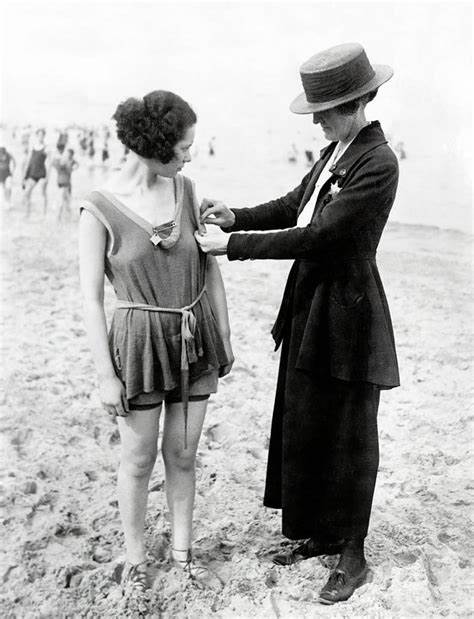
Gertrude Ederle was one of the most important women of the 1920s. She is a perfect example of a “new woman.” On August 6, 1926, she proved that women could not only compete in physical challenges on the same level as men, but do them better. Her historic swim came at a time when women were regularly having their swimwear evaluated for modesty on public beaches, often being fined for showing too much skin or not having the correct swimming attire. Ederle’s swim proved that women were capable of accomplishing anything, and that they could professionally perform these tasks in attire that was previously deemed unacceptable.
By the mid 1910s, psychologists were beginning to recognize women as sexual beings. Universities began to teach classes on female sexuality, and the media began to write books and articles about this ever expanding topic. As the twenties dawned, women began to explore and adopt this new part of their identity. Birth control slowly became accessible, championed by people like Margret Sanger, and attitudes towards women in the workplace changed. Young women’s views on marriage and societal norms also began to shift towards a more open and freeing nature. As women began to enter the workplace, they were able to financially support themselves for the first time, instead of having to rely on a man for all their needs. While the average woman’s wage was not enough for her to live off, it did allow her to purchase luxuries she may not have previously had access to and gave for more freedom in her clothing choices and hairstyles. This economic freedom also gave women social liberation, allowing them more time to experience the world’s offerings, which they often did in jazz clubs and dance halls. This new existence was particularly freeing for young women, who were able to delay marriage and enjoy their newly liberated status instead of having to immediately fall into the role of wife and mother.
Ederle’s swim further supports this narrative. At the age of 20, when in previous eras would have been married, relying solely on their husbands, and likely already mother, Gertrude Ederle was breaking societal norms. She was an athlete, trying for elite conceptions like the Olympics, and redefining what women could achieve.
Despite the progress women began to make in the 1920s, they saw great push back from other members of society. Young women in particular were often called “immoral, irresponsible, irreligious” for their sexual, financial, and social liberation. Their clothing, hair styles, entertainment choices, and actions were looked down upon by older generations. Movies, newspapers, and books contained tales of women involved in scandalous content ending with lessons on morality and warnings to young women about their futures. Despite these attempts at repression, young women continued to express themselves and were insistent on expressing their personal choices in fashion and behavior.1
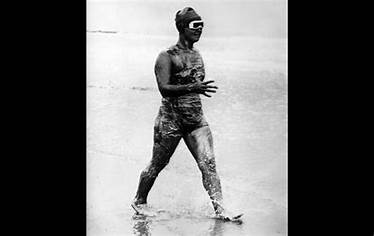
Gertrude Ederle was no exception to this. Women’s swimwear was not designed for practicality, but modestly. Ederle challenged this. On August 6, 1926, she stood on a French beach lathered in lard and in a customized two piece swimsuit. She modified a traditional swimsuit to meet the needs of an athlete about to undertake an extremely difficult physical feat. Upon the completion of her swim, Ederle in her modified swimsuit was seen around the world on the front pages of the paper. Ederle proved to the world that a “new woman” was a capable and accomplished person. She would go on to receive numerous awards and opportunities because of her swim.
The idea of a “new woman” is one who challenges social norms ultimately leading to the acceptance and adoption of new ones. Gertrude Ederle certainly did this. She was a prime example of a 1920s “new woman.”
Bibliography:
“600,000 VISIT CONEY IN A DAY OF RECORDS: FIFTY GET INTO TROUBLE OVER BATHING SUIT RULES AND THOUSANDS CUT FEET. STRICKEN BY HEAT IN SURF MAN IS PULLED FROM ICY WATER AND RESUSCITATED — LOST CHILDREN OVERRUN POLICE STATION.” New York Times (1923-), Jul 21, 1924. http://library.ramapo.edu:2048/login?url=https://www.proquest.com/historical-newspapers/600-000-visit-coney-day-records/docview/103355297/se-2.
Constad, Alyssa. “From Bloomers to Bikinis: A Brief History of the Bathing Suit.” South Carolina State Museum, n.d. https://www.scmuseum.org/learn/deeper-dive-series/bloomers-bikinis-brief-history-bathing-suit.
Dumenil, Lynn. The Modern Temper: American Culture and Society in the 1920s. First Edition. Hill and Wang, 1995.
“GERTRUDE EDERLE’S SUCCESS.” New York Times (1923-), Aug 08, 1926. http://library.ramapo.edu:2048/login?url=https://www.proquest.com/historical-newspapers/gertrude-ederles-success/docview/103809286/se-2.

I am an undergraduate teacher education student at Ramapo College, minoring in history. As a future teacher, I hope to inspire my students to love the subject of history and to understand its importance in their lives.
