
The Cotton Club was arguably the most popular nightclub in Harlem during the 1920s, emerging at the height of the Jazz Age and the Harlem Renaissance. Established in September 1923 by white American gangster Owen Maddey, the Cotton Club would remain a staple of Harlem’s nightlife until it changed locations in 1936.1 However, the Cotton Club was much more than just a famous nightclub. It was a direct representation of the intersection between the 1920s leisure culture, race relations and perceptions of women.
When conceptualizing the decade known as the Roaring Twenties, people are inclined to imagine an era of excess and festivities. While this is often exaggerated, there is a kernel of truth to these imaginings. Indeed, the 1920s saw the creation of a new type of consumer culture that was reliant on a newfound commercialization of leisure. These new spending habits are reflected in how 300% more money was spent by Americans on leisure during this decade than previous ones. What exactly were Americans now spending their money on? While there were many industries that benefited from consumer culture, with one of the foremost examples being that of cars, commercial entertainment also saw an increase in patronage. For this reason, nightclubs and other such urban amusements prospered and thrived in the 1920s.2 This, of course, contributed to the establishment and success of the Cotton Club during that decade.
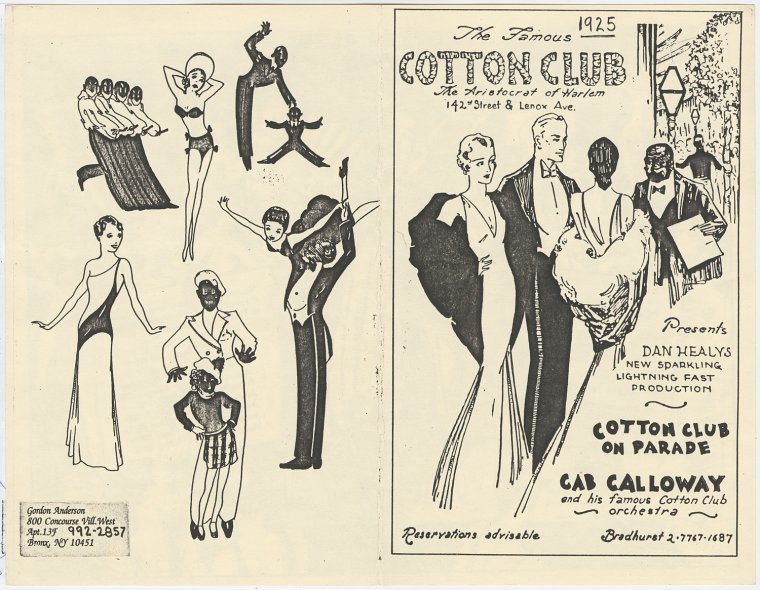
As leisure proliferated as a common pastime in the United States in the 1920s, Harlem became known as the “great playground,” known for its proliferation of amusing activities, with much of this being tied to its importance as a hub for jazz music and artists. The image of Harlem as “thrilling, bizarre [and] sensuous” that was cultivated during this era frequently brushing aside the more wretched aspects of Harlem’s cultural explosion. Despite being home to primarily African American cultural innovations, white subversion of African American communities was pervasive. In fact, the Cotton Club was one of a number of nightclubs in Harlem that only allowed for white patrons, while having predominantly African American performers. This occurred in conjunction with the phenomenon of “white slummers,” in which wealthier white individuals would take part in Harlem’s vibrant nightlife, doing dances like the Charleston and listening to jazz, both of which were originated by the African American community. It is thus no coincidence that there was a racial divide between the white audience and African American entertainers.4 In the problematically named Cotton Club, the existence of African American individuals and blackness became a performance, and created a socially acceptable platform for white patrons to reaffirm the subservience of African American performers. That is to say, the fact that the African American artists were performing and entertaining for white spectators ensured that racial inequalities were maintained in the leisure sphere.5 Even the advertising products distributed by the Cotton Club would reinforce these divisions by featuring caricatured African American performers alongside the more elegantly depicted white patrons.6 The Cotton Club was, therefore, a product of and proponent of the racism of the 1920s.
Although wealthier classes were able to take part in many types of entertainment in a frequent manner, such leisure was not limited to them. In fact, the working classes not only took part in more thrifty forms of recreation but were also able to significantly influence the new forms of entertainment that were emerging. Many different ethnic classes were able to make significant contributions to 1920s leisure, and this includes African American communities. In particular, their dance and music trends, which includes jazz, would become an integral part of American mainstream culture in the decade and was appropriated by many white artists. In this way, these working-class African American communities were not just on the receiving end of 1920s cultural phenomena, but were also significant contributors. The jazz clubs, like the Cotton Club, that many congregated to were a direct result of African American cultural contributions. This entertainment industry would further reinforce the perceptions of ethnic identities, with the proliferation of “race” records, featuring African American styles of music like the blues and jazz, being a clear example of this.7 Another example can be seen in the famous film, The Jazz Singer, which featured the clear influences of African American and other immigrant communities on the culture of the 1920s.8

Consumer culture’s impact on the entertainment industry also had significant implications for the African American working class by creating new forms of labor. One is the ‘commercial model,’ which includes such models who took part in entertainment performances. Such a job, which had employed African-American individuals in the Cotton Club, was part of a new movement to commodify aesthetics and the creation of a particular ‘feel.’ At the Cotton Club, those working in this capacity were meant to model their African American identity as a particular cultural type for their all-white audiences.10 Those employed in this position at the Cotton Club, and other nightclubs, were mainly women of color. Such a ‘model showgirl’ would not have to truly perform through song or dance, but would pose on stage in costume.11 This is deeply tied to the new emphasis on women’s sexuality in the 1920s, which would prove to be greatly problematic for African American women. African American women reformers found the sexualization of African American to be a form of dangerous exploitation. In fact, women writers in the Harlem Renaissance steered away from the emphasis on “primitivism” that their male counterparts took part in. This was because, when tied to sexuality, such a philosophy could contribute to undesirable stereotypes about African American women, which were at least in part shaped by white societal expectations.12 The Cotton Club’s presentation of African American chorus line women as visual and sexual ‘objects’ contributed to these stereotypes.
The Cotton Club was part of a larger national movement geared towards leisure as promoted by the new consumer culture. Art and joyous times were the image of nightlife in Harlem. However, institutions such as the Cotton Club were demonstrative of the greater problems that plagued Harlem and the rest of the United States. Despite being a platform for African American artists, their contributions to American culture were often diminished, and all-white nightclubs like the Cotton Club actually supported the negative stereotypes about African Americans.
- Maureen Maryanski, “The Aristocrat of Harlem: The Cotton Club,” The New York Historical, February 17, 2016, https://www.nyhistory.org/blogs/the-aristocrat-of-harlem-the-cotton-club. ↩︎
- Lynn Dumenil, The Modern Temper: American Culture and Society in the 1920s, ed. Eric Foner (New York, NY: Hill and Wang, 1995), 77. ↩︎
- The Famous Cotton Club Presents Dan Healy’s Cotton Club on Parade with Cab Calloway and His Famous Cotton Club Orchestra., JSTOR (Schomburg Center for Research in Black Culture Photographs and Prints Division, 1925), https://www.jstor.org/stable/community.31816453. ↩︎
- Gilbert Osofsky, “Symbols of the Jazz Age: The New Negro and Harlem Discovered,” American Quarterly 17, no. 2 (Summer 1965): 229–38, https://doi.org/10.2307/2711356, 235. ↩︎
- Malcolm Womack, “Harlem Holiday: The Cotton Club, 1925-1940,” University of Washington University Libraries (dissertation, 2013), http://hdl.handle.net/1773/23357, 102. ↩︎
- Womack, “Harlem Holiday,” 110-111. ↩︎
- Dumenil, The Modern Temper, 81-83. ↩︎
- Dumenil, The Modern Temper, 95. ↩︎
- Maude Russel At The Cotton Club, Getty Images (Michael Ochs Archives, 1929). ↩︎
- Elspeth H. Brown, “The Commodification of Aesthetic Feeling: Race, Sexuality, and the 1920s Stage Model,” Feminist Studies 40, no. 1 (2014): 65–97, https://doi.org/10.1353/fem.2014.0003, 65-68. ↩︎
- Brown, “The Commodification of Aesthetic Feeling,” 89. ↩︎
- Dumenil, The Modern Temper, 139. ↩︎
Bibliography
Brown, Elspeth H. “The Commodification of Aesthetic Feeling: Race, Sexuality, and the 1920s Stage Model.” Feminist Studies 40, no. 1 (2014): 65–97. https://doi.org/10.1353/fem.2014.0003.
The Famous Cotton Club presents Dan Healy’s Cotton Club on Parade with Cab Calloway and his famous Cotton Club Orchestra. JSTOR. Schomburg Center for Research in Black Culture Photographs and Prints Division, 1925. https://www.jstor.org/stable/community.31816453.
Maryanski, Maureen. “The Aristocrat of Harlem: The Cotton Club.” The New York Historical, February 17, 2016. https://www.nyhistory.org/blogs/the-aristocrat-of-harlem-the-cotton-club.
Maude Russel At The Cotton Club. Getty Images. Michael Ochs Archives, 1929.
Osofsky, Gilbert. “Symbols of the Jazz Age: The New Negro and Harlem Discovered.” American Quarterly 17, no. 2 (Summer 1965): 229–38. https://doi.org/10.2307/2711356.
Womack, Malcolm. “Harlem Holiday: The Cotton Club, 1925-1940.” University of Washington University Libraries, 2013. http://hdl.handle.net/1773/23357.

Stefanie Viera is a 3rd year History and Humanities & Global Studies double major who is taking the Discovering Digital History course in the spring of 2025. She currently work at the Jane Addams Papers Project as an Editorial Assistant.
