
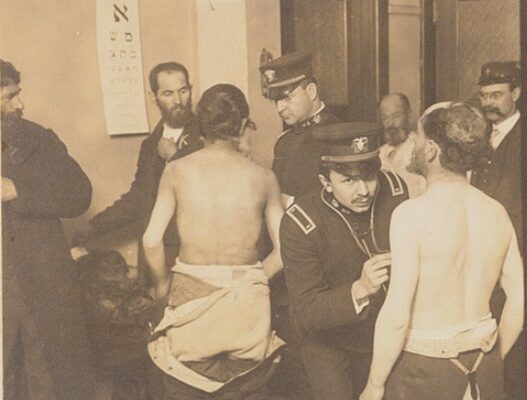
On January 11, 1921, as the post-Great War alarm about increased immigration intensified, the Congressional Committee on Immigration and Naturalization held a hearing called the “Physical Examination of Immigrants.” Members of the all-male Committee invited Joseph Broadman, MD, to discuss his observations of the medical inspections of immigrants at Ellis Island. At the hearing, Broadman, editor of “The Modern Health Advocate” magazine, testified about the “lack of precaution” being taken “to prevent the constant and ever-increasing influx of venereal disease into this country” (“Physical Examination of Immigrants” 1921, 3). Being at the intersection of anxiety about both immigration and the loosening of sexual mores, Broadman’s statements at the hearing clearly struck a nerve.
Beginning earlier in the twentieth century and escalating in the 1920s, there were unsettling changes in women’s roles, especially as they became more independent working outside the home. Working-class women sought respite from tedious jobs demanding long hours and found it in unchaperoned visits to amusement parks, dance halls, and cinemas (Dumenil 1995, 131). Many of these women were daughters of immigrants, if not immigrants themselves. A general increase in awareness of women’s sexuality, coupled with the opportunity (including especially the use of the automobile) led to more sexual experimentation. Indeed, Broadman’s publishing company, the Physical Culture Corporation, sought to capitalize on these trends, publishing “Intimate Health Talks,” a magazine whose titillating title belied its discussions of proper sexual hygiene (“Intimate Health Talks” 1922, 131).
Broadman’s appearance at the hearing may have been a publicity stunt. He criticized the process on Ellis Island as too focused on excluding those with obvious diseases or mental disabilities and not enough on venereal disease. He declared that gonorrhea was “next to measles in frequency” and cited research that 50-60% of adult males in the United States were infected. After claiming that venereal diseases could be contracted from toilet seats, or even from a glass of water handed to you by waiter in a restaurant (“Physical Examination” 6-8), there was this exchange between Broadman and Congressman Harold Knutson (R-MN), who was himself an immigrant from Scandinavia:
Broadman: “…it is found that the better educated people do not have venereal diseases to the same extent that the poorer classes have.”
Knutson: “Isn’t it found more prevalent among the Mediterranean people than among the people of northern Europe?”
Broadman: “Venereal diseases are more prevalent in those countries” (“Physical Examination” 10).
The second person to testify at the hearing was Assistant Surgeon General R.H. Creel, who had served on Ellis Island and defended the inspection process of the Public Health Service. He cited several studies, including one by the New York City Draft Board, which found only a 2.4% rate of venereal disease among draftees and an Ellis Island study showing the rate among seamen as less than 3%. Creel believed that fewer than 1% of immigrants had venereal diseases (“Physical Examination” 14-16).
Creel’s testimony fell on deaf ears. Committee Chair Albert Johnson (R-WA), an anti-immigrant activist, eugenicist and publisher, would push through the first quota act four months later, and it would severely limit immigration from Eastern and Southern Europe. The hearing served to whip up unfounded concern in Congress about venereal disease and immigrants, attaching to them both infectious illness and blame for the relaxation of Victorian sexual attitudes.
Bibliography
Dumenil, Lynn. 1995. The Modern Temper: American Culture and Society in the 1920s. Hill and Wang.
“Intimate Health Talks.” [Advertisement.] 1922. Physical Culture. July.
Physical Examination of Immigrants: Hearings Before the Committee on Immigration and Naturalization. 1921. House of Representatives, Sixty-Sixth Congress, Third Session. Government Printing Office.

Brian Scanlan is a former publishing executive with an interests in the history of the immigration and medicine. He has a B.A. in history from Rutgers University.
