
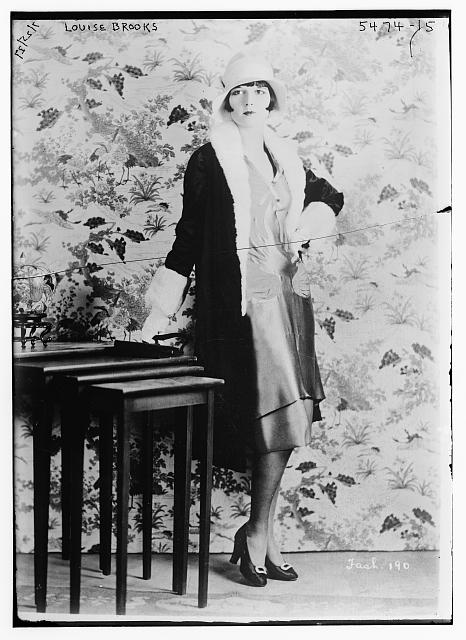
The Radium Girls, a group of girls who sued the United States Radium Corporation 1928, were a prime example of the struggles and shortcomings of the “New Woman” of the 1920s. The new woman, as opposed to the 19th century woman, as seen in the picture of Louise Brooks on the right, was a woman who worked outside of the house, typically only until she had a husband, at which point she would be expected to give up her job. While new women could be any race, and typically were lower or middle class, the most widely depicted new women were middle class white women, who worked in “feminized” jobs, like dial painting, education, secretary work, or retail.
The Radium Girls specifically were employed in a factory-esque setting in which they were paid by the number of dials that they produced and painted per hour. They were encouraged by the radium company to lick the paintbrush periodically so that the dials they were painting had finer lines and they could produce dials faster. As opposed to other women at the time, whose work was “largely devalued and poorly paid” 1 working in Radium was a highly coveted job because it was a “well-paid skilled labor” for women in the 1920s.2 In this case, the Radium Girl differs from the “New Woman” that characterized the 1920s because their work was paid at a higher rate than other feminized jobs.

While the new woman struggled to find work, and worked for poor pay in monotonous or harsh conditions, even after obtaining a degree, the Radium Girls were at first highly respected due to the advertisement and consumption of Radium in the 1920s. As Radium grew into an important part of the consumer culture of the 1920s, it was a desirable job to work with the new glowing substance. As seen in the advertisement to the right, Radium was originally advertised as a panacea for any beauty or health issue: health tonics, tooth paste, hair creams and many more items fell victim to the radium craze. Radium was even used as a wide scale treatment in hospitals, and was mixed with water and given as a cure-all to a variety of different patients as a cure for any illness.3 Radium girls would even use the radium to paint their nails or other parts of their body in order to create a glow in the dark look. These women were not informed of the negative effects of Radium, even though many officials in the company already knew about the effects by the time that Radium was being widely consumed. But due to US Radium Company’s greed and want for success in the growing consumerism market, specifically dominated by the “new women” who now had “pin money” from their jobs, they continued to push the poisonous radium on the public. Consumerism was another growing issue from the 1920s discussed in The Modern Temper, specifically as women had more money to spend, they wanted to follow the trends of higher-status women, thus leading to a growing market that focused more on advertising to a larger audience.
In the end, despite the appearance of a “better work” and “better life” for the Radium Girls, they ended up suffering just as much as the minority women who worked in factory jobs and “encountered harsh conditions and discrimination” for low pay.4 These women were continuously ingesting Radium in small doses, and over the years, ended up dying tragic and often gruesome deaths due to radium poisoning. The suffering of the Radium Girls fits into the larger trend of the early 20th century of the fight for equal rights and the struggle for worker’s protections in a growing industrialized market. After the Radium Girls’ trial, they all received a settlement from US Radium Company, which did not last them for long, as they all died within a few years of the trial. But, their trial had a lasting effect on the workers rights movement, and increased the demand for workers comp pay, women’s rights in the workplace, and enforced the judicial decision that employers could be held responsible for employee’s health and safety.
Overall, the Radium Girls were a “New Woman” of the 1920s. They worked outside of the home, in a feminized field, and received a ‘woman’s pay.’ They spent the majority of the money they earned in the budding consumerist market, and they even used the radium to decorate their bodies in order to appear more good looking or intriguing. At the end of the day, working as a radium girl gave the girls “an individual public existence, a public identity of her own, and a sense of her own worth.”5 Even though they all died from their exposure and ingestion of radium, they became a household name—especially in New Jersey—and a spearhead for worker’s rights. The radium girls connect to so many different branches of the 1920s, like consumer culture, women’s rights, and worker health and safety regulations, which shows just how much of a ‘public existence’ they really gained from their work.
- Dumenil, Lynn. The Modern Temper: American Culture and Society in the 1920s. United States: Hill and Wang, 2024, 122. ↩︎
- Balkansky, Arlene. “Radium Girls: Living Dead Women: Headlines & Heroes.” The Library of Congress, March 19, 2019. Accessed February 18, 2025. https://blogs.loc.gov/headlinesandheroes/2019/03/radium-girls-living-dead-women/.
↩︎ - Elgert, Patrick. “Radium: A Medical Treatment of the Early 20th Century.” Historical Medical Library. Accessed February 18, 2025. https://histmed.collegeofphysicians.org/for-students/radium/. ↩︎
- Dumenil, 117. ↩︎
- Dumenil, 126. ↩︎

Hannah Steinlauf is a senior history major with a minor in museum and exhibition studies at Ramapo College. She is a student research aide for the Jane Addams Papers Project. She is a member of the Ramapo College Dance Company and Tri Sigma. Hannah is going to attend Trinity College Dublin for a masters degree in Public History after graduation.
