
Overview — A History of Radium and the Girls Who Suffered From It
Discovery of Radium
Radium, the 88th element on the periodic table, was discovered by Marie and Paul Curie in 1898. The couple noticed that their samples glowed blue in dark or limited light, due to the element’s radioactivity, which sparked a broader interest in the element. From the start of the discovery of radium, there was an interest in the luminescence of the chemical, but there was also a concern over the health and safety of people interacting with the element on a daily basis. Strict limits were almost immediately put in place for scientists and doctors who interacted with radioactive substances on a daily basis, but the same protections were not put in place for factory workers such as the radium girls. Marie Curie herself said that she was “surprised that the U.S. Government would permit the handling of such dangerous substances as radium in such a careless manner.” 1 She even claimed that the ingesting of radium in the way that dial painters did was “criminal.”
Despite Marie and many other health professionals’ knowledge of the dangers of repeated exposure to radium, it was very quickly advertised to the public as “a wondrous and powerful element: a cure for cancer, and a source of beauty and vitality.”2 Radium was advertised for any issue beauty or health related. Starting in the 1920s, working with radium was seen as a respectable, covetable job by many women looking to work outside the home, even though the dangers were already known to many scientists.
United States Radium Corporation
The establishment of the United States Radium Corporation (USRC) factory in Orange, New Jersey in 1917 increased daily interaction with radium, specifically in groups of young girls aged 15-30. At the factory, girls were employed and paid approximately a penny and a half per watch dial that they completed. In an effort to make dials quicker and earn a higher daily wage, girls were instructed to do the “lip, dip, paint” technique to make the paint brushes have a finer tip, which in turn would make the lines on the watch dial more precise. By doing this, they could produce more watches per day. But, this also meant that they were ingesting more radium on a daily basis, as they pointed the tips of the paintbrushes in between their lips between every few dials they made.

During the height of World War I, the factory reached its peak production as watches were sent overseas to help men see the time in darkness. Over 300 girls were employed and painting watch dials during that time, and by 1924, approximately 50 had died and their deaths were attributed to radium-related ailments. While USRC did not take responsibility for the deaths yet, women who had been healthy five years prior contracted extreme diseases, like radium necrosis, also known as “radium jaw,” (as seen in the picture on the right) loose teeth, mouth ulcers, severe anemia, bone shrinkage and fractures. One of the sisters of the five girls who went on trial, Molly Maggia, died in 1922, and her death was attributed to syphilis, like many of the other radium girls dying in the early 20s. Dr. Martland, a New Jersey investigative surgeon, later attributed her death to radium poisoning, as he was studying the deaths of other radium girls.
Many of the girls who died in the early years before the trial had their reputations tarnished with accusations of syphilis, and they did not receive proper respect or diagnoses until years after they died. Similar to this is the case of Miss Eckert, a radium girl whose death was attributed to “shock from operation” and later re-diagnosed as radium poisoning. As the radium girl’s trial began, an autopsy was performed, which “showed that she was so full of radium that her bones fairly glistened in the dark.”3 Before the official start of the trial, and even as the girls were awaiting their decisions from the jury as the USRC continued to ask for a continuance, they continued to get sicker. In a sad interview with the Courier-Post, Quinta Maggia McDonald, sister of the now deceased Mollie Maggia, laments: “No, I no longer have any hope. I face the inevitable unflinchingly. What else can I do? I don’t know when I will die.” 4The map below details just a few key points in the history of Radium, from its discovery, to the deaths of many girls involved in the trial.
Five Girls and Their Fight for Justice
In January 1928, Grace Fryer, Edna Hussman, Katherine Schaub, Quinta Maggia Mcdonald and Albina Maggia Larice began their lawsuit against the USRC. Grace, the leader of the five girls suing USRC, tried to find a lawyer for many years before the trial officially began, as she noticed the frequent and irregular deaths of her friends and coworkers. She wanted to sue for compensation of medical bills, business malpractice and misinformation for the hazards of radium that they were ingesting daily. But, because of the strength and influence of the USRC, it took Grace over 2 years to find a lawyer willing to represent the girls. By the time that they found Raymond Berry, an attorney willing to take on the case, two of the girls were bedridden, and none of them could even raise their hands to take an oath. All of the girls already knew they were dying, like Edna Hussman admits in her interview with the Evening Courier, and they just wanted to win “because with the money us girls could have some of the comforts and joys of life before we go” rather than struggling to pay their increasing hospital bills.5 So the trial was less about getting the girls justice – they already knew they were doomed – and more about holding the USRC financially responsible for them, and potentially for future illnesses as well.
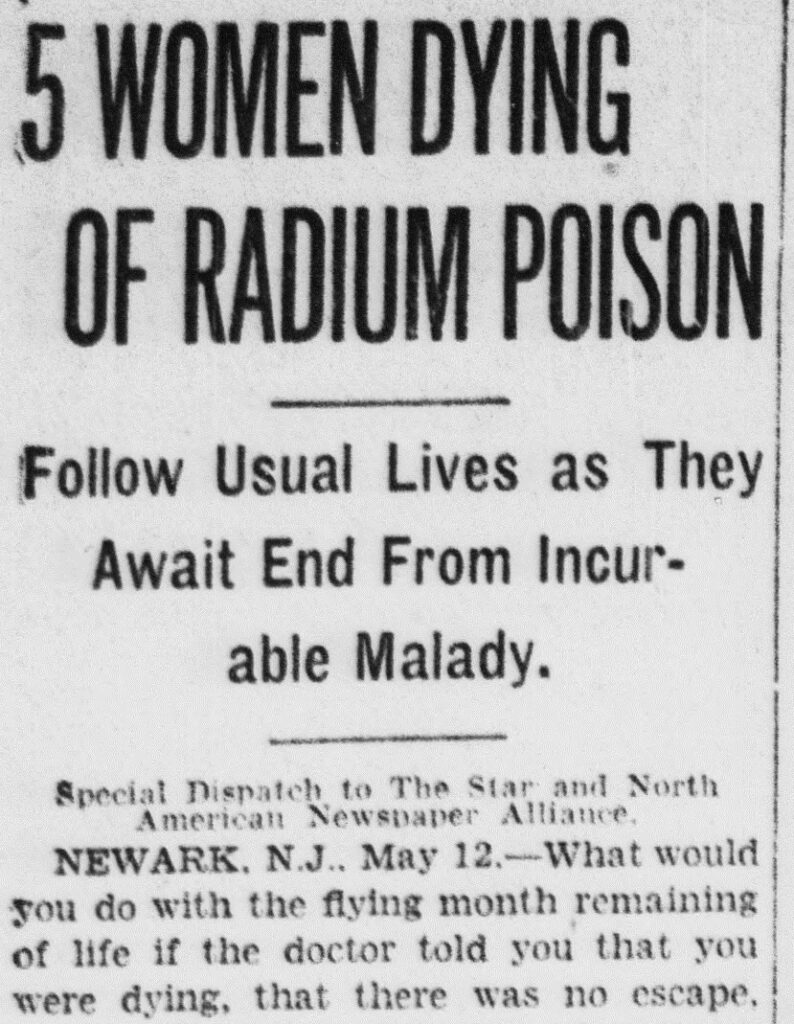
One of the biggest struggles of the radium girls trial was obviously ensuring that the USRC admitted their knowledge of the dangers of radium, and took responsibility for the death and illnesses of dial painters. One of the other more practical struggles of the trial was ensuring the girls could even attend. As they were all sick and dying, they needed many doctors appointments which took precedence during their days. Additionally, the USRC kept asking for a continuance, and trying to force the trial back, in hopes that the girls would just die, and the trial would die down. While many people argued that a trial or settlement needed to occur quickly before the girl’s deaths, the date kept being pushed back. Finally, evidence was pulled from a judgement of medical statistics by Dr. Frederick Hoffman done in 1925 showed that out of the 12 dying dial painters studied, 10 of them had necrotic lesions on the jaw bones directly connected to radium intake.6 USRC, unable to deny the obvious radiation poisoning of the girls who ingested radium, offered a settlement. The girls decided not to proceed with the trial, and to take the money.
The USRC offered the girls each $10,000 as well as $600 per year, for the rest of their lives, however short those were. They also agreed to pay the full medical and dental bills of the girls, which laid the precedent for the case of the Radium Girls from the Ottawa, Illinois plant in 1937. Even though the girls won their case, they were not the winners in the end, as they died before they, often poor, severely sick, and just ‘awaiting the inevitable.’ Many people saw these girls’ deaths as a repercussion for them working outside of the home. An Evening Courier article says that the girls’ struggle for representation and for payout from the trial was “just one more little illustration of some of the cons of this “career outside of the home” business.” 7 Even on their deathbeds, the girls were being criticized for working outside of the home, and this article makes it seem as if they had just stayed home, they would never have gotten radium poisoning in the first place. This trial brought to light just a few of the misogynistic ideals girls faced in the 1920s, whether it was their struggle to find a job in the first place, their struggle to find a lawyer, or the criticism that if they had not taken this job, they would not be dying of radium poisoning in the first place.
Significance — The 1920’s and Beyond
New Women in the 1920’s
The Radium Girls connection to other radium based deaths like those in Ottawa were not the only important aspect of their case. They also related to many broader cultural themes of the 1920s, like the New Woman. The New Woman was an idealized woman in the 1920s who worked outside of the house, typically only until she had a husband, at which point she would be expected to give up her job. The most widely depicted new women were middle class white women, who worked in “feminized” jobs, like dial painting, education, secretary work, or retail. The Radium Girls, with their non-unionized work, “feminized” pay, and gendered job opportunity are a prime example of the New Woman that became so popular in the 1920s.

As Radium grew into an important part of the consumer culture of the 1920s, it was a desirable job for women to work with the new glowing substance. As seen in the advertisement on the right, Radium was originally advertised as a panacea for any beauty or health issue: health tonics, tooth paste, hair creams and many more items fell victim to the radium craze. Radium girls would frequently use the radium to paint their nails or other parts of their body in order to create a glow in the dark look. These women were not informed of the negative effects of Radium, even though many officials in the company already knew about the effects by the time that Radium was being widely consumed. But due to US Radium Company’s greed and want for success in the growing consumerism market, specifically dominated by the “new women” who now had “pin money” from their jobs, they continued to push the poisonous radium on the public.
Consumerism was another growing issue from the 1920s specifically as women had more money to spend, they wanted to follow the trends of higher-status women, thus leading to a growing consumerist market that focused more on advertising to a larger audience of women. While the New Woman was dominated by middle and upper class women who had the freedom to do what she wanted, lower class women aspired to be like them and follow the trends they laid out. So, when women like the one in the advertisement said that they used radium for their hair or nails, lower class women purchase more radium based beauty products in order to follow the culture outlined by other women.
In the end, despite the appearance of a “better work” and “better life” for the Radium Girls, they ended up suffering just as much as the minority women who worked in brutal factory jobs and “encountered harsh conditions and discrimination” for low pay.8 These women were continuously ingesting Radium in small doses, and over the years, ended up dying tragic and often gruesome deaths due to radium poisoning. Despite their tragic deaths, the Radium Girls, like other New Women, had a lasting effect on consumer culture in the 1920s, and on women’s rights in general.
Overall, the Radium Girls were a real life example of the 1920s idea of a “New Woman.” They worked outside of the home, in a feminized field, and received a ‘woman’s pay.’ They spent the majority of the money they earned in the budding consumerist market, and they even used the radium to decorate their bodies in order to appear more good looking or intriguing. At the end of the day, working as a radium girl gave the girls “an individual public existence, a public identity of her own, and a sense of her own worth.”9 Even though they all died from their exposure and ingestion of radium, they became a household name—especially in New Jersey.
Worker’s Protections
The radium girls connect to so many different lasting themes of the 1920s, like consumer culture and women’s rights, but also worker’s health and safety regulations. Although the Occupational Safety and Health Administration was not made for another 50 years after the Radium Girls trial, they did have an effect on women workers rights. Women were typically not protected by the workers rights unions of the times, as unions did not extend membership to women workers in factories. For women who did not work in factories, typical women’s jobs, such as dial painting, secretarial work, or teachers, were not yet unionized.
For instance, there were many safeguards for medical professionals working with radiation as early as 1903, long before the US Radium Corporation built their New Jersey factory.10 While there had been minor cases of radiation burns or poisoning in the early 20th century, more serious examples of burns from exposure to X-rays and radiation in doctors were found, reported, and handled by 1911.11 In response to this health risk to medical professionals, there were increased health and safety regulations for physicians and medical professionals. In order to protect the professionals from the harmful effects of radiation, medical professionals had a strict limited exposure to X-rays and protection via medical shielding when handling radioactive substances. These medical professionals, after a few deaths in the early 20th century, were now effectively protected in order to limit future radiation-based illnesses.
While the harmful effects of radium were known and protected in doctors, women working in dial painting did not have the same protections while they worked with radium. For example, after the Radium Girls court case, “the New Jersey workers’ compensation laws were changed slightly, but not enough to help those who developed cancer and became disabled many years after their exposure.”12 While there were many issues brought up after their death, like this article written by the The Courier News which charges US Radium with murder of the girls, very few actual changes were made in the direct years after the trial.13 It was only after the deaths of many girls that doctors like Dr. Martland or Dr. Hoffman attributed their deaths to radium. The protections laid out for women working in radium were often bare bones, and usually did not financially support the women in the years after their employment for the illnesses they contracted.
It was not until the 1950s, when working on the Manhattan Project, that the radium girls got their justice and finally created protections for people working with radium. Through a study of the dead and alive radium girls during the 1950s, doctors established “the level of radioactivity associated with cancer and other changes in the skeleton and soft tissues.14 When realizing that the girls still had radioactive substances present in their bodies as long as ten, twenty, or thirty years after their death, the girls played a key part in establishing “maximum permissible standards for all workers exposed to radiation.”15 People argued, in some cases thirty years after the girls had died, that their increased exposure and consumption to radium was not only inhumane, but was also the cause for their extreme diseases and sicknesses. So, even though the radium girls did not get the justice they deserved in their lifetime, the study of their bodies and their illnesses in the 1950s established the expectations for radiation exposure.
Conclusion
Overall, the story of the radium girls is a tragic tale of a group of women who, in a struggle for freedom, self-sufficiency, and success in the 1920s, ended up dying gruesome deaths. These women left their home in an effort to make money in a recently “womanized” field painting watch dials. These watch dials were often painted with radium, in order to make them glow in the dark, so they could be more useful to men off at war in the dark or at night. Dial painters were instructed to “lip, dip, paint” for a finer line on the watches they painted, even though the negative health effects of radium were already known. The girls struggled to get legal representation or medical protections when they realized the harmful effects of radium on their bodies, and many of them died with their names tainted by accusations of syphilis.
The effects of the radium girls trial connect to broader trends of the 1920s, and beyond. While they related to the “new woman,” they also showcased how the lives of these working women often weren’t as free or as glamorous as the idealized perception of them was. They worked in poor conditions, for an unequal pay to male counterparts, and in the case of the radium girls, they died with their reputations tainted and in gruesome or painful ways. The consumption and advertisement of radium despite the known negative effects of the substance shows the poor morals of maybe people who just wanted to profit off of the easily consumable glowing substance. Finally, even though it was years after their trial occurred, the radium girls’ suffering helped regulate radiation exposure and bring awareness to women’s rights in the workplace. The radium girls, even though they struggled significantly during their lives, are remembered and given the attention they deserve in their death as they are credited with bringing to the public eye the harmful effects of radium.
Suggested Further Reading
Coursey, Bert M. “The National Bureau of Standards and the Radium Dial Painters.” Journal of Research of the National Institute of Standards and Technology, 14 Feb. 2022, nvlpubs.nist.gov/nistpubs/jres/126/jres.126.051.pdf.
Warren, Christian. “Toxic Purity: The Progressive Era Origins of America’s Lead Paint Poisoning Epidemic.” The Business History Review 73, no. 4 (1999): 705–36. https://doi.org/10.2307/3116131.
Bibliography
“Amelia Malia ‘Mollie’ Maggia (1896-1922).” Find a Grave, www.findagrave.com/memorial/99916653/amelia_malia-maggia. Accessed 12 Mar. 2025.
Balkansky, Arlene. “Radium Girls: Living Dead Women: Headlines & Heroes.” The Library of Congress, March 19, 2019. Accessed February 18, 2025. https://blogs.loc.gov/headlinesandheroes/2019/03/radium-girls-living-dead-women/.
Cowen, Ron. “New Jersey’s ‘Radium Girls’ and the NIST-Trained Scientist Who Came to Their Aid.” NIST, Ron Cowen, 24 Jan. 2025, www.nist.gov/blogs/taking-measure/new-jerseys-radium-girls-and-nist-trained-scientist-who-came-their-aid.
Dumenil, Lynn. The Modern Temper: American Culture and Society in the 1920s. United States: Hill and Wang, 2024.
Elgert, Patrick. “Radium: A Medical Treatment of the Early 20th Century.” Historical Medical Library. Accessed February 18, 2025. https://histmed.collegeofphysicians.org/for-students/radium/.
Fry, Shirley A. “Studies of U.S. Radium Dial Workers: An Epidemiological Classic.” Radiation Research 150, no. 5 (1998), S23. https://doi.org/10.2307/3579805.
“Government Moves To Protect Women in Radium Work” The Courier News, (Bridgewater, NJ), December 24, 1928, p. 15.
Hunt, Vilma R. “A Brief History of Women Workers and Hazards in the Workplace.” Feminist Studies 5, no. 2 (1979). https://doi.org/10.2307/3177594.
Moore, Kate. The Radium Girls: The Dark Story of America’s Shining Women. Naperville, ILL: Sourcebooks, Inc, 2016.
“Once Beautiful Blonde Aged By Radium Poison: Edna Hussman, DOOMED” Evening Courier, (Camden, NJ), May 23, 1928.
“Radium Victim’s Bones Glistened Says Physician” The Bayonne Times, (Bayonne, NJ), May 25, 1928, p. 2.
“Radium Victim Tells How She Awaits Doom” Courier-Post, (Camden, NJ), May 22, 1928, p. 2.
“Try ‘n Get It” Evening Courier, (Camden, NJ), May 3, 1928, p. 8.
- Vilma R. Hunt. “A Brief History of Women Workers and Hazards in the Workplace.” Feminist Studies 5, no. 2 (1979), 281. ↩︎
- Arlene Balkansky. “Radium Girls: Living Dead Women: Headlines & Heroes.” The Library of Congress, March 19, 2019. Accessed February 18, 2025.
↩︎ - “Radium Victim’s Bones Glistened Says Physician” The Bayonne Times, (Bayonne, NJ), May 25, 1928, p. 2.
↩︎ - “Radium Victim Tells How She Awaits Doom” Courier-Post, (Camden, NJ), May 22, 1928, p. 2.
↩︎ - “Once Beautiful Blonde Aged By Radium Poison: Edna Hussman, DOOMED” Evening Courier, (Camden, NJ), May 23, 1928.
↩︎ - Shirley A. Fry “Studies of U.S. Radium Dial Workers: An Epidemiological Classic.” Radiation Research 150, no. 5 (1998), S23.
↩︎ - “Try ‘n Get It” Evening Courier, (Camden, NJ), May 3, 1928, p. 8.
↩︎ - Lynn Dumenil. The Modern Temper: American Culture and Society in the 1920s. United States: Hill and Wang, 2024, 117.
↩︎ - Dumenil, 126. ↩︎
- Hunt, 280. ↩︎
- Hunt, 280. ↩︎
- Hunt, 281. ↩︎
- “Government Moves To Protect Women in Radium Work” The Courier News, (Bridgewater, NJ), December 24, 1928, p. 15.
↩︎ - Hunt, 282. ↩︎
- Hunt, 282. ↩︎

Hannah Steinlauf is a senior history major with a minor in museum and exhibition studies at Ramapo College. She is a student research aide for the Jane Addams Papers Project. She is a member of the Ramapo College Dance Company and Tri Sigma. Hannah is going to attend Trinity College Dublin for a masters degree in Public History after graduation.
