
Overview
The Rosewood Massacre occurred from January 1 to January 7, 1923. This week of terror took place in Rosewood, Levy County, Florida, United States. It was a race riot that occurred in a black rural community.
The town of Rosewood was established in 1847 near the Gulf of Mexico. In its early beginnings, it relied on the timber industry. Cedarwood trees were fruitful there, and due to the reddish color of the wood, the town was there by named Rosewood. There were originally both black and white residents, but when most of the cedar trees were cut down for profit, the economy decreased, and most whites moved to other towns, such as Sumner. Sumner was a predominantly white town, and by the year 1900, Rosewood was now a predominantly black community. Sumner and Rosewood were generally friendly towards each other, that is, until the beginning of 1923.1
Rosewood was a pleasant town. They had a school, different types of mills, three churches, two general stores, and a baseball team called the Rosewood Stars. There were about a dozen houses where some families even owned middle-class goods such as pianos and organs. About eighteen to twenty-five families were living in Rosewood.2 The general consensus was that Rosewood was that it was a nice place to live and had nothing negative to say. Robie Mortin, a survivor of the Rosewood Massacre, said, “Rosewood was a town where everyone’s house was painted. There were roses everywhere you walked.”3
Before the week-long massacre, Rosewood was a nice, beautiful, quiet, and primarily black town. It was a whistle-stop on the Seaboard Air Line Railway, where people traveling would go to fill up on necessities. No one would stay long at whistle stops, and they were deemed to be swift and unimportant visits.4
The massacre started when a white woman accused a black drifter named Jesse Hunter of assaulting her in Sumner. The woman was Frances “Fannie” Taylor. She was twenty-two years old, married to a thirty-year-old man named James, and had two children. Neighbors and people living in the town stated that Taylor was very aloof, not well known, and very peculiar overall. Taylor’s face was indeed bruised when she made her claim, and she asserted she was not raped by the man, only beaten. Her neighbors, who arrived when they heard her screaming, could not find anyone else in the house despite Taylor saying there was a black man present. Sarah Carrier, a black woman living in Rosewood, worked for Taylor the day of the alleged attack. Carrier and her granddaughter Philomena Goins said they both saw a white man leave the Taylor house on the morning of January 1, 1923. This opposes what Taylor’s neighbors said. Carrier’s words meant very little, though, and she was shot dead and burned in her house during the massacre.5 In spite of being beaten, rumors spread that Taylor was raped and robbed, which fueled anger among the white mob at an exponential rate.6
Jesse Hunter, the accused man, was a Rosewood resident and was lynched by several white men from neighboring towns after Taylor’s claims were made public. These men hunted for him, and after his lynching, a mob consisting of several hundred white individuals started to reign down in the countryside to hunt for more black people, where the Rosewood massacre soon transpired.7
Every building in Rosewood was burnt down or demolished, tragically with people still inside. During the massacre, the citizens of Rosewood either hid in their houses, tried to run, fought back, and ran to adjacent swamps. Those who hid in the swamps were there for days until they were rescued and sent to different towns for hospitalization for hypothermia and wound care.8
The impact the Rosewood Massacre had was not only physical but mental and emotional, especially for the women and children. Minnie Lee Mitchell Langley, just nine years old at the time, witnessed her uncle almost being lynched, her great-grandmother killed, her cousin kill and injure others in order to save the family and to run and hide in the woods and swamp until the massacre ended. Minnie Lee, who was eighty years old at the time of her story being told, can still feel how cold the nights were when she saw the enormous flames of the Rosewood buildings being burned from the swamp. Minnie Lee recounted her story in 1993, at age 79. She was one of five women who survived the massacre who were willing to testify.9
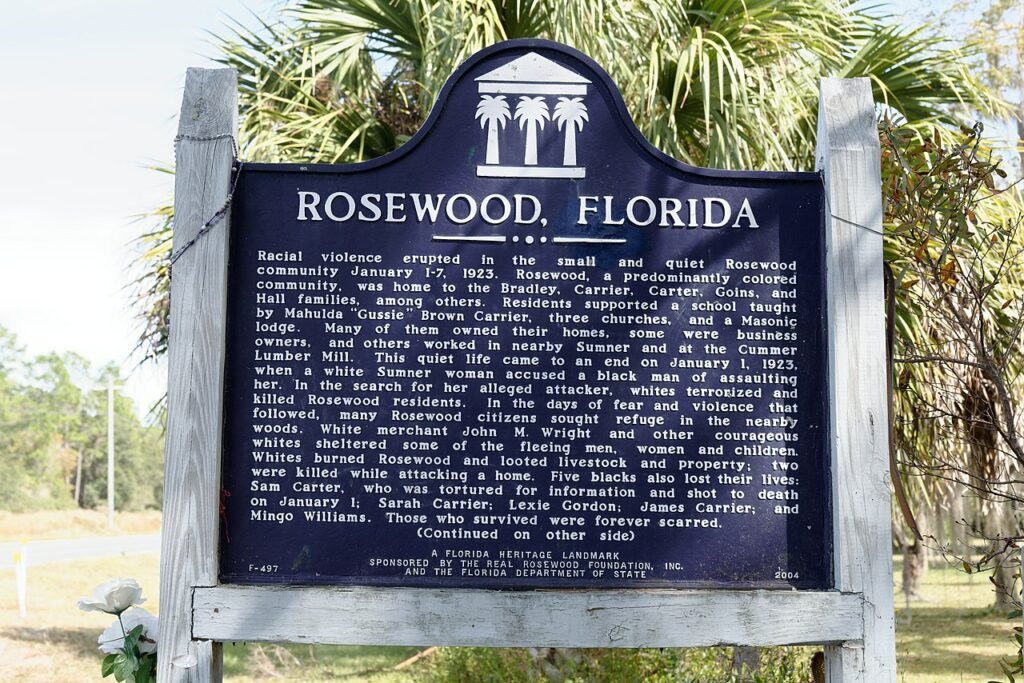
After the Rosewood Massacre, the town was abandoned. No one, either black or white, moved back. The site was officially cleared, and the empty site remained a painful memory. There is now a plaque to commemorate the atrocity.10
The death tolls are debated. According to officials, at least six black and two white people were killed, with numerous people injured and traumatized. Some survivors claim that twenty-seven black residents were murdered and that the number of white deaths was also higher. Minnie Lee stated that she stepped over many white bodies, which is contradictory to the official death records. Perhaps the public did not want to say there were more white deaths. In 1984, a newspaper estimated that one hundred fifty people died, which others claim to be an exaggeration and misinformation.12
However, very few official records and documents about the Rosewood Massacre exist. Even the survivors and their descendants, as well as the perpetrators, did not speak about the Rosewood Massacre. It was not until the 1980s, sixty years after the event, that it started to gain publicity, and there was a demand for an investigation. Since so much time has passed, many survivors are too elderly or have passed away to testify or hear their stories, meaning there is little to confirm or deny the many claims.13
There were attempts to receive justice for the Rosewood Massacre. First, there was a pursuit to sue Florida for the failure to protect the black community in Rosewood. Then, in 1993, the Florida Legislature had finally commissioned a report on the Rosewood Massacre. In its findings, Florida gave the survivors and their descendants financial compensation for the physical damages that occurred due to the racial violence. However, many do not think this was enough. In 1997, there was a feature film dedicated to the Rosewood Massacre, directed by John Singleton, called Rosewood. It is an excellent film and stars Don Cheadle, Ving Rhames, Jon Voight, and Esther Rolle. Minnie Lee served as help in the set design. The film does have mixed reviews, as it offers a fictional story amidst the panic and there is a “happy ending.” In 2004, Florida designated the site where Rosewood was as a Florida Heritage Landmark, where people can visit a plaque and pay their respects.14
Minnie Lee testified in the 1994 Florida House of Representative hearing In The Matter For Relief Of Arnett T. Goins, Minnie L. Langley, et. al, Claimants vs. State of Florida, Respondent. The other four women were Robie Robinson Mortin, Mary Magdalene Hall, Margie Hall Johnson, and Dorothy Goins Hosey.15 Each woman got $150,000 but will never be the same.16

Dr. Carolyn Tucker said that those who testified exhibited signs of post-traumatic stress disorder and that the massacre had a negative impact on their parenting, social, and economic skills.18 When they were children, the survivors dreamed of being pianists, singers, and politicians, yet those dreams were crushed, and they all became maids, domestic servants, cooks, and other low-paying jobs. Richard Hixson, the hearing officer, said to establish a scholarship fund for the Rosewood families and descendants. The Florida House of Representatives passed the Rosewood Compensation Bill on April 4, 1994, in which two million dollars were given to the Rosewood survivors and descendants.19
Significance
In the 1920s, the United States was experiencing a time of rapid social change, and people today typically think of the richness and exuberance of The Great Gatsby when picturing the 1920s. Flappers, gangsters, and lavish parties take up the mind. However, in reality, for black people in the South, things were terrible. Blacks were losing political power, were in dire economic struggles, and were subject to lynchings and terror caused by white residents on a consistent basis.
At this time, other race riots different from the Rosewood Massacre were generally reported. Lynchings also increased exponentially in the 1920s. For example, Florida’s history included the highest records of lynchings against black men in this decade. Just one year before the Rosewood Massacre, in 1922, the Perry Massacre occurred, where whites killed four black men and destroyed Perry, a black community. Charles Strong, a victim of the Perry Massacre, was lynched and burned at the stake.20
Black women were not excused from lynching. According to the National Association for the Advancement of Colored People (NAACP), in 1916, two black women named Stella Long and Mary Dennis, both mothers, were lynched. Long had four children, and Dennis was pregnant with her third at the time of their deaths.21
White supremacy started to be very active, and southern states started to decrease black voters as a way to keep the South white. In the middle of the 1920s, the Ku Klux Klan (KKK) had a peak in membership in Southern states and the Midwest. The KKK had a revival around 1915 due to the influx of black people settling in towns, and society’s views started to change towards social issues and rapid industrialization. The KKKs main targets were African Americans, Jews, Catholics, and immigrants before its ultimate demise in the mid-1920s.22 The KKK supported and executed many white mobs throughout black communities, such as Rosewood, where the authorities did little to nothing. Rosewood is just one of many unfortunate communities terrorized and abandoned by white supremacists and racists.23

To contextualize, the 1920s was also when prohibition started. Prohibition was not just about alcohol, but it gave power and dominance to white Anglo-Saxon Protestants in American society. These whites controlled the law through prohibition against the ever-growing consciousness of change.25 Working-class citizens, typically African Americans, were more boisterous regarding alcohol consumption. Saloons were popular, as was bare-knuckle fighting, where African Americans and other minorities were able to let loose and have alcohol as a point of leisure and outlet.26
In addition to working-class leisure, attractions like amusement parks were taken by storm in the 1920s. African Americans and other minority groups were able to express themselves, yet were frequently appropriated by white entertainers.27 Blackface was popular at the time. The Modern Temper talks about Jack, an Americanized Jewish entertainer who performed in blackface. The Jazz Singer helps to see how African American and immigrant performers influenced the new culture that the 1920s is known for. One reason people did blackface was because they offered whites a mask to be more expressive than their Victorian norm.28
The Petersburg Index published a newspaper on January 12, 1923, that focused on the whites who died rather than the atrocious massacre that occurred. It stated that the result of the massacre was from the “brutal assault upon a young white woman,” which paints a different picture. In the newspaper article, it lists those who died and puts the two whites first instead of putting the black victims by age and gender. There is a section in the newspaper article titled “Two Whites Shot Dead” with no highlights on the racist reasons.29
The Rosewood Massacre is significant for numerous reasons. Black communities before the 1920s, during the 1920s, and beyond have been threatened and destroyed due to racism. We can see repeats in history to current times, where the violence against BIPOC communities is ever-present.

Citations
Footnotes
- Wikipedia contributors, “Rosewood massacre.” ↩︎
- Maxine D. Jones. “The Rosewood Massacre and the Women Who Survived It.” 194. ↩︎
- Wikipedia contributors. ↩︎
- Wikipedia contributors. ↩︎
- Jones, 195. ↩︎
- Wikipedia contributors. ↩︎
- Wikipedia contributors. ↩︎
- Wikipedia contributors. ↩︎
- Jones. ↩︎
- Wikipedia contributors. ↩︎
- https://en.wikipedia.org/wiki/Rosewood_massacre#/media/File:Rosewood,_Florida_historical_marker_(1).jpg. ↩︎
- Jones. ↩︎
- Wikipedia contributors. ↩︎
- Wikipedia contributors. ↩︎
- Jones, 207. ↩︎
- Jones, 208. ↩︎
- https://en.wikipedia.org/wiki/Rosewood_massacre#/media/File:Sara_Carrier.jpg. ↩︎
- Jones, 207. ↩︎
- Jones. ↩︎
- Wikipedia contributors. ↩︎
- Jones, 193. ↩︎
- Lynn Dumenil, The Modern Temper (Hill and Wang). 9. ↩︎
- Wikipedia contributors. ↩︎
- https://en.wikipedia.org/wiki/Rosewood_massacre#/media/File:Rosewood_1923_map_from_Tropic_Magazine.jpg. ↩︎
- Dumenil, 9. ↩︎
- Dumenil, 81. ↩︎
- Dumenil, 81. ↩︎
- Dumenil, 81. ↩︎
- Newspaper ↩︎
- https://en.wikipedia.org/wiki/Rosewood_massacre#/media/File:Rosewood_Florida_Highway_Marker.jpg. ↩︎
Bibliography
Dumenil, Lynn. The Modern Temper (Hill and Wang).
Jones, Maxine D. “The Rosewood Massacre and the Women Who Survived It.” The Florida Historical Quarterly 76, no. 2 (1997): 193–208. http://www.jstor.org/stable/30146346.
Wikipedia contributors, “Rosewood massacre,” Wikipedia, The Free Encyclopedia, https://en.wikipedia.org/w/index.php?title=Rosewood_massacre&oldid=1219583334.
More Resources
Asante, Molefi Kete. “Litany of Horror: A Survey of Newspaper-Reported Lynchings.” The Journal of Blacks in Higher Education, no. 43 (2004): 116–23. https://doi.org/10.2307/4133570.
Colburn, David R. “Rosewood and America in the Early Twentieth Century.” The Florida Historical Quarterly 76, no. 2 (1997): 175–92. http://www.jstor.org/stable/30146345.
Dye, R. Thomas. “The Rosewood Massacre: History and the Making of Public Policy.” The Public Historian 19, no. 3 (1997): 25–39. https://doi.org/10.2307/3379554.
Edward González-Tennant. “Intersectional Violence, New Media, and the 1923 Rosewood Pogrom.” Fire!!! 1, no. 2 (2012): 64–110. https://doi.org/10.5323/fire.1.2.0064.
Jackson, David H., and Kimberlyn M. Elliott. “African Americans in Florida, 1870-1920: A Historiographical Essay.” The Florida Historical Quarterly 95, no. 2 (2016): 152–93. http://www.jstor.org/stable/44955672.
Newman, Richard. “Rosewood Revisited.” Transition, no. 80 (1999): 32–39. https://doi.org/10.2307/2903166.
Photo Citation: Florida Memory. https://www.floridamemory.com/discover/photographs.

History major and Human Rights and Genocide Studies minor at Ramapo College of New Jersey class of 2025.


