
The 1921 Tulsa Massacre and the burning of Black Wall Street have garnered significant attention in recent times. However, Tulsa was not an isolated incident in the 1920s. Across the Atlantic and the Mediterranean, there was another city in a similar situation to Tulsa. It was a city where minority populations thrived and which had become one of the most diverse on the Mediterranean.Just like the whites in Tulsa the Turks burned the city on the 13 September 1924 to kick out the minorities. After the fire, the Armenian and Greek parts of the city were damaged, while the Jewish and Turkish areas remained largely untouched. Just like in Tulsa, the Greek and Armenian communities of Smyrna would never fully recover, losing their homes forever. The diversity of Smyrna and the larger narrative of the burning of the city all fit within the themes of the 1920s despite it seeming like such an unrelated event.
Before the fire, Smyrna was a vibrant, diverse city, perhaps the most diverse within modern-day Turkey by the beginning of the 1920s. According to the most recent statistics before the city burned, there were one hundred and sixty-five thousand Turks, one hundred and fifty thousand Greeks, twenty-five thousand Armenians, twenty-five thousand Jews, and twenty thousand foreigners.1 Compare this to Constantinople’s population, the capital of the Ottoman Empire, from a decade before, which had two hundred seventy nine thousand Muslims, sixty four thousand Greeks, twenty seven thousand Armenians, and 13 thousand Jews.2 Smyrna’s demographics resembled those of an American city rather than one that might be part of an ethnic Greek or Turkish state. The city had four quarters: the Turkish/Muslim Quarter, Jewish Quarter, Armenian Quarter, and Greek/European Quarter. Although it would be very common to see all 4 groups outside of their quarters and mingling with each other. There was even a 5th group who resided outside of the city called the Levantines who were descendents of European immigrants that had started to assimilate into Turkish culture.3


Once WWI ended everyone knew that Smyrna was going to change hands, but the question was how would each of these groups fit into the state that would control Smyrna next. The Ottoman Empire, the state that governed Smyrna before, was on its last legs and the Greeks had plans to annex Western Turkey. Inside the Ottoman Empire a group of Turkish nationalists called the Young Turks, were becoming very popular and it seemed the Young Turks and the Greeks would soon be on a collision course for Smyrna. The Turks, the Greeks, and maybe even the Armenians knew what each of these states meant for them, but for the Jews it was different. They faced the same questions as the Jews in America during the 1920s: how to balance their Jewish identity with that of their state. Under the Ottoman Empire, Jews were Jews, as it wasn’t a nation-state, but under a Turkish or Greek state it was more complex. In America during the 1920s, Jews found ways to preserve their ethnic identity while embracing Americanization.4
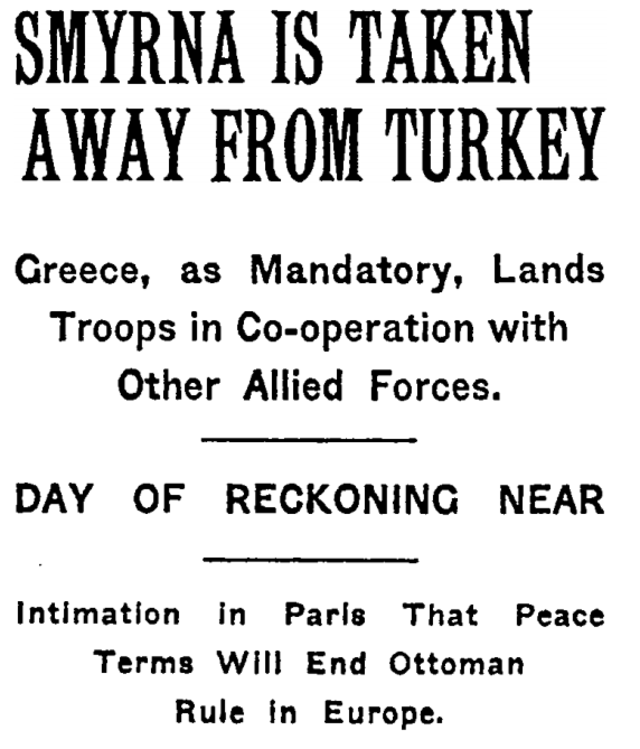
The Greeks ended up being the first to make move on Smyrna after WWI ended. The Greeks at the Paris Peace conference of 1919 represented by their Prime Minister, Eleftherios Venizelos, claimed almost all of modern-day Western Turkey that bordered the Aegean Sea on the grounds that it was the historic lands of the Greeks and that many of those places had Greek majority populations. . Then on May 9 at a meeting of the big three Allied Powers, Britain, France, and the United States would decide to allow the Greeks to invade Smyrna to deter the Italians from gaining territory in Asia Minor. David Lloyd George brought up the idea to Venizelos by asking him the simple question of “Do you have troops available?”5 This simple question would have obvious consequences that the leaders of the big three all should of known but decided to ignore. By letting the Greeks invade they opened up Pandora’s box and the Greeks, Turks, and Armenians of Anatolia would pay a great price for it.
The Greek Invasion and Occupation of Smyrna
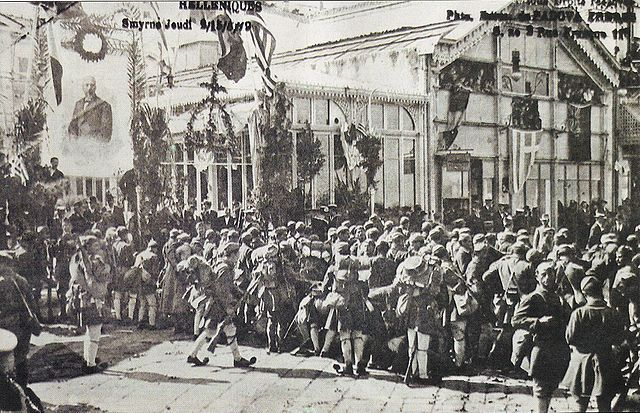
The Greeks invaded Smyrna on the May 15, 1919 and were greeted by the cheers of the Greek population. The Greeks had failed to plan ahead to secure the city though and the month that followed the invasion was chaos. The Greeks started looting the Turkish houses and massacres of both Turks and Greeks were committed. For a month there wasn’t even a Greek General in Smyrna.6
The Greek occupation and invasion of Smyrna would only last for about 3 years. The invasion only made the Turk and Greek Nationalists hate each other even more. With Greeks being resettled, Turks being kicked out, and the lower ranks of the military and Greek citizens committing violent acts against the Turks. 7 The Greeks decided to keep pushing East but eventually the Turks beat them back and pushed them all the way back to Smyrna. Turkish troops under the command of their nationalist commander, Mustafa Kemal Ataturk, ended the Greek occupation of Smyrna on September, 9, 1922. This assured Smyrna and its diverse population that the city would be apart of a future Turkish state. But, a Turkish state was supposed to only include Turks so the question was now what would happen to the Greeks, Armenians, Levantine, and the other non-Turk populations of the city. 4 days later those population would figure out what the new Turkish leaders of the city wanted to do with them.

The Turkish Occupation
The Fire
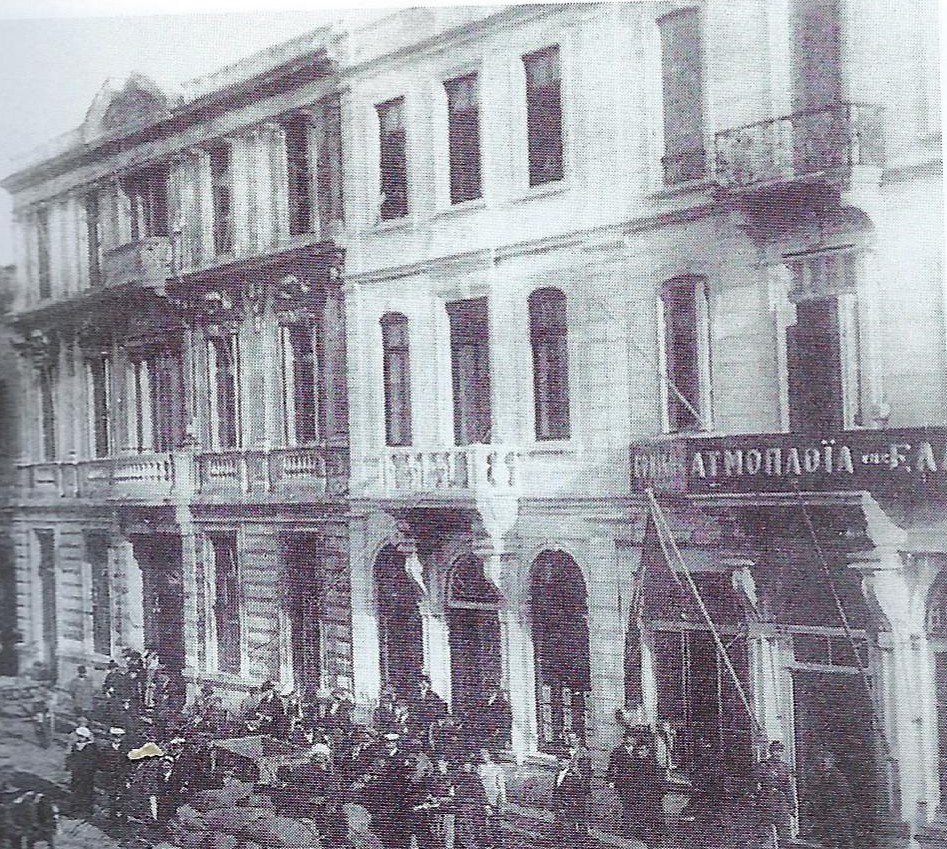
In the afternoon on September 13, 1922 a small fire broke out in the Armenian quarter in Smyrna. This small fire would end up devouring the entire Greek and Armenians quarters of the city and heavily damaging the general European quarter of the city. This is the 1922 Fire of Smyrna. According to the Minnie Mills of the American Collegiate Institute she saw a Turkish soldier enter the building in the Armenian quarter where the first fire started and then exit with tins that containing fuel. Then soon after many other small fires started. She added that on this day the wind was blowing West away from the Turkish quarter. Mills also said that soon after Armenians start to crowd the streets but the Turks blocked the road and instructed them to go back into their houses. Mrs. King Birge who went to the top of the tower of the American Collegiate Institute also said she saw Turkish soldiers with fuel cans setting fires in the Armenian quarter of Smyrna. When George Horton, the American Consul in Smyrna, looked out his terrace on the afternoon of September 13 he saw a dark cloud of black smoke covering the city. 8 The fires in the Armenian quarter were only the beginning of the fire. The fire would spread to the Greek and European quarters and would last for 9 whole days.
The Americans weren’t the only ones to notice Turkish soldiers lighting fire to the Armenian quarter. A firemen who arrived to the scene of the first fire, Sargent Tchorbadjis, testified that he saw a Turkish solider lighting fire to the interior of a drawer in an Armenian house. Another firefighter, Emanuel Kastros, said he saw Turkish soldiers puring drums of petroleum in an Armenian;s house and when asked about it they said their orders were to light fire to the Armenian houses. By 2 PM almost the entire Armenian quarter was in flames and all the residents who didn’t burn in the fire or weren’t murdered by Turkish soldiers crowded the wharf. 9 The Armenians were now stuck in a huge crowd between the bay and the giant fire raging behind them. They would wait on the wharf for 9 days while they watched their homes and the city that they called home turn into ashes. The Armenians had lived mostly peacefully in Smyrna for centuries and now the forces that adhered to the foreign ideology of Nationalism had erased all of that history. They forced the Armenians to leave the only place they called home just because they weren’t considered Turks.
On the first day the Armenians weren’t the only ones who were in trouble. The British, the French, and the Americans had to also flee from the European quarter on the first day of the Fire. The Europeans and the Americans though had a safe far away place to retreat to. Any American, French, or British citizen was guaranteed a spot on a battleship of the coast away from the blazing heat and choking black smoke of the fire. For example, some French Catholic fathers from their Church that was on fire to the French Consulate where after that caught fire they were transferred to a French battleship.10

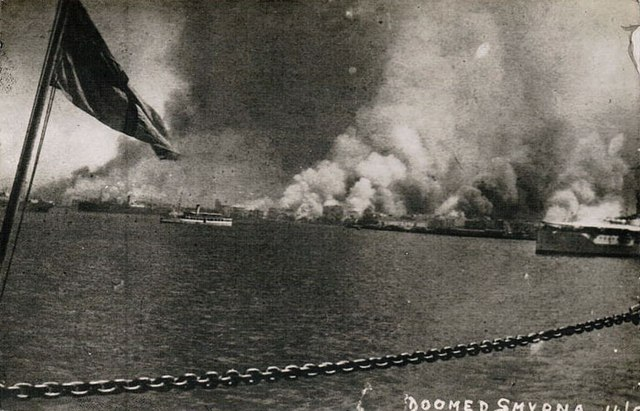
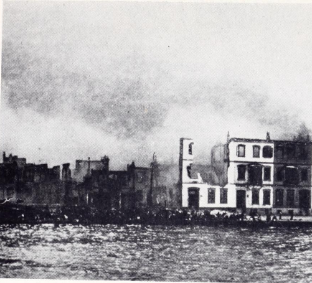
The Europeans and Americans did have a safe place to go to offshore but on their way there many tried to help the Greek and Armenian refugees. For example, George Horton held 2,000 refugees that consisted of Armenians, Americans, and Greeks. Horton had an American petty officer James Webster along with other American Marines guided Armenian, Greek, and American refugees to the wharf and protected them when Turkish soldiers started shooting at them on their way to the wharf.11 Horton and the other Americans would end up using those same marines to push through the crowd at the wharf to get to the waterfront and leave on a ship.leaving the Another example, is when the French decided to take an Armenian girl and her immediate family onto their battleship after she showed up at the French consulate speaking great French. 12
By the end of the first day almost of the Armenians and Europeans had evacuated the city proper and were either stranded on the wharf or sailing back to their home countries. The Armenian and European quarters of the city were in ashes by the end of the day, but for the Greek quarter it was a different story. The Greeks had not totally evacuated the city yet as not the entire quarter was in flames and the Turks had been focusing on the Armenians all day so there were still safe places to hide in the Greek quarter. But, by the next day on September 14 the slight relief the Greeks felt would end. For example, Georgios Tsoubariots, an eleven year old Greek child at the time was hiding with his family in a Greek Church on the 13th but in the morning of the 14th bandits came with knifes and robbed them at knife point. After they fled to the inside of family tomb at a Greek Cemetery. Another Greek family, the Verkine family had survived hiding in their house the first night but on the second day the flames finally caught up to their house and they were forced to flee to the wharf.13
The Quay
Almost all of the refugees who were fleeing their burning homes ended up at the quay. The quay was indeed safe from the fire thanks to it being but at the quay there was much more to worry about than just the fire. Horton described the quay as he was sailing away on the night of the 13th as “a narrow water-front covered with a great throng of people-an ever increasing throng”.14 An even more detailed account by a British eyewitness, Mr Wallace, described the quay as the most tragic sight he ever saw. The quay had no food or water there and was crowded beyond capacity. They were so starved and exhausted that the fire no longer even panicked them. 15 According to the American vice-consul in the middle of the hunger, thirst, and exhausted refugees were armed Turks with clubs that were going through hitting everyone in sight.16
By the 19th of September conditions at the quay became even worse. Decaying corpses were spread among the hundreds of thousands of people stranded and disease was rampant thanks to contaminated food and water. The Allies had refused to use their ships in the Smyrna harbor to help the starving masses of refugees. Luckily, thanks to one man’s intense resolve to help the people on the quay they wouldn’t have to say their much longer. This man was Asa Jennings, an employee of Smyrna’s YMCA. Jennings through a combination of bluffing and pure luck had convinced the Greeks to put him in charge of all Greek ships in the Aegean and an American ship to escort them to Smyrna. By morning of September 24 his rescue fleet arrived at the quay.17

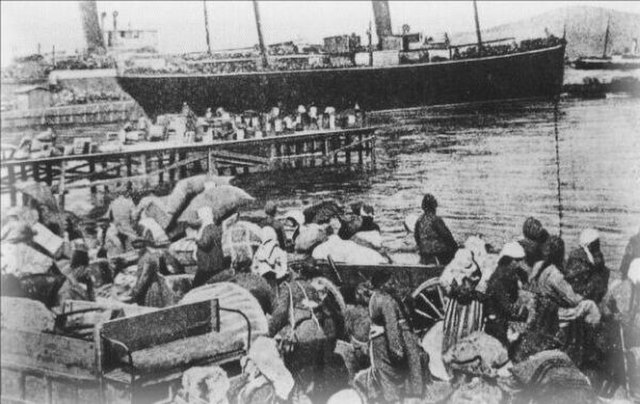
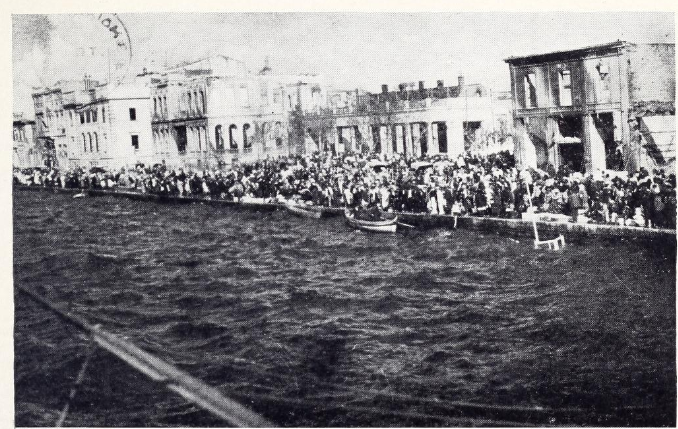
Jennings had made it to Smyrna with a fleet of Greek ships, but getting the ships to come was the easy part comparatively to his next task. There were hundreds of thousands of refugees on the quay who were desperate for help to escape the fire and only a limited amount of ships. The Turkish authorities didn’t make it easy at first for Jennings to rescue them and put severe restrictions on Jennings rescue effort. Eventually the Turkish authorities realized this was how they would get rid of the non-Turks of the new Turkish state and started helping the evacuation effort. All of the living refugees on the quay would be evacuated to Greece where refugees either or used a jumping off point to immigrate to other countries like France, the United States, and Canada.18
Aftermath
There are conflicting reports on the amount of the shear cost of human life the fire had caused. The lowest estimates of the time from the newspapers said 120,000 people had died. The United States had spent over 95 millions 1922 dollars on relief for the refugees of Smyrna.19 Later estimates said 100,000 people died while another 100,00 were deported to the interior.20 Newspapers in America and England at the time did talk about the death and destruction, but it was a lot more focused on the American and British destruction that was done. The front page of the Washington Times from September 16, 1922 said in big letters “U.S. Suffers Loss of 15,000,000 in Great Fire Sweeping Smyrna” and under that in small letters they put “300,000 homeless.21 The Birmingham Post in England titled their article on December 2, 1924 “£20,000,000 Involved in Insurance Claims. The article was about how an insurance company went to court to have it decide if the fire was an accident or not as his clients were trying claiming it wasn’t an accident to reap the insurance benefits.22 The American, British, and other European governments were pushing the narrative that the Turks started the fire yet here were British businessmen trying to go against all the proof that those governments had stated just so they didn’t have to suffer the loss of property in a place that was in conflict for years before the fire.
At the end of the day the specific human and monetary cost of the damage doesn’t matter. What matters is the Turks purposefully set the fire to purge all the non-Turks from one of the most diverse cities in Asia Minor by almost all accounts of the time. What matters is once the fire ended hundreds of thousands of people were now homeless and kicked out of the only home they ever knew. What matters is that almost the entire cultural history of two populations who lived in Smyrna peacefully for centuries was erased in the matter of weeks. What matters is that Turkish historians still deny today that the Turkish military had any involvement in the fire despite the hundreds of personal accounts of the fire by Greeks, Armenians, and other who say otherwise.
Sadly in Turkey and Greece the animosity between the two populations only grew until the Greco-Turkish war ended with the Treaty of Lausanne and the Convention Concerning the Exchange of Greek and Turkish Populations in 1923. The convention didn’t transfer though just the Greek and Turkish populations in each state like it is popularly thought. The text of the agreement specifically says that Greek Orthodox Christians in Turkey will go to Greece and Muslims in Greece will go to Turkey.23 There were ethnic Greeks and other ethnicities in Turkey who were Greek Orthodox and Muslims in Greece who weren’t Turkish and so they got caught up in the fight and had to leave their homes. 1.6 million people left their homes and transferred to their new declared countries as said by a bunch of leaders who had not asked them whether they wanted to move or not. The Fire of Smyrna was only a small part and precursor to this much larger conflict.


The Fire of Smyrna and the 1920s
Smyrna before the fire could very much be described as a “melting pot” just like how many people described America in the 20s. Both the people of Smyrna and all of the over the world, especially in America were trying figure whether being a “melting pot” was a good or bad. In the 1920s it was decided in many places including America and Smyrna that this was bad and their countries needed to be more homogenous. The Turks did this with the Fire of Smyrna and the population transfer at the end of it. The Americans did this by enacting immigration legislation and calling for the Americanization of immigrants that were already there.24 The Greeks, Turks, and other ethnicities were also forced with Grecification and Turkification when they arrived in their newly assigned countries. In Greece the refugees were forced to live in poverty in the worst quarter of Athens, but they forged a community there.25 The same was true for American immigrants like Mexicans who lived in poor conditions but forged a community through that.26
Another big theme of the 1920s persistent in the narrative of the Fire of Smyrna was the rise of cooperate power. American and other European corporations had a lot interests in Smyrna as seen by the earlier mentioned news articles. In the 20s it was a popular opinion that business should just be allowed to pursue their interests with as government interference as possible and was favorable towards business in general.27 This explains the context behind why so many foreign newspapers were covering the loss suffered by business in the fire because many people genuinely wanted to know about it and probably thought businesses should be able to recoup their losses from the fire.
Another big theme of the 1920s persistent in the narrative of the Fire of Smyrna was the rise of cooperate power. American and other European corporations had a lot interests in Smyrna as seen by the earlier mentioned news articles. In the 20s it was a popular opinion that business should just be allowed to pursue their interests with as government interference as possible and was favorable towards business in general.27 This explains the context behind why so many foreign newspapers were covering the loss suffered by business in the fire because many people genuinely wanted to know about it and probably thought businesses should be able to recoup their losses from the fire.

Significance
The Fire of Smyrna is just one small example of the many crimes that were committed before and after the Greco-Turkish War by both governments, the consequences of Nationalism, and European intervention. Nationalism was a European invented ideology that had spread to one of the few places in the world where multiple different peoples, ethnicities, and religions had gotten a long for almost a thousand years. All over the Middle East in the post WWI era massacres just the like Fire of Smyrna motivated by Nationalism. Hundreds of thousands of people died then and still die today because Europeans decided to spread the ideology that caused them to fight the biggest and deadliest war to ever be fought in history at the time to the places they colonized and traded with. Massacres like the Fire of Smyrna should not just be used an example of why genocide needs to be prevented, but why Nationalism is a flawed ideology that leads to conflict not peace. Neither the Turks nor the Greeks started the conflict that led up to the Fire of Smyrna, the Europeans started. Its the same for almost every other conflict in the Middle East. One people for one land always leads to crimes like the Fire of Smyrna happening whether that was the intention or not. People need to realize in battles all over the world that the battles they are fighting are not their battles, but the battles foreign nations wanted them to fight. They need stop blaming each other for starting conflicts and instead blame the real culprits, European colonial powers.
The Fire of Smyrna on a Map of Modern Day Izmir
Additional Resources
- Greek Genocide Resource Center provides online access to resources on the atrocities the Ottoman Empire and Turkey committed against from 1914 – 1923.
- Armenian National Institute is a website dedicated to the study of the Armenian Genocide.
- Levantine Heritage Foundation is a website dedicated the study and preservation of the communities in the Levant from the 1600s to the 1900s. The website has a lot of really amazing information about the Greek and Armenian communities in Smyrna before the fire and was one of my main resources when making my map.
Footnotes
- George Horton, The Blight of Asia: an Account of the Systematic Extermination of Christian Populations by Mohammedans and of the Culpability of Certain Great Powers; with the True Story of the Burning of Smyrna, (Indianapolis, IN: Bobbs-Merrill Company, 1926), 101. ↩︎
- Kemal H. Karpat, Ottoman Population 1830-1914: Demographic and Social Characteristics, (Madison, WI: University of Wisconsin Press, 1985), 102. ↩︎
- ↩︎
- Lynn Dumenil, The Modern Temper: American Culture and Society in the 1920s, (New York: Hill and Wang, 1995), 260-262. ↩︎
- Michael Llewyn Smith, Ionian Vision: Greece in Asia Minor 1919-1922, (New York: St Martins Press, 1973), 78-81. ↩︎
- ↩︎
- ↩︎
- Horton, Blight of Asia, 144-145. ↩︎
- Giles Milton, Paradise Lost: Smyrna 1922: Destruction of a Christian City in the Islamic World, (New York: Basic Books, 2008), 307-309. ↩︎
- Ibid, 308. ↩︎
- Ibid, 312. ↩︎
- Horton, Blight of Asia, 152. ↩︎
- Milton, Paradise Lost, 329-332. ↩︎
- Horton, Blight of Asia, 152. ↩︎
- “Smyrna’s Last Days: A Manchester Man’s Experience” in The Martyrdom of Smyrna and Eastern Christendom: A File of Overwhelming Evidence, Denouncing the Misdeeds of the Turks in Asia Minor and Showing Their Responsibility for the Horrors of Smyrna, ed. Lysimachos, Oeconomos, (Plymouth, UK: The Mayflower Press, 1922), 52-54. ↩︎
- Milton, Paradise Lost, 336. ↩︎
- Ibid, 354-360. ↩︎
- Ibid, 361-373. ↩︎
- Horton, The Blight of Asia, 173-175. ↩︎
- Milton, Paradise Lost, 373. ↩︎
- “US Suffer Loss of $15,000,000 in Great Fire Sweeping Smyrna”, Washington TImes, (Washington D.C., District of Columbia), Sep 16, 1922. ↩︎
- “The Law Courts: Sequel to the Great Fire At Smyrna: £20,000,000 Involved in Insurance Claims”, Birmingham Post, (Birmingham, UK), 2 Dec, 1924. ↩︎
- Treaty of Lausanne IV: Convention Concerning The Exchange on Greek and Turkish Populations, (Hellenic Resources Network, 1923), ↩︎
- Dumenil, The Modern Temper, 203-206. ↩︎
- Milton, Paradise Lost, 374. ↩︎
- Dumenil, The Modern Temper, 251. ↩︎
- Ibid, 32-34. ↩︎
- Ibid, 32-34. ↩︎
Bibliography
- Dumenil, Lynn. The Modern Temper: American Culture and Society in the 1920s. New York: Hill and Wang, 1995.
- Horton, George. The Blight of Asia: An Account of the Systematic Extermination of Christian Populations by Mohammedans and of the Culpability of Certain Great Powers; with a True Story of the Burning of Smyrna. Indianapolis, IN: Bobbs-Merrill Company, 1926.
- Karpat, Kemal H. Ottoman Population 1830-1914: Demographic and Social Characteristics. Madison, WI: University of Wisconsin Press, 2000.
- Milton, Giles. Paradise Lost: Smyrna 1922 – The Destruction of Islam’s City of Tolerance. New York: Basic Books, 2008.
- Oeconomos, Lysimachos. The Martyrdom of Smyrna and Eastern Christendom: A File of Overwhelming Evidence, Denouncing the Misdeeds of the Turks in Asia Minor and Showing Their Responsibility for the Horrors of Smyrna. Plymouth, UK: The Mayflower Press, 1922.
- Smith, Michael Llewellyn. Ionian Vision: Greece in Asia Minor, 1919-1922. New York: St Martins Press, 1973.
- The Law Courts: Sequel to the Great Fire At Smyrna: £20,000,000 Involved in Insurance Claims”. Birmingham Post.(Birmingham, UK). 2 Dec, 1924. ↩︎
- “US Suffer Loss of $15,000,000 in Great Fire Sweeping Smyrna”, Washington Times. (Washington D.C., District of Columbia). Sep 16, 1922.
