
Introduction
The letter was written by the NHAAPA to the senator of Washington state citing events of spies and undercover agents being used to crack down on the sale and use of liquor. The document goes further and points out that these government agents have been getting drunk themselves, therefore leading to hypocrisy and distrust in the government.
Transcription
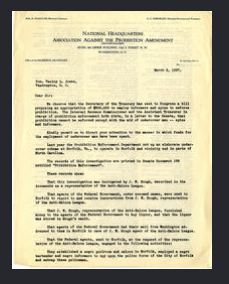
Hon. Wesley L. Jones,
Washington D.C.
Dir Sir:
We observed that the Secretary of the Treasury has sent to Congress a bill proposing an appropriation of $500,000 to employ informers and spies to enforce prohibition. The Internal Revenue Commissioner and the Assistant Treasurer in charge of prohibition enforcement both state, in a letter to the Senate, that prohibition cannot be enforced except with the aid of undercover men — spies and informers.
Kindly permit us to direct your attention to the manner in which funds for the employment of undercover men have been spent.
Last year the Prohibition Enforcement Department set up an elaborate undercover scheme at Norfolk, VA to operate in Norfolk and vicinity and in parts of North Carolina.
The records of this investigation are printed in Senate Document 198 entitled “Prohibition Enforcement”.
These records show:
That the investigation was instigated by J.W. Hough, described in the documents as a representative of the Anti-Saloon League.
The agents of the Federal Government, under assumed names, were sent to Norfolk to report to and recieve instructions from J.W. Hough, representative of the Anti-Saloon League.
That J.W. Hough, representative of the Anti-Saloon League, furnished money to the agents of the Federal Government to buy liquor, and that the liquor was stored in Hough’s vault.
That agents of the Federal Government had thier mail from Wasington addressed to them in Norfolk in care of J.W. Hough agent of the Anti-Saloon League.
That the federal agents, sent to Norfolk, at the request of the representative of the Anti-Saloon League, engaged in the following activities:
They established a negro poolroom and saloon in Norfolk, employed a negro bartender and negro informers to spy upon the police force of the city of Norfolk and entrap these policemen.
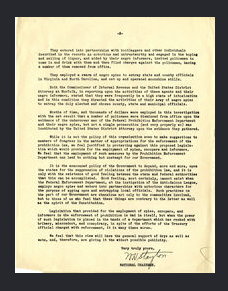
They entered into partnerships with bootleggers and other individuals described in the records as notorious and untrustworthy and engaged in the buying and selling of liquor, and aided by thier negro informers, invited policemen come in and drink with them and then filed charges against the policemen, having a number of them removed from office.
They employed a swarm of negro spies to entrap state and county officials in Virginia and North Carolina, and set up and operated moonshine stills.
Both the Comissioner of Internal Revenue and the United States District Attorney at Norfolk, in reporting upon the activities of these agents and their negro informers, stated that they were frequently in a high state of intoxication and in his condition they directed the activiteis of their army of negro spies to entrap the duly elected and chosen county, state and municiple officials.
Months of time, and thousands of dollars were employed in this investigation with the net result that a number of policemen were dismissed from office upon the evidence of the undercover men of the Federal Prohibition Enforcement Department and their negro spies, but not a singular prosecution (and very porley so) was instituted by the Unites States DIstrict Attorney upon the evidence they gathered.
While it is not the policy of this organization even to make suggestions to members of Congress in the matter of appropriations for the enforcement of the prohibiton law, we feel justified in protesting against this proposed legislation which would provide for the employment of spies, snoopers and informers. We feel that the employment of such measures by the Prohibition Enforcement Department can lead to nothing but contempt for our government.
It is the announced policy of the Government to depend, more and more, upon the states for the suppression of violations of the prohibition law, and it is only with the existance of good feeling between the state and federal authorities that this can be acomplished. Good feeling, most certantly, cannot exist when the Federal Enforcement Department, at the instgation of the Anti-Saloon League, employs negro spies and enters into partnerships with notorious characters for the purpose of spying upon and entrapping local officials. Such practices on the part of our Government are obnoxious not only to the communities involved, but to those of us who feel that these things are contrary to the letter as well as the spirit of the Constitution.
Legislation that provided for the employment of spies, snoopers, and informers in the enforcement of prohibition is bad in itself, but when the power of such legislation is placed in the hands of a department which has reeked with bribery, misconduct, and conspiracy, in spite of the efforts of the Treasury official charged with enforcement, it is many times worse.
We feel that this view will have the general support of drys as well as wets, and, therefore, are giving it the widest possible publicity.
Very truley yours,
National Chairman
Citation
National Headquarters Association Against Prohibition Amendment. National Headquarters Association Against Prohibition Amendment A Letter to Senator Wesley Jones regarding corruption in enforcement of prohibition March 3, 1927. Documents, 1927. https://jstor.org/stable/community.29380025.
Jeffrey Horn is a senior history major at Ramapo College and will graduate in May 2023. He is also a captain of the Ramapo College Swim team and aspires to become a High School history teacher after gradutation.
