
Source: https://commons.wikimedia.org/wiki/File:Wall_Street_bombing_1920_wreckage.jpg
Overview
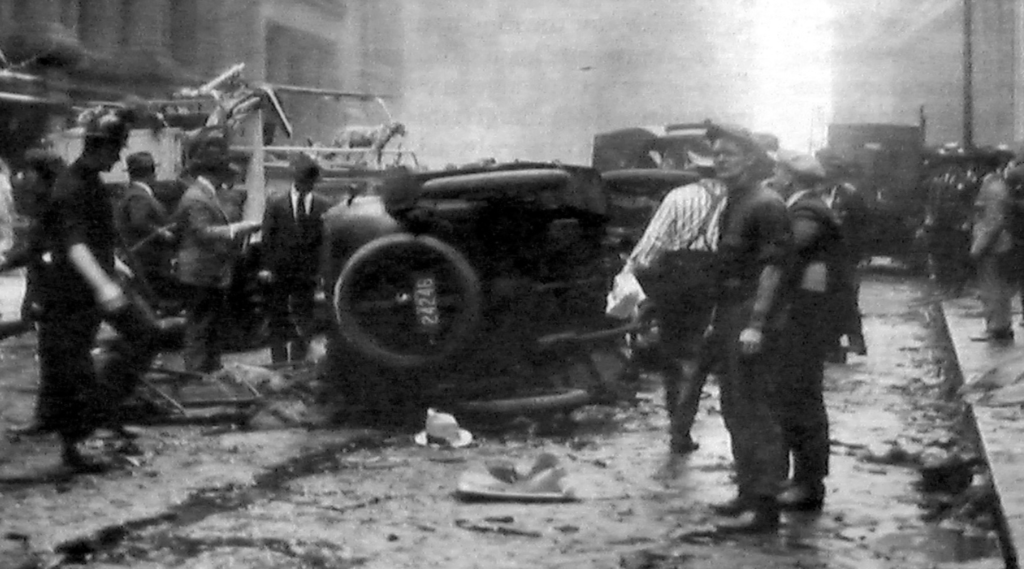
On September 16, 1920, it seemed like an average day for the busy Wall Street region of New York until a cart that was being pulled by a horse abruptly stopped in front of the United States Assay Office which was near the J. P. Morgan building, and the driver disappeared into the crowd. It did not take long for the cart to explode, leaving metal fragments flying into the crowd and instantly killing thirty people and injuring over an additional hundred people. An additional eight people died due to their injuries and more than $2 million worth of damage was left behind.
When police officers and soldiers arrived on the scene, they were able to identify that the bomb was built with TNT and supported by iron-based weights which were the leading cause of severe injury that afternoon. It was also discovered that the bomber was able to detonate the bomb using a timer. In the following weeks, nobody claimed the responsibility for the bombing. This left the New York Police Department (NYPD) to begin investigating scenarios and various groups that may have been either affiliated with or initiated the bombing. At first, they did not want to classify it as a terrorist attack because it seemed as if there was not a clear target and many innocent bystanders were killed.
One of the motives that were suggested, and is thought to be the actual motive, was that the bombing was an attempted murder of J. P. Morgan himself, however, he was out of the country at the time of the bombing. His son, Junius Spencer Morgan, was injured in the attack, and Morgan’s chief clerk, Thomas Joyce, died of injuries he sustained. Morgan’s Another theory that the NYPD came up with was the bombing was supposed to be a distraction and the culprits were supposed to have robbed the Sub-Treasury Building where there was $900 million in gold bars being held.
After the continuous investigation, the NYPD officially declared that this was an act of terrorism when a letter carrier came upon flyers from a local anarchist and communist group, the “American Anarchist Fighters” which advocated for the release of political prisoners and for the destruction of American capitalism. The possible connection that these flyers held to the bombing was that a few years prior, Italian Anarchasits had published their potential plans for two bombings using similar flyers. If anarchists were behind the attack, those leading the investigation believed that it would likely be Italian anarchist and associate of Sacco and Vanzetti, notorious anarchists, Mario Buda.
Some historians believed it was Buda due to his associates, Sacco and Vanzetti’s recent arrests, and this was Buda’s way of getting back at them as revenge. He was familiar with how to use dynamite and had used time bombs before with sash weights, which was the same exact situation in the Wall Street Bombing. He was assumed to have developed bombs, some of the largest package bombs in fact, for a group called the Galleanists. The Bureau of Investigation, now known as the Federal Bureau of Investigation (FBI), were also investigating Italian Anarchist named Luigi Galleani who was the leader of the Galleanists. The Galleanist were followers of Luigi Galleani, who spread propaganda that some violence was necessary and to fight back against capitalist oppression. He fled the country when he caught on that he was being investigated, and even so, there was no solid evidence to connect him to the bombing. Even his own nephew had stated to the police that Buda was involved. At the time, he was living under an alias of Mike Boda. However, the investigation of that lead led to a dead end.
The bombing being done by a radical group such as anarchists, communists or Bolsheviks was the second most believed motive, because at the time, they were known to turn to violence to show their opposition to financial and government institutions in the United States. An academic article titled “Why Violence Matters: Radicalism, Politics, and Class War in the Gilded Age and Progressive Era,” written by Beverly Gage for Michigan State University’s Journal for the Study of Radicalism, dives deep into understanding the issues that led to such violence. While the years of the Gilded Age were roughly from the late 1860s to 1890, and the Progressive Era ranged from 1897 to 1920, the class conflicts that were occurring were still relevant to the 1920s. Based on the evidence provided in the article, the bomb was thoughtfully planned, as the horsedrawn carriage was filled tightly with heavy sash weights and set off during the lunch hour to purposely injure more financial workers as more people would be out of the office at this time.
Another key suspect was a lawyer and tennis professional, Edwin P. Fischer. He had a history of mental illness and predicted to many of his friends and random strangers on the street that an explosion on Wall Street would take place in mid-September. However, he could not be directly linked to the bombing as he was in Canada on the actual date of the bombing and investigators came to the conclusion that it genuinely was a strange coincidence and prediction.
The investigation continued for the next three years and every lead that was followed fizzled out. To this day, no bomber nor a group has claimed responsibility for the bombing that was one of New York’s earliest and worst terrorism cases, with, unfortunately, a pattern of terrorism threats growing exponentially over the following years.
Significance
This event shaped the 1920s because it illustrated the “social unrest” that was taking place in society. Leading up to the bombing, there were many instances of violence and class conflict, specifically between the anarchists and wealthy businessmen. The J.P. Morgan building was a “symbol of American capitalism.” [1] It also holds great importance in history as the wall street bombing was the worst terrorist attack in the history of the United States until the Oklahoma City Bombing attack in 1995, and then subsequently, the terrorist attack on the Twin Towers on September 11, 2001. Author Beverly Gage describes the attitude that Americans hold towards the bombing in her book, The Day Wall Street Exploded. The Story of American In Its First Age of Terrorism, and delves into why so many Americans seem to forget the role that violence frequently played in our nation at the time.
Aside from being the deadliest terrorist attack during the 1920s, forensic evidence was beginning to modernize during this time. Had the terrorist attack occur in more modern times, a culprit would likely have been caught. In general, there were many significant contributions towards crime scene investigation during the 1920s. For example, Calvin Goddard, an American ballistics expert, discovered that when a firearm is shot, it leaves behind a unique marking on the bullet and the case of the bullet when it is fired. His discovery was used to solve a separate massacre in Chicago, Illinois in 1929. However, as the discovery was further mastered, it was learned that this discovery could be applied to crime scenes in which other weapons and tools were used. For example, in the case of the Wall Street Bombing, this technique could have been used to gain more information regarding the shrapnel from the bomb to further understand what type of bomb was used and which groups of people would have access to such materials.
Physical evidence was already tampered with when crews came to clean up the scene prematurely in order to prepare the New York Stock Exchange for “regular hours” the following day. Physical evidence that could have been used to solve the crime was then ruined while they prepared for “business as usual.” This was likely the largest error made during the investigation process, as some form of justice could have been brought to the victim’s families and to those injured, however, the leaders of the New York Stock Exchange solely focused on how to keep the money flowing. In modern times, such a decision would not have been allowed to be made.
In an article for the Smithsonian Magazine, it also has been noted that the proximity of the attacks of the Wall Street Bombing in 1920 and the terrorist attack on September 11, 2001, may have a particular relation to the movement of Occupy Wall Street. However, the biggest difference is that the terrorist attacks of 1920 and 2001 were carried out by “anarchists” and used heavy violence, whereas the Occupy Wall Street movement was more of a nonviolent protest. [2] Throughout the 1920s, anger towards the wealthy white man who worked on Wall Street grew, leading to anarchist attacks and assassination attempts. However, this bombing in particular did not hurt the wealthy, it hurt people among the working class. To this day, the missing pieces of limestone from the old J.P. Morgan building have never been repaired, and remain as a symbol of a dreadful terrorist attack that is often forgotten about.
Resources:
“Crime-Scene Investigation and Forensic Sciences.” Encyclopædia Britannica. Encyclopædia Britannica, inc. Accessed May 13, 2021. https://www.britannica.com/topic/police/Crime-scene-investigation-and-forensic-sciences.
Gage, Beverly. “Why Violence Matters: Radicalism, Politics, and Class War in the Gilded Age and Progressive Era.” Journal for the Study of Radicalism 1, no. 1 (2007): 99–109. https://doi.org/10.1353/jsr.2008.0021.
Jensen, Richard Bach. “Capitalists, Cronies, and Their Nemesis.” The Journal of the Gilded Age and Progressive Era 10, no. 1 (2011): 125-27. http://www.jstor.org/stable/23046630.
King, Gilbert. “Anger and Anarchy on Wall Street.” Smithsonian.com. Smithsonian Institution, October 4, 2011. https://www.smithsonianmag.com/history/anger-and-anarchy-on-wall-street-96057606/.
Morton, Ella. “9/16: The Forgotten New York Terrorist Attack.” Slate Magazine, September 16, 2014. http://www.slate.com/blogs/atlas_obscura/2014/09/16/the_1920_wall_st_bombing_a_terrorist_attack_on_new_york.html.
Soffer, Jonathan M. The Business History Review 84, no. 2 (2010): 393-95. http://www.jstor.org/stable/20743920.
Ugc. “Wall Street Bombing Scars.” Atlas Obscura. Atlas Obscura, June 24, 2011. https://www.atlasobscura.com/places/wall-street-bombing.

Angelina Farallo is a Law and Society Major at Ramapo College of New Jersey. Ever since she was in elementary school, history has always been her favorite subject. During her studies at Ramapo College, she has studied how the modernization of technology has affected various industries such as the law, and in this case history which is what drew her to take this Digital Humanities course.
