
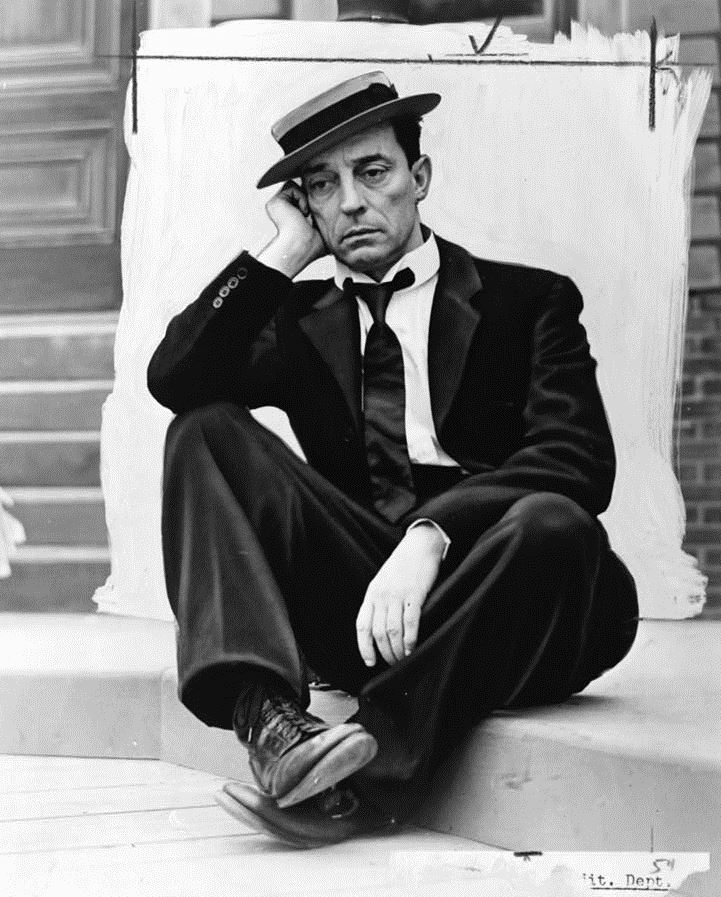
Biography
Childhood (1895-1917)
Buster Keaton had an abnormal childhood. Joseph Frank Keaton was born on October 4, 1895 in Piqua Kansas to Joe and Myra Keaton, both Vaudeville performers. He would gain the nickname “Buster” at 18 months old. Keaton took a tumble down a flight of stairs as a baby and, depending on the source, either Harry Houdini or, more realistically, George Pardey commented “Gee whiz, he’s a regular buster!” At three years old, Buster would make his first appearance on stage. He would perform with his parents in “The Three Keatons.” Their act was a comedy routine with Myra playing the saxophone on the side while Joe and Buster performed center-stage. Buster played a mischievous son who would constantly disobey his father. Joe would then throw his son across the stage either into the orchestra pit or even into the audience. Surprisingly, Buster would rarely get hurt. He learned quickly how to take a dive without hurting himself, something that would continue throughout his entertainment career.
“The dexterity or expertness with which Joe Keaton handles ‘Buster’ is almost beyond belief of studied ‘business.’ The boy accomplishes everything attempted naturally, taking a dive into the backdrop that almost any comedy acrobat of more mature years could watch with profit.”
Variety, March 12, 1910
Keaton did not have a formal education. He lasted only until lunch on his first day of school in Jersey City before being sent home for being too distracting to other students. Instead he learned from his mother, tutors, and his fellow performers. What he lacked in a formal education he made up with his knowledge of show business. He knew how to sing, dance, play the piano and the ukulele, juggle, do magic and write gags and parody. He learned how to dance from Bill “Bojangles” Robinson, who would later teach Shirley Temple how to dance, and he learned magic from Harry Houdini. Keaton could often be found watching Houdini’s magic from either behind stage or above in the flies trying to figure out the tricks.1“The Damfinos.” About Buster. Accessed May 03, 2021.https://www.busterkeaton.org/the-flickers
Keaton would continue performing with his parents until 1917. By then, Buster and his family were successful, well known stars. However, Joe Keaton had become a violent alcoholic. He had been one as early as 1915, when Buster was 19 years old. In January 1917, Buster and his mother quit the act and left Joe stranded in California.
Silent Film Career (1917-1928)
Buster Keaton’s like would change forever when he met Roscoe “Fatty” Arbuckle. At the time, Keaton was working on Broadway in n Shubert’s Passing Show of 1917. He met Arbuckle at Talmadge Studios. Arbuckle immediately asked him to jump in and start acting for the film Arbuckle was currently working on, The Butcher Boy – Keaton’s first film appearance. So amazed, Keaton was hired on the spot. He quit Broadway and began working with Arbuckle, quickly becoming his assistant director and gag writer. Keaton would work with Arbuckle for 14 films until 1920.
In 1920, veteran producer Joseph M. Schenck gave Keaton the chance to direct his own films. Based out of Charlie Chaplin’s old studio in California. Here he would become a true star bigger than anything he ever did in vaudeville or with Arbuckle. Between 1920 and 1928, Keaton would make 19 short films and 12 features. His films were different from his contemporaries like Chaplin and Harold Lloyd. He deployed his distinct slapstick comedic style and filled his films with crazy physical feats, acrobatics, and stunts. Keaton brought his vaudeville past to the big screen. He would write the scripts and do the stunts himself (most of the time). During this time, Keaton made what critics consider his best films such as Our Hospitality (1923), The Navigator (1924), Sherlock Jr. (1924), Seven Chances (1925), The General (1926), The Cameraman (1928), and Steamboat Bill Jr. (1928).
Sound “Talkie” Film Career (1928-1966)
“In 1928, I made the worst mistake of my career. Against my better judgment I let Joe Schenck talk me into giving up my own studio to make pictures at the booming Metro-Goldwyn-Mayer lot in Culver City.”
Buster Keaton
In 1928, Buster Keaton signed with MGM, a decision he would describe as the worst decision of his life. MGM did not give him the freedom he had when directing his own films. The comedy was no longer the same and, for insurance reasons, he could no longer do such dangerous stunts. On top of this, he was forced to do talking films. Keaton only lasted until 1933, being fired for not wanting to work on what he considered inferior films. His MGM films were financially more successful than his silent films, but are not considered inferior to the works he directed himself.
For the next three decades, Keaton would be in and out of MGM as a gag writer while doing various things in between. From 1934 to 1937, he did educational films. From 1939 to 1940, he worked with Columbia Pictures. After going back to MGM in 1940, he was a part of various feature films, including Charlie Chaplin’s Limelight (1952), only the second two worked with each other. During this time, Keaton also ventured into television with CBS and as a guest on various talk shows, as well as other television productions. He would appear in The Twilight Show episode “Once Upon a Time” and It’s a Mad, Mad, Mad, Mad World.
Buster Keaton would die of lung cancer on February 1, 1966, aged 70, in Woodland Hills, California. He would be buried at Forest Lawn Memorial Park Cemetery in Hollywood Hills, California.
Personal Life
Buster Keaton married three times and had two children. On May 31, 1921, he married actress Natalie Talmadge, sister to Norma Talmadge who was married to Joseph M Schmeck, Keaton’s producer. Keaton would have both his children with her, Joseph “James” and Robert. The couple would get divorced in 1932, taking his two sons with her. Keaton became an alcoholic during his first stint at MGM, causing him to be institutionalized. He escaped his straight jacket and the institution due to tricks he learned from Harry Houdini’s escapes. He married his nurse, Mae Scriven, in 1933. They would only last three years after Keaton was found cheating on her. On May 29, 1940, Keaton married MGM dancer Eleanor Norris. Norris might have been 23 years younger than Keaton, but their marriage was an extremely happy one. The marriage lasted until Keaton’s death in 1966.
Keaton’s Importance to the Film Industry
Buster Keaton revolutionized the film industry. There are two things that make his films stand out over his contemporaries – his camera skills and his stunts. Keaton was fascinated with technology, cameras in particular. After his first meeting with Arbuckle, he borrowed the camera they were using to film. By the following morning, he had taken apart and put back together the camera. This was the beginning of Keaton’s partnership with the camera, “where his contemporaries pointed the camera at funny people doing funny things, Keaton made the camera his partner and developed a new comic vocabulary with it.2“The Damfinos.” About Buster. Accessed May 03, 2021.https://www.busterkeaton.org/the-flickers” Keaton also revolutionized stunts in film. He did bigger and more dangerous stunts than anyone before him. And he did them without getting hurt. One of his most iconic stunts is from Steamboat Bill Jr. In the scene, the front of a two story building falls on Keaton. The building falls perfectly so that he fits through the second story window unscathed. The prop weighed two tons, so if he miscalculated even a few inches, he would have mostly like been seriously injured or killed. Buster Keaton’s innovation with the camera and dedication to stunts forever changed films for the better.
Citations
Bibliography
- Barber, Nicholas. “Deadpan but Alive to the Future: Buster Keaton the Revolutionary.” The Independent. January 08, 2014. Accessed May 03, 2021. https://www.independent.co.uk/arts-entertainment/films/features/deadpan-alive-future-buster-keaton-revolutionary-9037459.html.
- Bourne, Mark. “Buster Keaton Double Feature: The General/Steamboat Bill Jr.” The DVD Journal | Reviews : The General/Steamboat Bill Jr. Accessed May 03, 2021. http://www.dvdjournal.com/reviews/b/busterkeatondf.shtml.
- Meade, Marion. Buster Keaton: Cut to the Chase: A Biography. New York: Open Road Integrated Media, 2014.
- Sanders, Judith, and Daniel Lieberfeld. “Dreaming in Pictures: The Childhood Origins of Buster Keaton’s Creativity.” Film Quarterly 47, no. 4 (1994): 14-28. Accessed March 3, 2021. doi:10.2307/1212979.
- “The Damfinos.” About Buster. Accessed May 03, 2021. https://www.busterkeaton.org/.

Michael Kilduff is a history major at Ramapo College of New Jersey. He is looking to become a high school history teacher after going to graduate school for history education.
- 1“The Damfinos.” About Buster. Accessed May 03, 2021.https://www.busterkeaton.org/the-flickers
- 2“The Damfinos.” About Buster. Accessed May 03, 2021.https://www.busterkeaton.org/the-flickers
