
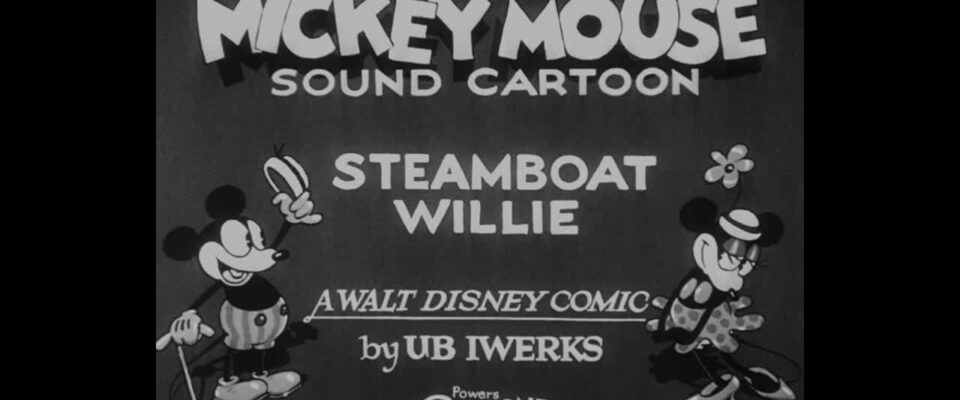
Walt Disney and Ub Iwerks directed the animated short film Steamboat Willie in 1928. The film opened at New York’s Colony Theater on November 18th, 1928, which would later become Mickey’s birthday. Walt Disney Studios made it in black-and-white, and Celebrity Productions distributed it. While both Mickey Mouse and his girlfriend Minnie had previously appeared in a test screening of Plane Crazy, the cartoon is considered their official debut. Steamboat Willie was the first Mickey Mouse film to be released since Walt Disney had promised to make one of the first full synchronized sound cartoons since seeing The Jazz Singer. This would cause the market of silent animation to go bankrupt and films with synchronized sound to rise. Steamboat Willie is notable for being the first Disney cartoon to feature synchronized sound. The first to feature a wholly post-produced soundtrack, distinguishing it from earlier sound cartoons, Disney realized early on that synchronized sound was the way of the future. Steamboat Willie quickly rose to prominence as the most famous cartoon of the time. Wilfred Jackson and Bert Lewis composed the music for Steamboat Willie, which included the songs “Steamboat Bill,” popularized by baritone Arthur Collins in the 1910s, and “Turkey in the Straw,” popularized by minstrelsy in the nineteenth century. The film’s title may be a spoof of Buster Keaton’s 1928 film Steamboat Bill, Jr., which was a nod to Collins’ song. Although there is a little intelligible dialogue, Walt Disney performed all of the voices in the film. Steamboat Willie introduced one of the most famous cartoon characters and recognizable its technological innovation for the time. Disney was able to put together the breakthroughs of technology, craftsmanship, and abstraction to create such a groundbreaking movie for all to take in.
Making Behind the Magic
Steamboat Willie was produced between July and September 1928, with an approximate budget of $5,000.( For comparison, according to Investopedia.com the average cost to produce a major studio movie has been around $65 million.) The animators were initially unsure if a sound cartoon could be convincing enough, so before creating a soundtrack, Disney arranged for a screening of the film with live sound to test the audience. Steamboat Willie was just partially done when this screening took place on July 29. In a space adjacent to Walt’s office, the audience stood. The movie projector was installed outside, and the film was projected through a window so that the projector’s sound did not interfere with the live sound. Ub Iwerks draped a bedsheet over the movie projector, behind which he set up a microphone and speakers for the audience. From behind the bedsheet, a live sound was made. Wilfred Jackson performed the music on a mouth organ, Ub Iwerks provided percussion with pots and pans, and Johnny Cannon provided sound effects with a variety of instruments, including slide whistles and spittoons for bells. Walt delivered the film’s sparse dialogue, which consisted mainly of grunts, screams, and squawks. They were ready for the crowd, which consisted of Disney employees and their wives, after many rehearsals. The audience’s reaction was overwhelmingly positive, giving Walt the courage to continue working on the film. “The effect on our small audience was nothing short of electric,” he later said of the first screening. They reacted to the combination of sound and motion almost instinctively. I figured they were joking when they said that. So they put me in the audience and re-enacted the scene. It was awful, but it was fantastic! It was also something different!” “I’ve never been so happy in my life,” Iwerks said. Nothing since has come near.” Walt moved to New York City to find a sound production company. He finally decided on Pat Powers’ Cinephone system, which Powers developed using a modified version of Lee De Forest’s Phonofilm system without crediting De Forest, a decision he later regretted. The Green Brothers Novelty Band arranged the music for the final soundtrack, which was conducted by Carl Edouarde. The band’s Joe and Lew Green also helped with the timing of the music for the film. On September 15, 1928, the first attempt to synchronize the recording with the film was a disaster. But with disaster there is always a success to follow, to fund a second recording, Disney had to sell his Moon roadster. The inclusion of a filmed bouncing ball to maintain the pace was a success. From there Disney was ready to fit the theaters with his first production staring a mouse driving a steamboat.

Synopsis of Short Film
Mickey Mouse is depicted as the captain of a steam river side-wheeler. He whistles “Steamboat Bill” and blows the boat’s three whistles cheerfully. Pete, the actual caption, appears soon after and tells Mickey to leave the bridge. Mickey gives Pete a raspberry. Pete tries to kick him, but Mickey sprints away just in time, and Pete kicks himself in the back. Mickey dashes down the stairwell, tripping over a bar of soap on the boat’s wall and landing in a bucket of water. Mickey throws the bucket at a parrot, who laughs at him. Pete, who has been watching it, takes the helm of the steamboat. He spits into the wind after biting off a piece of chewing tobacco. The spit flies backward, ringing the bell on the boat. Pete spits again, amused, but this time the spit strikes him in the ace, causing him to fuss. The steamboat picks up a cargo of different livestock at “Podunk Landing.” Minnie Mouse appears just as they are about to set off again, sprinting to catch the boat before leaving. Mickey misses her, so she chases the boat down the sea, where Mickey hooks the freight crane to her underwear and hoists her aboard. When Minnie lands on deck, she drops a ukulele and some sheet music for the song “Turkey in the Straw,” which a goat eats.
The two mice use the goat’s body as a record player, rotating its tail like a crank to play music. Mickey “plays” the animals like musical instruments, using various items on the boat as a percussion accompaniment. Mickey concludes by playing the song on a xylophone with the teeth and tongue of a donkey. Captain Pete isn’t entertained by the musical performance and assigns Mickey to peel potatoes. The same parrot laughed at him earlier appeasements in the porthole of the potato bin and laughs at him again. The mouse, enraged by the bird’s antics, throws a half-peeled potato at it, knocking into the river below. Mickey laughs as he sits next to the potatoes at the end of the movie.
Impact on the 1920s
Disney’s Steamboat Willie was the turnover of the movie industry for the 1920s. It was one of the first movie’s with sound incorporated which was huge for the time period. This short film was a breakthrough of animation in the 1920s. The birth of Steamboat Willie would change the movie industry forever not only with the birth of one of the most notorious Disney characters that we know and love but the birth of synchronized sound in the movie industry because of the breakthroughs that it had on audience’s in America during this time period.
Citations
“Moma Learning.” Accessed April 28, 2021. https://www.moma.org/learn/moma_learning/walt-disney-ub-iwerks-steamboat-willie-1928/.

I am a Ramapo senior who is majoring in Elementary Education. I am taking this course because I want to be certified in Social Studies at the middle school level. I graduated from Bergen Community College in the Spring of ’19 with an associate’s in Early Childhood Education. Currently, I am working at Starbucks as a Shift Supervisor until I obtain my degree from Ramapo.
