
The 1920s were a decade of rapid industrialization that are often remembered for their improvements in transportation technology. These advancements, however, did not prove useful to the town of Nome on the west coast of Alaska. An outbreak of diphtheria among the town’s children in early 1925 resulted in a scramble to secure antitoxin from hundreds of miles away in an environment that contemporary technology simply could not traverse. The town was forced to rely on dog sled teams to transfer the serum 674 miles from Nenana, where the railroad ended, all the way to Nome.
Lynn Dumenil’s book The Modern Temper discusses the technological boom that the 1920s witnessed, including a 64% increase in industrialization over the decade as a whole. This growth included both the chemical and automobile industries.1 The former had an important impact on the Nome Serum Run, as it was the H. K. Mulford Company that had manufactured the diphtheria antitoxin.2 However, the transportation advancements that were dispersing throughout the mainland United States, such as paved roads and cars, had yet to reach the furthest corners of the country. The Nome Serum Run demonstrates that despite the decade’s improvements in transportation technology and Americans’ increasing ability to utilize them, these developments were not yet able to help those outside of the increasingly urban mainland United States.
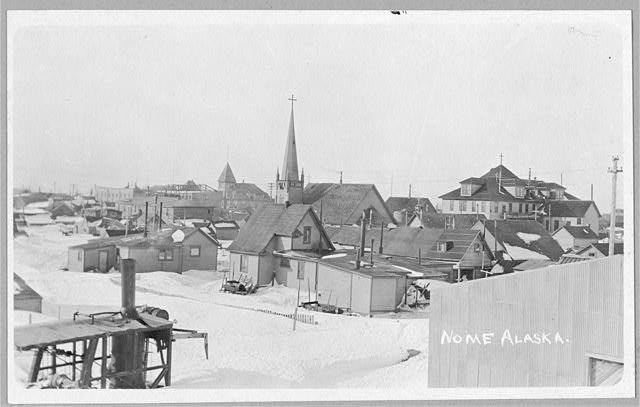
Unlike transportation improvements, advancements in newspaper technology did impact the Nome Serum Race, though this influence was largely felt outside of Alaska. Instead, it took place in the minds of people in the contiguous United States. Dumenil writes that “because of developments in technology and distribution, [newspapers] increasingly consisted of syndicated news information and photographs.”3 This system, in which a single news story is written and distributed to numerous papers, was exemplified during and after the Nome Serum Run. One week following the serum’s arrival in Nome, the town’s lone physician Dr. Curtis Welch wrote an article for the United Press that was sent to and published by newspapers across the country, all the way from Nebraska to New Jersey. All of this followed weeks of coverage about Nome’s plight as newspapers from all 48 of the recognized states at that time plus the territories of Alaska and Hawai’i reported on the dog sled relay. This also demonstrates the increasingly national news coverage that people were consuming, as described by Dumenil.4 It allowed people throughout the country to eagerly follow the Nome Serum Run, waiting to see if it would be successful.
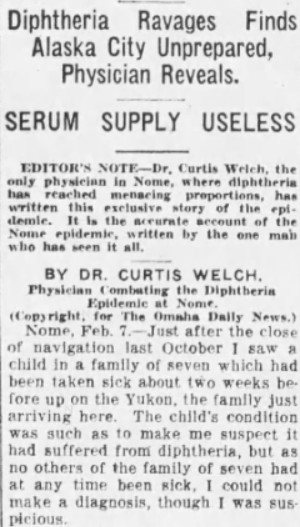
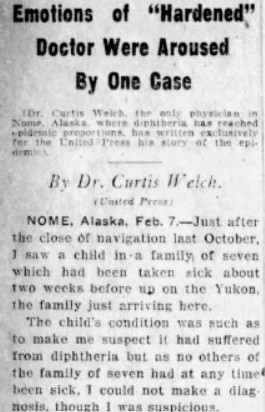
Left: An article written by Dr. Curtis Welch appears in the February 8, 1925 edition of The Trenton Evening Times, based in New Jersey. Right: The same article appears in The Omaha Daily News, based in Nebraska, on the same day. This is an example of syndicated, national news coverage described by Lynn Dumenil in The Modern Temper.
Technological advancements in transportation and publishing were a large part of life for many in the 1920s. Cars were becoming increasingly available to the American public and connecting the country in new ways.5 At the same time, newspaper articles written with a national audience in mind allowed for the spread of information from virtually anywhere in the country. These two factors could help explain why the Nome Serum Run became so prominent for so many Americans: at a time when travel was becoming easier in much of the country, a nationalized newspaper story of what happens when these advancements are unavailable entranced the American public.
- Lynn Dumenil, The Modern Temper: American Culture and Society in the 1920s (New York, NY: Hill and Wang, 1995), 58. ↩︎
- William H. Wilson, “The Serum Dash to Nome, 1925,” The Alaska Journal 16, (1986): 257. ↩︎
- Dumenil, The Modern Temper, 72. ↩︎
- Dumenil, The Modern Temper, 73. ↩︎
- Dumenil, The Modern Temper, 58. ↩︎

Grace Martinez is a Ramapo college history major with a minor in museum & exhibition studies.
