
The two chapters I looked at are “The Roaring Life of the 1920s” from The Americans (2005) and “Prosperity’s Promise” from The Adventure Of American People (1966), while the article I looked at is “THE 1920s—A HISTORIOGRAPHICAL SURVEY” by Jennifer Fronc. These three resources give examples of what historiography of the 1920s is like, and how it has changed in American textbooks.
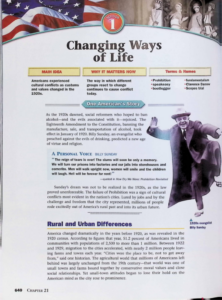
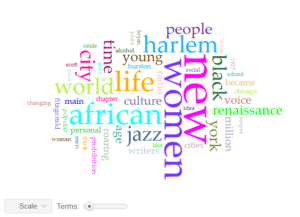
“The Roaring Life of the 1920s” splits its chapter into four parts, detailing the changing mindsets of the time, the women of the 1920s, education and pop culture, and the Harlem Renaissance. When discussing women during the 1920s, they do mention there being a “double standard” and that “many women were pulled back and forth between the old standards and the new.”1 A discussion of struggle happens in the section on the Harlem Renaissance, writing that “Northern cities in general had not welcomed the massive influx of African Americans. Tensions had escalated… culminating… in approximately 25 urban race riots.”2
This is very important, as the struggles for both women and black Americans during the 1920s are clearly stated in the book, and not sugarcoated so children have an idea that, despite the movements during the time, the past is complicated, especially when it comes to oppressed groups.
Despite this, there is no mention of the hardships immigrants faced, with the most being that they “often ached for home.”3 Additionally, under a chart for the causes and effects of prohibition, the authors write that “native-born Americans developed a hostility to German-American brewers and toward other immigrant groups that used alcohol,” which could easily be glossed over if a child isn’t paying close attention.4
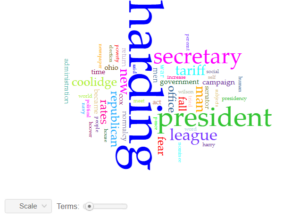
On the other hand, “Prosperity’s Promise” has more subtle splits that discuss the presidency and government of the time, the different movements and changes across America, and the economy.
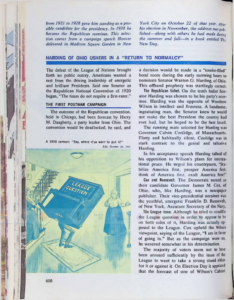
There is no mention of “flappers” in this textbook, only referring to them as “liberated women” who became less and less modest, with examples such as skirts being “9 inches from the ground! It soon had reached the knee” and “[women cutting] their hair short—and differently, it seemed, every year.”5
Any mention of the Harlem Renaissance is within the economic section, as they had moved to cities such as New York City due to labor shortages due to World War I. Despite this, it is only written as “a period of extraordinary creativity for Negro artists and musicians.”6
There are very few similarities between these two chapters. Neither chapter discusses the Stock Market Crash, though I figure that topic is saved for their respective Great Depression chapters. They also discuss the culture of the decade, albeit in varying depths. Overall, “The Roaring Life of the 1920s” is better for a general overview of the culture of the 1920s, while “Prosperity’s Promise” is better for a general overview of the 1920s, before the Great Depression.
Based on what Jennifer Fronc writes in “THE 1920s—A HISTORIOGRAPHICAL SURVEY,” these chapters fit into the context of what she writes about. “The Roaring Life of the 1920s” doesn’t go into full depth to how women were treated during the 1920s, but does mention how they were trapped between modernity and tradition. In regards to the Harlem Renaissance, it does a does still treat it “as an adjunct to the mainstream narrative of U.S. history,” as they discussed prominent African-Americans, such as James Weldon Johnson and Marcus Garvey and their accomplishments.7
On the contrary, “Prosperity’s Promise” Barely touches upon women and black Americans in the 1920s, but does touch upon immigrants. Unfortunately, there is only mention of Jewish and Catholic immigrants and the discrimination they faced.
Understanding when historians write helps evaluate how one could use a source, and understand how trustworthy it is. The different motives historians have during each decade is a huge driving factor that scholars have to take into account. Older sources are not more trustworthy than more modern sources, and trustworthiness depends on the author’s motives rather than the age of a source. Once this is finally understood scholars can more accurately determine which sources are best to use when writing a paper.
Citations
Footnotes
- Gerald A. Danzer et al., The Americans, 647. ↩︎
- Danzer et al., 659. ↩︎
- Danzer et al., 642. ↩︎
- Danzer et al., 643. ↩︎
- Henry Graff and John Krout, The Adventure Of American People, 615. ↩︎
- Graff and Krout, 623. ↩︎
- Jennifer Fronc, “THE 1920s—A HISTORIOGRAPHICAL SURVEY,” 20. ↩︎
Bibliography
Danzer, Gerald A., J. Jorge Klor de Alva, Larry S. Krieger, Louis E. Wilson, and Nancy Woloch. The Americans. Houghton Mifflin Harcourt Publishing Company, 2005.
Fronc, Jennifer. “THE 1920s—A HISTORIOGRAPHICAL SURVEY.” Taylor & Francis Group, 2018.
Graff, Henry and John Krout. The Adventure Of American People. Rand McNally, 1966.

Eryn is a Ramapo College sophomore majoring in History and minoring in Museum Studies.
