
David J. Goldberg claims the 1920s is one of the most interesting decades to study because of how social and economic change are highlighted, interpretations of this decade from historians will continue to change as the years go on.1 The Roaring Twenties was also a time period of economic growth, major social/cultural changes, including flappers, the jazz age, prohibition, and rapid industrial growth. While the entertainment scene during the twenties was vibrant and lively, the twenties was also a time of conflict between traditional and modern values. The two articles I chose were “The Golden Twenties”(1960) and “Affluence and Anxiety” (2004) as they provide different perspectives on the twenties.
Comparison – Economy
In “The Golden Twenties,” They explain how the twenties were a horrible time for farmers. While industry thrived, farmers were in agricultural distress. Farmers struggled with falling prices and heavy debt from wartime land investments. Despite the creation of the Federal Farm Board in 1929, farm prices continued to trend downward.2 The author primarily defines the era through the lens of production and credit. The 1920s are portrayed as the “second Industrial Revolution,” where the success of the decade is measured by the “producing power of industry” and the rise of large, standardized corporations. While in “Affluence and Anxiety,” the author talks about the economic boom in the twenties and how it was beneficial for modern corporations.3 The article explains that “The “second Industrial Revolution” was powered by electrification, which transformed industrial productivity and brought labor-saving gadgets like washing machines and vacuum cleaners into two-thirds of American homes.” While one historian explained the benefits of the economic boom in the twenties, the other explained how it negatively affected farmers.
Comparison – Politics
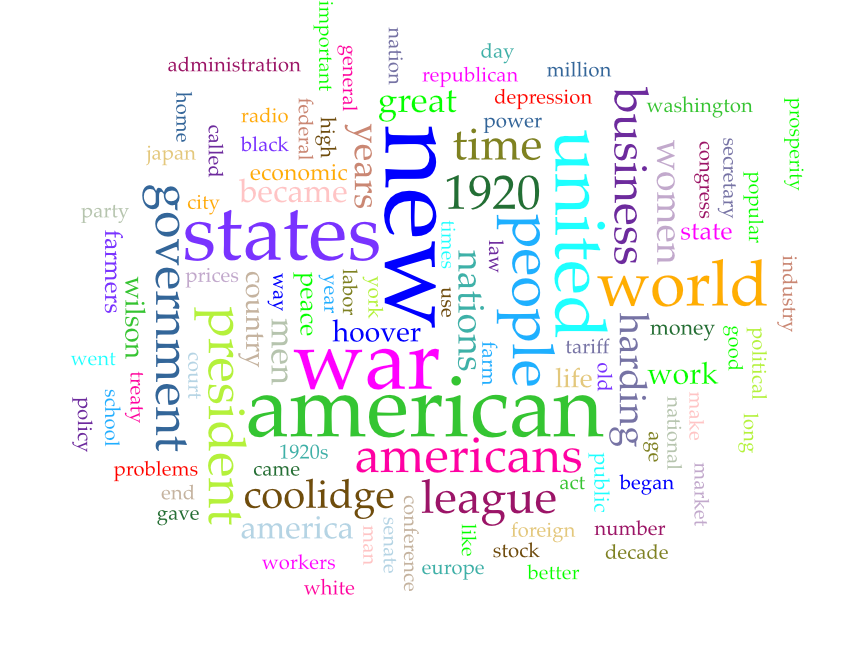
According to David J. Goldberg, most of the political events that took place in the 1920s can be traced back to the presidential administrations during that time.4 In “Affluence and Anxiety,” the author analyzes the Palmer Raids, which were a series of raids that took place from November 1919 to January 1920 under the Woodrow Wilson administration to capture suspected socialists, anarchists, and communists and deport them from the United States. This perspective frames the 1920s as a time when “unreasoned fear” of foreigners and radicals dictated government policy and judicial outcomes.5 “The Golden Twenties,” explains how the Harding administration was marred by significant scandals, including fraud within the Veterans’ Bureau led by Charles R. Forbes.6 The text emphasizes the role of the federal government in shaping the decade’s character. It focuses on legislative actions, specifically tariffs and tax reductions that directly influenced national prosperity and international trade. As stated previously, most political events can be traced back to presidential administrations, whether its for judicial or legislative outcomes.
Conclusion
Due to how many major events happened in the twenties, there’s so many different ways historians can interpret this era. “Affluence and Anxiety” mainly focused on how the 1920s began with a significant shift away from the social progressivism of the war years, replaced by suspicion and fear, and “The Golden Twenties” details the evolution of the American economy and government after the First World War.
- David J. Goldberg, “Rethinking the 1920s: Historians and Changing Perspectives,
OAH Magazine of History, (July 2007), pp. 7-10. ↩︎ - 1960-Our Nation’s Story – The Golden Twenties ↩︎
- 2004 – The American People – Affluence and Anxiety ↩︎
- David J. Goldberg, “Rethinking the 1920s: Historians and Changing Perspectives,” OAH Magazine of History, (July 2007), pp. 7-10. ↩︎
- 2004 – The American People – Affluence and Anxiety ↩︎
- 1960-Our Nation’s Story – The Golden Twenties ↩︎
