
The two chapters that I chose to focus on were “Political Problems of the 1920’s” (1964), and “American Life in the ‘Roaring Twenties” (1998). The article that I will referencing these chapters against is titled “Rethinking the 1920s: Historians and Changing Perspectives” by David J. Goldberg (2007). While the goal of both chapters are to inform people about the 1920s and the importance of it, they focus on different aspects of the decade.
Using Voyant to create visualizations of the chapters are very revealing of their content and focus. The top 5 most frequently used words in “Political Problems of the 1920’s” (1964) are “new”, “states”, “united”, “American”, and “president”. The 5 most frequently used words in “American Life in the ‘Roaring Twenties” (1998) are “new”, “American”, “1920s”, “war”, and “life”. The 3 phrases that stand out the most between these two chapters are “president”, “war”, and “life”. These words, along with the titles, make the focus of the chapters clear: the government during the 1920s, and the experiences and effects of war on the average American citizen during the 1920s. “Political Problems of the 1920s” (1964) speaks a lot about the president, mentioning “president” 55 times, and “American Life in the ‘Roaring Twenties” (1998) only mentions “president” 4 times. The earlier focuses on the elite and the later focuses on the majority of the population.
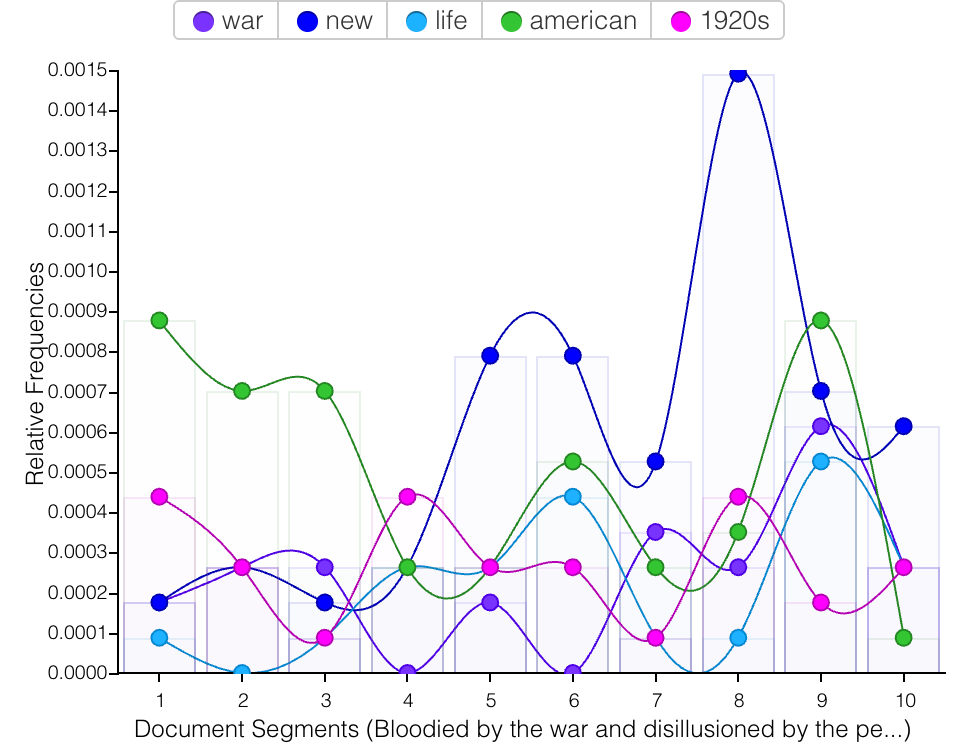
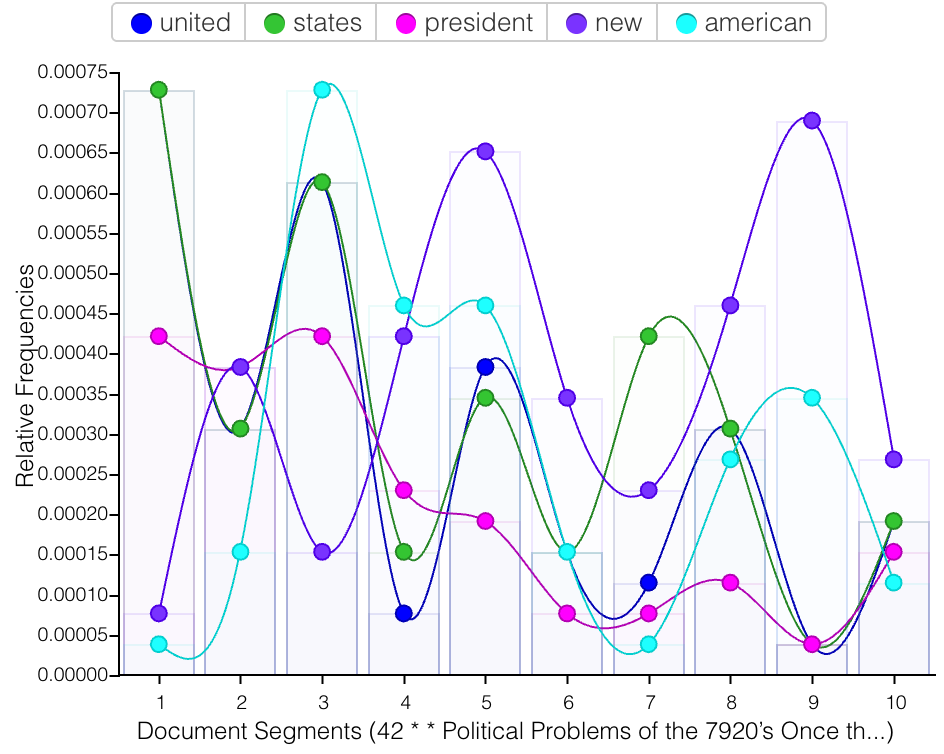
These two chapters can fit into the context of historiography discussed in the article by David J. Goldberg. Goldberg explains that “New works dealing with social and cultural history have supplemented the more traditional focus on political history to provide us with a fuller and more well-rounded portrait of a society where class, ethnic, racial, regional, political, and cultural divisions remained quite sharp”. 1The older of the two articles focuses on political history, and the more recent one focuses on social and cultural history. Newer works are starting to drift away from the traditional study of political history to focus on the lower areas of society.
Knowing the time period in which historians are writing helps us to evaluate their information and sources more effectively. Being able to place their work in a timeline makes it easier to understand how they were influenced by changing understandings, morals, focuses, and ideas. Older history is not necessarily less professional than more recent history, but it is often outdated or supports older/outdated theories, beliefs, topics, and concepts. There are many works on various topics that are written in a way that our current times can understand in a comprehensible way, such as focusing on the everyday person, so that we can put ourselves in that position. When authors write in outdated styles, such as employing “great men” history in the majority of writings, it only focuses on the upper class people of the time, which can be very hard for readers to understand on a personal level. A very small population of people understand what it is like to be the president, but nearly everybody understands how it is to be a working class individual.
Citations
Footnotes
- David J. Goldberg ↩︎
Bibliography
Chapters: “Political Problems of the 1920’s” (1964); “American Life in the ‘Roaring Twenties’” (1998)
David J. Goldberg, “Rethinking the 1920s: Historians and Changing Perspectives” OAH Magazine of History, (July 2007), pp. 7-10.

Ramapo College sophomore majoring in History and minoring in Museum Studies + Music Industry
