
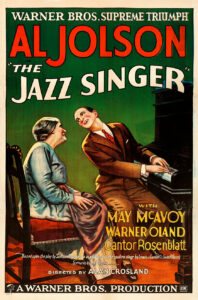
Released on October 6th, 1927, The Jazz Singer was directed by Alan Crosland and distributed by Warner Bros. Pictures. The film is also credited with changing the filmmaking landscape by transitioning films from silence to sound.
Overview
Despite The Jazz Singer‘s fame from being the first film with synchronized dialogue, there is much more to this film than being the first “talkie.” It’s a reminder of how stories take influence from surrounding culture, creating contemporary pieces that give an understanding of what life was like in the past. The Jazz Singer is a prime example of one of these stories, and is important to understanding the 1920s due to its reflections upon assimilation, racism, and consumer culture of the decade.
Production
The Vitaphone was invented and utilized to create synchronized sound, and was the key tool that made production of The Jazz Singer possible. Originally developed by Bell Laboratories, this device could record and play back sound that was synchronized with a film reel, and amplify that sound throughout a room, provided the audio could be played within it.

Warner Bros., then a small film studio, was the main company interested in such technology since it could save them on musician fees by having the scores pre-recorded, as they were “in the process of becoming major theater owners themselves.”1 With the help of Western Electric, Warner Bros. invested in, and put the Vitaphone to use in both production and their own theaters.
The first test of the Vitaphone was Don Juan, directed by Alan Crosland and released on August 6th, 1926. It became the first film to utilize synchronized sound via the Vitaphone. The film was met with stellar reviews, with many fascinated by the technology. Mordaunt Hall comments on the film in the New York Times, writing that anyone will “have the opportunity of listening to and seeing grand opera as it is given in New York,” and also praises the prefaced short featuring Will H. Hays with how “audible and clear” his voice was.2 This large success among patrons and critics led to Warner Bros. investing more time into this new market for films with synchronized sound.
On October 6th, The Jazz Singer was released in theaters. Directed again by Alan Crosland it was the first film to utilize synchronized sound and dialogue. However, the public reaction to the film was lukewarm compared to Don Juan. Robert E. Sherwood states that “[it] has a good idea (taken from Sam Raphaelson’s play), but it has been hoked and sugared to a regrettable extent; and Al Jolson as an actor on the screen is only fair.”3
Despite this less than favorable reception, the film showed that synchronized dialogue was possible, and it wasn’t long until films, such as Lights of New York, made use of synchronized dialogue throughout its entire runtime, putting silent films to rest.
Film Summary
The film starts with Cantor Rabinowitz, who represents traditions and religion. He is awaiting his son, Jackie Rabinowitz, who will sing the Koi Nidre for the synagogue. Sara Rabinowitz, Jackie’s mother and the canton’s wife, suggests that maybe Jackie doesn’t wish to be a Cantor. However, he refuses such a notion and suggests he must be a Cantor because it’s tradition to do so.
While this is happening, Jackie, as a young boy, is performing at a local saloon. He represents modernization and secularism. He is then caught by one of his fathers friends, who alerts Cantor Rabinowitz before he goes to take Jackie back home. Jackie threatens to run away if he gets whipped, and does so after he is punished by his father. Later, at the Yom Kippur service, Cantor Rabinowitz denounces Jackie as his son.
Years later, Jackie changes his name to Jack Robin and is now a jazz singer. He is not famous, but his singing of “Dirty Hands, Dirty Face” and “Toot, Toot, Tootsie” leads to him meeting a woman named Mary Dale, someone who’s been on the stage. She compliments his voice and offers to help him get famous.
As that happens, Cantor Rabinowitz is instructing another child on being a cantor as Sara reads a letter from Jack about how he’s currently doing. After the child leaves and tells Sara that the Cantor is angry, she decides to tell him about how Jack is doing. It’s baffling she’s saddened after he denounces Jack once again, as she should have figured telling him would make things worse, but I suppose it’s her life.
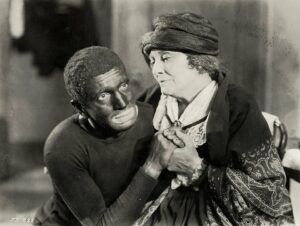
After traveling from Portland to Chicago, Mary lands a lead role for a musical in New York City, leaving Jack behind in Chicago. A few minutes later, Jack also lands a role for a musical in New York City and travels there. Back at home, Cantor Rabinowitz celebrated his 60th birthday, and Jack returns home to find his father teaching a class on being a cantor, while his mother works in the kitchen. Sara and Jack hug and catch up before his father catches him. For a third time, his father is upset at Jack for being different, they argue, and Jack leaves the house for a second time.
After that, it showcases April Follies, the musical Jack and Mary are performing in. He’s shocked by her appearance, and rehearsal continues normally. However, Cantor Rabinowitz is sick in bed, and Jack finds out through his father’s friend. He now has to make the choice between performing at the synagogue in place of his dad, or performing on Broadway, which tears him apart before he makes his final decision.
After a few talks with Mary, meeting his mother once again, and seeing his father on his death bed, he ultimately decides to disappear on opening night and sing at the synagogue. This makes his father happy before he dies, and mends Jack’s internal rift between religion and modernity. After the fact, despite being told he would never have another job on Broadway again, the film ends with him performing “My Mammy” on the stage at a later date.
Significance
Religion and Assimilation
The major conflict within The Jazz Singer is Jack wanting to be a jazz vocalist, while his father wants him to be a cantor. This is reflective of not only secularization, but assimilation as well. The 1920s brought upon change to society, which made Americans more secular. This contributed to poor attendance in various religious institutions and “eroding support for missionary activities.”4 As a result of this decline, religions had to change in order to keep with the times and keep attendance rates up.
One way Judaism changed, especially more Conservative congregations, was to modify their “traditional orthodoxy of their Southern and Eastern European parents to make it more palatable to modern Americans.”5 Despite it not working as well as they hoped, these attempts to assimilate and appeal to the American public reflect upon Jack’s character in The Jazz Singer as he tries to pursue the theater.
One of the major ways this is shown is Jack’s name, as he was originally named Jacob Rabinowitz. Being the son of a Jewish immigrant, he decided to anglicize his name in an attempt to fit in with the rest of American society. This practice still happens today; immigrants and their children anglicize their names in the United States, typically to fit in in a crowd of mainly white-sounding names. My mother comes to mind as an example; she tells restaurant workers that her name is “Maya” in order to make writing and calling her name easier.
Jack also attempts to appeal to the 1920s public by pursuing the career of a jazz singer instead of a cantor, like his father. This does paint Jack as being secular against his father’s religion, especially as the film shows Jack striving away from being a cantor, reflecting upon the attitude towards religion in the 1920s.
Additionally, the film’s climax shows Jack abandoning the theater to sing at the synagogue, before ending the film with a performance on stage, showing that religion is only a fraction of life, as Jack pursues his goal of being a jazz singer at the end of all. Times change, the world becomes more modern, and Jack is a representation of an assimilationist who, ultimately, decided against Judaism in favor of a more American lifestyle.
Racism
Besides the conflict between an immigrant father and his American-born son, one of the biggest points of The Jazz Singer is Jack’s use of blackface throughout the film. This is likely because “one of the functions of blackface was to offer whites a mask that allowed them to be more expressive than the Victorian norm permitted whites.”6 It was also seen as the norm within Vaudeville entertainment, since it derived itself from minstrel shows, where white actors utilized blackface in order to portray racial stereotypes of African Americans.

Scholars such as Michael Rogin provide a more in-depth look at the film’s use of blackface, writing that Jewish Vaudeville is a successor to blackface minstrelsy, and as a result, “Jack develops his character, expresses his interior, finds his own voice by employing blackface caricature.”7 The rest of the article discusses how it transforms Jack from being the son of a Jewish immigrant to American through blackface, which provides an interesting spin into making blackface seem like a necessary part of the film.
Additionally, it does make sense considering that anti-Semitism was rampant during the 1920s, especially considering that a handful of immigrants at the time were Jewish people attempting to assimilate into a Protestant country. Jewish people were one of the many groups targeted by the Klu Klux Klan.
I’m not trying to defend blackface. It’s completely acceptable to be uncomfortable with the film’s use of blackface, especially considering The Jazz Singer is accredited with being the film that killed the silent film industry without the other parts of it being mentioned. However, modern audiences should not only be aware of blackface being a prevalent part of The Jazz Singer, but draw their own understanding of why it’s being utilized. There were unfortunate norms during the 1920s, as stated above when discussing Vaudeville as a successor to minstrel shows. On the other hand, Jews were also an oppressed group during the 1920s, meaning Rogin’s interpretation of intersectionality may not be entirely wrong.
At the end of the day, it’s up to audience interpretation as to their thoughts on the presence of blackface within The Jazz Singer. However, the average person in the modern day may agree that it is used to harm instead of connecting with black people.
Reflection of Culture
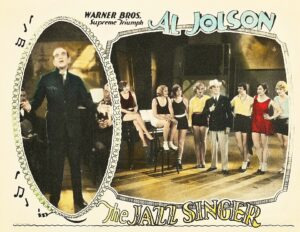
The Jazz Singer, alongside showcasing assimilation and racism, “reflected and reinforced the consumer culture” of the time.8 This is blatantly shown in the film, as the protagonist is pursuing the job of a jazz vocalist. He sings to entertain an audience, which, as stated before, is a point of conflict between him and his father.
This career choice directly reflects upon the way society consumed material goods, especially after the Victorian Era, which promoted traditionalism and restraint. After World War I, societal values began to lax and become open minded in comparison to upholding traditional values. This included secularism, causing those who finished a day at work to have free time on their hands that attending a religious service, such as a sermon, would typically fill.
Since workers didn’t wish to attend religious service, especially as religion began to be pushed farther and farther from society’s minds, consumerism began to fill the void as the 1920s continued on, which has managed to seep into the modern day. As more material goods and services began pandering to a broader public, such as the sale of cars to the everyday worker, there was a sense of abundance that increased the demand for these products among citizens.
This influx in demand created even more goods and services to be created, such as nightclubs and theaters, especially as business owners attempted to cash in on the buzz around such services. This opens up more opportunities for the public to experience these services, ultimately fueling the cycle of consumerism. Jack isn’t an expedition to this cycle, as the career he pursues directly helps to keep it a well-oiled machine. Both in the sense that the film is being released in theaters and Jack himself is a jazz singer, which is one of the many performances people would pay to see.
Although he does perform at the synagogue, he still returns to the theater to sing jazz after his father passes. Religion plays a part in his life, but he still prioritized theater, showcasing secularism and his willingness to continue the cycle of consumerism, whether he knows it or not.
The 1920s and Beyond
At the end of the day, the 1920s as a whole is looked back on with fondness, including the entertainment industry. This has manifested as tributes over the years, with films such as Singin’ in the Rain paying homage to the shift towards dialogue within films.
However, there should still be acknowledgement of The Jazz Singer’s story and how it reflects the 1920s at the time of its production. There’s more to the time period than the entertainment it provides, as there are examples of modernism with Jack’s character and reflections of culture in the job he pursues. Additionally, there’s the issue of racism with the film’s use of blackface and a conflict between religion and secularism that manages to provide the best of both worlds via a mix of a happy ending for both sides at the end of the film.
While it’s not a worldwide event such as the stock market crash, The Jazz Singer is still an intriguing window into the way the people of the 1920s reflected upon changing societal norms and problems.
Citations
Bibliography
Dumenil, Lynn. The Modern Temper : American Culture and Society in the 1920s. New York, Ny: Hill and Wang, 2007.
Hall, Mordaunt. “VITAPHONE STIRS AS TALKING MOVIE: New Device Synchronizing Sound With Action Impresses With Its Realistic Effects. NOTED MUSICIANS HEARD Provides Orchestral Accompaniment to Photoplay “Don Juan” With John Barrymore.” New York Times (1923-), 1926. https://ramapo.idm.oclc.org/login?url=https://www.proquest.com/newspapers/vitaphone-stirs-as-talking-movie/docview/103776000/se-2.
Koszarski, Richard. “Vitaphone’s First Night.” MoMA 2, no. 2 (1989): 16–17. http://www.jstor.org/stable/4381092.
Sherwood, Robert E. “The Silent Drama.” Life 90 (1927): 24
Rogin, Michael. “Blackface, White Noise: The Jewish Jazz Singer Finds His Voice.” Critical Inquiry 18, no. 3 (1992): 417–53. http://www.jstor.org/stable/1343811. Tankel, Jonathan D. “The Impact of The Jazz Singer on the Conversion to Sound.” Journal of the University Film Association 30, no. 1 (1978): 21–25. http://www.jstor.org/stable/20687409.
Footnotes
- Richard Koszarski, “Vitaphone’s First Night,” MoMA 2, no. 2 (1989): 17. ↩︎
- Mordaunt Hall, “VITAPHONE STIRS AS TALKING MOVIE: New Device Synchronizing Sound With Action Impresses With Its Realistic Effects. NOTED MUSICIANS HEARD Provides Orchestral Accompaniment to Photoplay “Don Juan” With John Barrymore,” New York Times (1923-),(1926): 6. ↩︎
- Robert E. Sherwood, “The Silent Drama,” Life 90 (27 October 1927): 24. ↩︎
- Lynn Dumenil, The Modern Temper: American Culture and Society in the 1920s, New York, Ny: Hill and Wang, (2007): 170. ↩︎
- Lynn Dumenil, The Modern Temper: American Culture and Society in the 1920s, New York, Ny: Hill and Wang, (2007): 176. ↩︎
- Lynn Dumenil, The Modern Temper: American Culture and Society in the 1920s, New York, Ny: Hill and Wang, (2007): 95. ↩︎
- Michael Rogin, “Blackface, White Noise: The Jewish Jazz Singer Finds His Voice,” Critical Inquiry 18, no. 3 (1992): 430. ↩︎
- Lynn Dumenil, The Modern Temper: American Culture and Society in the 1920s, New York, Ny: Hill and Wang, (2007): 94. ↩︎

Eryn is a Ramapo College sophomore majoring in History and minoring in Museum Studies.
