
Overview:
The English Channel is a three hundred and fifty-mile-long stretch of water that separates the British Isles from the rest of mainland Europe. At its greatest width the channel is one hundred and fifty miles wide, and at its narrowest point stretches a distance of twenty-one miles. This frightening body of water remains cold throughout the entire year, ranging in temperature from forty-six to sixty-six degrees Fahrenheit on average. Separating the two major sections of Europe, the Channel is trafficked by numerous boats, commercial and privately owned. It is also home to natural, deadly creatures like jellyfish and sharks. To brave this treacherous stretch of water takes a willpower and strength most people do not possess. A person must be willing to risk life and limb to swim this gray, churning expanse…1
Gertrude Ederle was not fazed by the dangers and risks of swimming the English Channel. On August 6, 1926, the nineteen-year-old made history. She became the first woman to successfully swim across the Channel.
Preparing to Make History
Her journey to successfully swimming the English Channel began long before she stepped foot on the French coast at Cape Gris-Nez on the fateful August day. Ederle grew up learning how to swim at the Jersey Shore, where her family vacationed during the summer. These formative years of swim instruction led her to develop a passion for the sport, which continued into her teen years. Trudy proved to be an extremely powerful and accomplished swimmer, setting twenty-nine records between the ages of fifteen and nineteen. For Ederle, successfully swimming the English Channel was the sign of a truly accomplished swimmer. On August 18, 1925, she made her first attempt at swimming the Channel. Eight hours forty-eight minutes into the swim, her coach pulled her from the water. The conditions were extremely rough, and the then eighteen-year-old had swallowed large amounts of salt water. Trudy was extremely upset as she was removed from the water. Channel expert Bill Burgess said, “The girl was short of her best condition… She will do it if she trains properly.”2 The speed and strength Ederle showed on her first attempt were unseen before in previous Channel swims. Following her failure to complete the swim on the first try, Gertrude was determined to complete the task. Ederle was interviewed following her failed attempt. She assured the world she would attempt the Channel swim again.
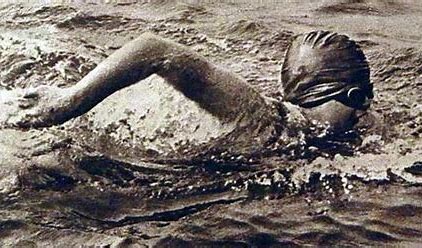
“My motto is ‘If at first you don’t succeed, try, try again.” And I want the public to know that I am going to attempt to swim the English Channel again next July.” – Gertrude Ederle3
One year later, Gertrude Ederle was back on the French beach at Cape Gris-Nez. Assisted by her sister Margaret, Trudy began to prepare for her second attempt at crossing the English Channel. For this try, she wore a modified black one-piece swimsuit that her sister reworked into a functional two-piece. Part of Ederle’s challenge when attempting to swim the Channel the year prior was her swimsuit. The heavy wool one-piece swimming costume was not designed for the athletic feat that Trudy was undertaking. It weighed her down, becoming another obstacle during an already difficult swim. To prevent this from happening again, Ederle and her sister designed her a one-of-a-kind swimsuit. She also donned a red swim cap and a special pair of goggles, waterproofed with wax. To complete her swimming ensemble, Trudy lathered her body in a thick layer of lanolin and other fatty substances. This coating was supposed to help Ederle stay warm in sixty-one-degree weather and to protect her from possible jellyfish stings.
Ederle’s Swim
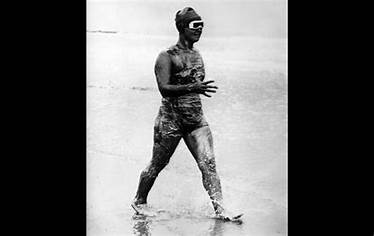
At approximately 7:09 a.m., Gertrude Ederle entered the frigid waters of the English Channel. The route she chose to swim had a distance of approximately twenty-one miles from the French to British shores. However, because of the strong currents and tides in the Channel, Ederle would end up fighting through numerous extra miles of water to reach her intended destination. To combat the strong seas, she immediately began to swim at a steady and rhythmic pace using the relatively new American Front Crawl. All previous channel swimmers used a combination of breast, side, or trudgen strokes. These are all traditionally slower swimming styles and require less physical exertion. Ederle’s choice to use the front crawl gave her the advantage of being able to move faster and more efficiently than if she chose to use another swimming technique. This was extremely important because she was pushed, off course, several times, resulting in Ederle swimming a total of thirty-five miles.
Like her previous attempt, Trudy was not alone as she fought the conditions of the English Channel. She was accompanied by two tugs. Among the people on the Tugs was her sister and father. Henry Ederle was one of the main supporters of his daughter, promising her a brand new roadster if she completed the swim. One of the main jobs of Ederle’s support team was to give her food and fluids to keep her body fueled. These items were delivered to Trudy in a net-like contraption. On her Channel crossing menu, Ederle consumed chicken legs, pineapple juice, chocolate, and sugar cubes. The other major job of the support tugs was to keep Ederle motivated. They played her some of her favorite popular American songs, which included “Rosie O’ Grady,” “Let Me Be Your Sweetheart,” “East Side, West Side,” and “The Star-Spangled Banner.” These kept her going as she battled through the frigid, churning waters of the English Channel4.

As the hours passed, the conditions of the channel worsened as a squall blew in. Ederle was already battling six-foot waves and strong currents, but they continually got more challenging. The support team on the tugs asked Trudy to stop her swim because of the weather, but she refused and kept swimming. At one point her left leg started to stiffen up, causing her to not be able to kick properly, but this too did not hinder her. Gertrude Ederle fought on. Darkness descended upon her as she neared the English coast. The waiting crowds lit fires to guide her to shore. At 9:40 p.m., fourteen hours and thirty-one minutes after leaving Cape Gris-Nez, France, Ederle stepped foot on English soil. The first person to greet her was a British customs officer requesting her passport. Upon her arrival in Kingsdown, England, Gertrude Ederle was able to claim the title of the first woman to swim the English Channel. She was not only the first woman to swim the Channel successfully but also set a new record for the Channel swim, which was nearly two hours better than the standing record set by a male swimmer in 1923.
The World Responds to Gertrude Ederle’s Accomplishment
Upon her arrival in England, the legitimacy of Ederle’s swim was challenged. The British and French press questioned if she had received extra help or somehow cheated. Even with these false claims, Gertrude Ederle’s accomplishment was not undermined. In an interview with her the following day, Trudy expressed her thrill at successfully completing the Channel swim. When asked how she managed to complete the swim, she said, “I said I would do it; I meant to do it; I did it. I never felt like giving up… I told them not to let me give up, and I stuck to it.5” Her mom and dad kept her going too. Even though her mom was not with her, she sent her communications through the radio. These were read to Gertrude and only encouraged her to swim harder. Ederle described her feelings of accomplishment, saying, “I’m tickled to death that I have taken the Channel honors for women to America. That’s great.”6. Despite the huge accomplishment, she assured the press she would swim another fourteen hours, “but never again in the English Channel.”7

The world was captivated with Gertrude Ederle’s accomplishment. The press coined the term “Queen of the Waves” for Ederle.8 Headings like “City Throngs Give Greatest Welcome to Gertrude Ederle,” “Sees Victory Over Corsets, Coach Robison Says Miss Ederle Proves Conquest of Petticoats,” “Hailed as Gertrude of America,” and numerous other titles showed the enthusiasm people had for her. Ederle had articles written about her every move and was greeted by adoring crowds as she visited her grandma in Germany and stopped in Paris. Her greatest welcome, though, had to be when she returned to New York City on August 27, 1926. Nearly two million people welcomed her home. Among the many to congratulate her was the president of the United States, Calvin Coolidge, who called her “America’s Best Girl.”9 For a time, Gertrude Ederle was recognized among the greatest athletes in American history. She left a legacy in the swimming world, showing that women could accomplish any feat, sometimes even better than their male counterparts.
Significance:
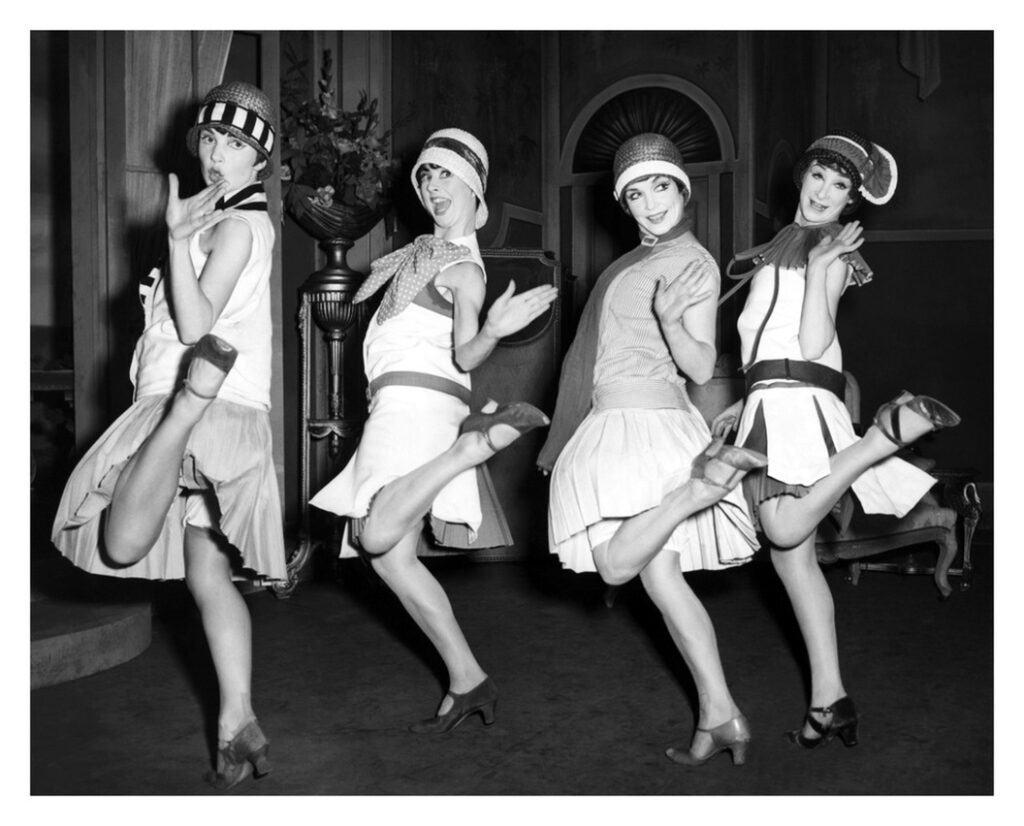
Image from: https://1920sfashionhonors.weebly.com/flappers.html
“The New Woman”
The 1920s saw the emergence of the New Woman. Following the passing of the 19th Amendment, young women began to enter the workforce at a rapid rate. Instead of getting married and relying on a husband for financial support, they choose to hold jobs and have economic freedom. This denial of marriage and choice to work went against the standards set by the previous generations of women. Never before had such large amounts of young people been liberated to experience the world on their own terms. These women spent their hard earned money on leisure activities and keeping up with the latest fashion trends.10
When she swam the English Channel, Gertrude Ederle was at an age where she could have been married or in the process of becoming. Instead, she chose following her life passion and make swimming her career. She accomplished numerous challenging swims during her professional career. Upon her reach as of celebrity status following her Channel Swim, Ederle showed that a woman could not only remain unmarried and become successful in her chosen career, but also do her job better than her male counterparts, having beat the standing record set by a male Channel swimmer in 1923 by nearly two hours. While definitely able to, Gertrude Ederle would never marry, providing for herself until her death, further showing the capacity of a woman in the workplace.
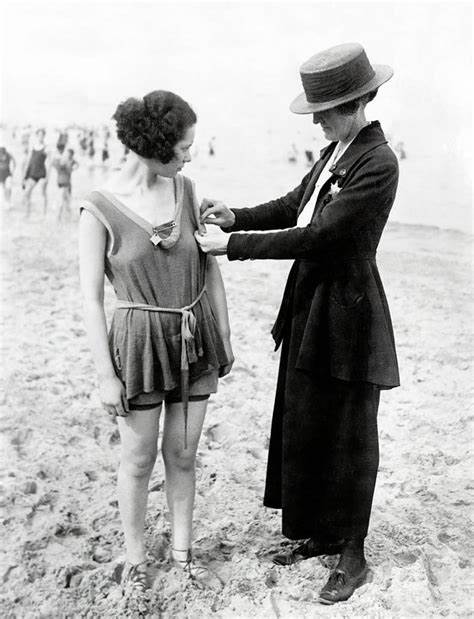
Another huge portion of this recreation of womanhood was the changes in clothing and hairstyles. Young women rejected the strict, structured garments of the Victorian and Edwardian eras in favor of loose-fitting dresses with high hemlines. They also cut their hair into much more manageable bob styles.11 This rejection of the old and adoption of the new was a huge part of the decade. Despite the numerous changes in fashion, swimwear remained relatively the same. Women were expected to wear modest, woolen swimwear. Beaches across the country had police officers whose sole purpose was to ensure that female beach goers were wearing swimsuits of modest and appropriate length. If a woman was found to not meet the modesty standards of a beach, she risked being kicked off the beach, fined, or in extreme cases, arrested. As the popularity of the sport of swimming grew, the old, archaic, heavy woolen swimsuit styles proved to be problematic for competitive swimmers. Little was done to remedy the problem.12 This left Gertrude Ederle to create her own swimsuit design that would allow her freedom of movement and a more weightless feeling. The result was a custom-made two-piece ensemble that she wore when she successfully swam the English Channel. While her swimsuit would not have been allowed on American beaches, it was needed for her to accomplish such a feat. Thanks to the heavy media coverage of her swim, photos of Ederle in her head of the time getup were seen all over the world. Swimwear did not change overnight, but Gertrude Ederle creating her own swimsuit showed the need for proper active swimwear for women, laying the foundation for the wide variety of options available today. 13
The World of Swimming
For much of human history, women have always been viewed as the weaker sex, and this extended to their athletic abilities. At the 1924 Summer Olympics, the farthest swimming distance in the female events was four hundred meters, and the now widely used front crawl was deemed feminine and graceful, “particularly suitable for women.”14 While slowly gaining notoriety, the front crawl was still not the go-to swimming stroke of athletes. When Gertrude Edele swam the English Channel, she chose to use the front crawl. The front crawl is one of the most effective swimming strokes. It allows the swimmer to maintain a steady rhythm while propelling themselves at a rapid rate forward without exhausting the swimmer.15 Ederle showed the effectiveness of the stroke, and it gained notoriety through her. The mass consumerism of the decade meant that people around the world were able to hear updates through their radios as she swam across the Channel.16 Trudy ended up setting a new record using the front crawl. She was a modern woman using a modern swimming technique. Despite Ederle showing the effectiveness of the swimming technique, some people still thought of it as too feminine. Male athletes like Johnny Weissmuller were needed to get the public fully on board with the front crawl.17
Concerning the frailty of women in the sport of swimming, Gertrude Ederle crushed all previously existing thoughts. When asked for comment on her swimming thirty-five miles, Tom Robison, swimming instructor at Northwestern University, said, “A woman could not possibly have accomplished the same feat thirty years ago.”18 However, he also stated that “as far as physical strength is concerned, women…have shown a prowess equal to men.”19 Through newfound liberation, Gertrude Ederle showed that a woman was capable of anything in the world of athletics.
One hundred years later, at the 2024 Summer Olympic Games, both men and women had seven events of varying lengths solely using the freestyle (the front crawl), the most of any stroke. The longest distance event at the games was the one thousand five hundred meter freestyle race. Both men and women competed in the race. For the women, Katie Ledecky, one of the greatest female distance swimmers of this generation, won the gold medal for Team USA.20
Conclusion
Gertrude Ederle’s swim across the English Channel showed that women were capable athletes who could accomplish impossible feats. She embodied a New Woman, rejecting traditional values and creating her own way in the world. Ederle also helped to create changes in the sport of swimming paving the way for female swimmers a hundred years later like Katy Ledecky. Gertrude Ederle was a hero then and an inspiration now.
Further Reading:
“Life Story: Gertrude Ederle.” n.d. Women and the American Story: New York Historical Society. New York Historical. Accessed March 24, 2025. https://wams.nyhistory.org/confidence-and-crises/jazz-age/gertrude-ederle/.
Ward, Mary Ederle, Brenda Greene, and Tim Dahlberg. America’s Girl: The Incredible Story of How Swimmer Gertrude Ederle Changed the Nation, 2009. http://ci.nii.ac.jp/ncid/BB1455158X.
Citations
Footnotes
- “English Channel Water Temperature.”
Ingrid Leonard, “How Wide Is the English Channel?”
↩︎ - “Salt Water made the Swimmer Ill.” ↩︎
- “Miss Ederle to Try Channel Next July.” ↩︎
- G Middleton, “Miss Ederle Happy, Won’t Try It Again.” ↩︎
- G Middleton, “Miss Ederle Happy, Won’t Try It Again.” ↩︎
- G Middleton, “Miss Ederle Happy, Won’t Try It Again.” ↩︎
- G Middleton, “Miss Ederle Happy, Won’t Try It Again.” ↩︎
- “Neighborhood Roars Welcome to Trudy.” ↩︎
- “Memories are Still Golden for Gertrude Ederle.” ↩︎
- Dumenil, 126-127. ↩︎
- Dumenil, 135. ↩︎
- Ibbetson, “A History of Women’s Swimwear | Fashion History Timeline.” ↩︎
- “Life Story: Gertrude Ederle.” ↩︎
- Stieglitz, .“The American Crawl” 71. ↩︎
- Stieglitz, .“The American Crawl” 71. ↩︎
- Dumenil, 77-78. ↩︎
- Stieglitz, .“The American Crawl” 72. ↩︎
- “Sees Victory Over Corsets.” ↩︎
- “Sees Victory Over Corsets” ↩︎
- Ioc, “Paris 2024 Swimming – Olympic Results by Discipline.” ↩︎
Bibliography
“600,000 VISIT CONEY IN A DAY OF RECORDS: FIFTY GET INTO TROUBLE OVER BATHING SUIT RULES AND THOUSANDS CUT FEET. STRICKEN BY HEAT IN SURF MAN IS PULLED FROM ICY WATER AND RESUSCITATED — LOST CHILDREN OVERRUN POLICE STATION.” New York Times (1923-), Jul 21, 1924. http://library.ramapo.edu:2048/login?url=https://www.proquest.com/historical-newspapers/600-000-visit-coney-day-records/docview/103355297/se-2.
Antrim, Doron K. “Where Is Gertrude Ederle?” Saturday Evening Post 216, no. 50 (June 10, 1944): 100. https://research-ebsco-com.library2.ramapo.edu:2443/linkprocessor/plink?id=6a6f1381-2306-3721-85bb-8b2ad9766497.
Anderson, Kelli. 1999. “The Young Woman And the Sea.” Sports Illustrated 91 (21): 90. https://research-ebsco-com.library2.ramapo.edu:2443/linkprocessor/plink?id=5a4a21b0-3450-3347-ab75-4960b18ddd51.
Alec Rutherford, “Expert Says ‘Crawl’ Conquered Channel: Modern Stroke, He Finds, and New Knowledge of Tides Made Fast Time Possible. Ederle Route Described Tells How Course Was Fixed To Catch Favorable Tide – Burgess Long Studied It. Expert Says ‘Crawl’ Conquered Channel.”New York Times (1923-), Sep 01, 1926. http://library.ramapo.edu:2048/login?url=https://www.proquest.com/newspapers/expert-says-crawl-conquered-channel/docview/103811340/se-2.
“Big Welcome for ‘Trudy’ Ederle: City’s Committee Will Greet Channel Swimmer, Coming Today on The Berengaria. Mayor to Present Medal. Neighbors Decorate Several Blocks and Crowds Will Hall Swimmer at Homecoming.” New York Times (1923-), Aug 27, 1926. http://library.ramapo.edu:2048/login?url=https://www.proquest.com/newspapers/big-welcome-waits-trudy-ederle/docview/103676633/se-2.
“Channel Exploit Thrills the City: Public Men Rejoice with Miss Ederle’s Family in Her Achievement. Mother Deeply Stirred, Germans Plan a Demonstration When Swimmer Returns Home.” New York Times (1923-),Aug 07, 1926. http://library.ramapo.edu:2048/login?url=https://www.proquest.com/newspapers/channel-exploit-thrills-city/docview/103814041/se-2.
Dumenil, Lynn. The Modern Temper: American Culture and Society in the 1920s. First Edition. Hill and Wang, 1995.
English Channel Water Temperature: Current, Historical Data & Forecast. “English Channel Water Temperature: Current, Historical Data & Forecast,” n.d. https://seatemperature.net/seas/english-channel.
G Middleton. “Miss Ederle Happy, Won’t Try It Again; Is Hailed in France: Bringing Channel Swim Honor to American Women Satisfies Her Ambition, She Asserts. Mother Won, She Insists Tells How Radio From “Mum” Put Fight in Her to Beat Cross tides at Crisis. Welcomed Back to France She Has A Triumphal Gay Talese. New York Times (1923-), Aug 08, 1926. http://library.ramapo.edu:2048/login?url=https://www.proquest.com/historical-newspapers/miss-ederle-happy-wont-try-again-is-hailed-france/docview/103838653/se-2.
“Gertrude Ederle’s Success.” New York Times (1923-), Aug 08, 1926. http://library.ramapo.edu:2048/login?url=https://www.proquest.com/historical-newspapers/gertrude-ederles-success/docview/103809286/se-2.
“Memories are Still Golden for Gertrude Ederle: She has no Regrets about Years since Her Channel Swim.” New York Times (1923-), Aug 06, 1958. 32. http://library.ramapo.edu:2048/login?url=https://www.proquest.com/historical-newspapers/memories-are-still-golden-gertrude-ederle/docview/114387802/se-2.
“Hailed as “Gertrude of America.” 1926. New York Times (1923-), Aug 08, 3. http://library.ramapo.edu:2048/login?url=https://www.proquest.com/newspapers/hailed-as-gertrude-america/docview/103807642/se-2.
Ibbetson, Fiona. “A History of Women’s Swimwear | Fashion History Timeline.” Fashion History Timeline, n.d. https://fashionhistory.fitnyc.edu/a-history-of-womens-swimwear/.
Ioc. “Paris 2024 Swimming – Olympic Results by Discipline.” Olympics.com, n.d. https://www.olympics.com/en/olympic-games/paris-2024/results/swimming.
Leonard, Ingrid. “How Wide Is the English Channel?” Geographic Pedia, June 24, 2024. https://www.ncesc.com/geographic-pedia/how-wide-is-english-channel/.
“Life Story: Gertrude Ederle.” n.d. Women and the American Story: New York Historical Society. New York Historical. Accessed March 24, 2025. https://wams.nyhistory.org/confidence-and-crises/jazz-age/gertrude-ederle/.
“Miss Ederle’s Challenge.” New York Times (1923-), Aug 19, 1926. http://library.ramapo.edu:2048/login?url=https://www.proquest.com/historical-newspapers/miss-ederles-challenge/docview/103741744/se-2.
“Miss Ederle to Try Channel Next July: Says She Will Make Charges Against Jabez Wolfee in Thirty Days.” New York Times (1923-), Sep 24, 1925. http://library.ramapo.edu:2048/login?url=https://www.proquest.com/historical-newspapers/miss-ederle-try-channel-next-july/docview/103509557/se-2.
“Neighborhood Roars Welcome to Trudy: Swimmer is Crowned ‘Queen of the Waves’ by Excited Throng on Amsterdam Avenue. Gertrude Ederle’s Neighbors on Amsterdam Avenue and the Side Streets Welcomed Her Back Home Last Night in a Delirious Demonstration of Affection.” New York Times (1923-), Aug 31, 1926. http://library.ramapo.edu:2048/login?url=https://www.proquest.com/newspapers/neighborhood-roars-welcome-trudy/docview/103739081/se-2.
“Procession from Boulogne to Griz-Nes When She Returns From Dover. Miss Ederle Happy, Won’t Try it Again.” New York Times (1923-), Aug 08, 1926. http://library.ramapo.edu:2048/login?url=https://www.proquest.com/historical-newspapers/miss-ederle-happy-wont-try-again-is-hailed-france/docview/103838653/se-2.
“Salt Water made the Swimmer Ill: Miss Ederle Loses Hard Channel Fight.” New York Times (1923-),Aug 19, 1925. http://library.ramapo.edu:2048/login?url=https://www.proquest.com/newspapers/salt-water-made-swimmer-ill/docview/103606081/se-2.
“Sees Victory Over Corsets: Coach Robision Says Miss Ederle Proves Conquest of Petticoats.” New York Times (1923-), Aug 08, 1926. http://library.ramapo.edu:2048/login?url=https://www.proquest.com/newspapers/sees-victory-over-corsets/docview/103771356/se-2.
“Sets Out Swimming Strongly.” New York Times (1923-), Aug 07, 1926. http://library.ramapo.edu:2048/login?url=https://www.proquest.com/newspapers/sets-out-swimming-strongly/docview/103878697/se-2.
Shapiro, Lauren. 2005. “Can She Do That?” Berkeley Journal of Gender, Law & Justice 20 (May): 196–98. https://research-ebsco-com.library2.ramapo.edu:2443/linkprocessor/plink?id=bab5f3eb-b853-3a29-a508-5949c54e0ae9.
Stieglitz, Olaf. “The American Crawl – Praktiken Von Geschlecht Und Moderne in US-amerikanischen Schwimmbecken, 1900–19401.” Gender 10, no. 1.05 (January 2018): 63–80. https://doi.org/10.3224/gender.v10i1.05.
“Tug Party Defends Miss Ederle.” New York Times (1923-), Aug 17, 1926. http://library.ramapo.edu:2048/login?url=https://www.proquest.com/newspapers/tug-party-defends-miss-ederle/docview/103778982/se-2.
Ybarra, T. R. “Cheered at British Shore: She Lands at Kingsdown After Hard Battle From Gris-Nez. Conquers Wind, Rain, Tide Fights for Three Desperate Hours Off English Coast Till Favoring Current Aids. Bonfires Light Last Dash. Searchlights also Sweep from Shore as New York Girl comes in with Strokes Still Strong.” New York Times (1923-), Aug 07, 1926. http://library.ramapo.edu:2048/login?url=https://www.proquest.com/historical-newspapers/cheered-at-british-shore/docview/103878568/se-2.

I am an undergraduate teacher education student at Ramapo College, minoring in history. As a future teacher, I hope to inspire my students to love the subject of history and to understand its importance in their lives.
