
Overview
The Tulsa Race Massacre or Tulsa Race Riot is a tragic event in American history that occurred on May 31, 1921, to June 1, 1921. The exact cause of the event is a topic of contention, but on May 30th of 1921 a black man named Dick Rowland entered an elevator, when he got out the city of Tulsa was changed. After events transpired, a massive riot broke out where a white mob razed the black neighborhoods of Tulsa. Businesses and residential buildings were brought to ashes in less than 48 hours and Federal Government officials had to take charge,
May 30th, 1921
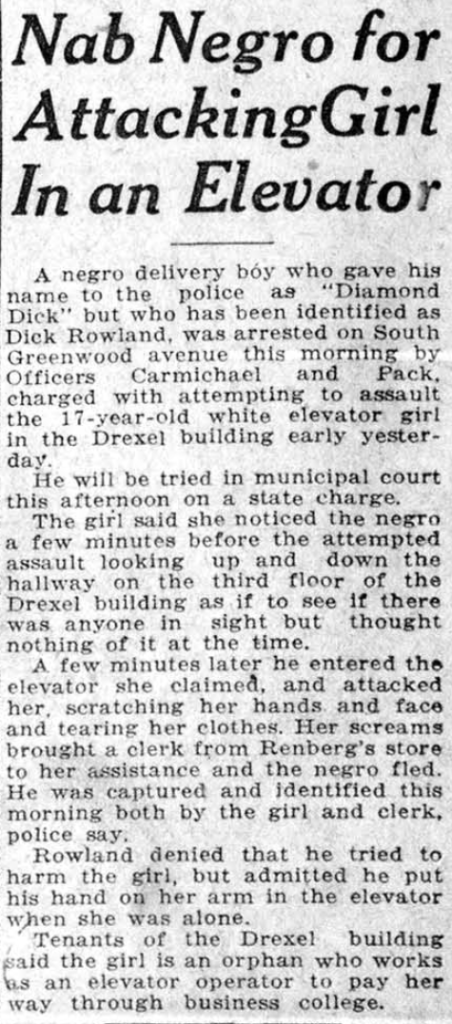
On May 30th, a shoe shiner named Dick Rowland entered the Drexel Building, his intentions remain unknown but he did interact with the elevator operator. Shortly after Rowland left the elevator rumors spread of Dick Rowland forcing himself upon the elevator operator Sarah Page. Since Sarah Page was white and Rowland was an African American, outrage sparked in Tulsa among the white citizens. As more and more people were informed of the alleged incident, details were muddied and accusations become more heinous than the last. It is uncertain what happened between the two individuals in the elevator, but what was certain was that Dick Rowland’s life was in danger.
May 31st, 1921
The following day police took Dick Rowland into custody and questioned him on the alleged assault. While he was in police custody, rumors of a lynch mob forming to kill Dick Rowland spread through the city like wildfire, which accelerated tensions between the African American and white communities. An armed group of nearly 100 black men, descended on the courthouse to protect Rowland. Once reaching the courthouse the group was turned back by the sheriff who tried to reassure them that Rowland was safe in police custody. The group had little to no confidence in the sheriff, due to a man being lynched a year prior while being in police custody. The sheriff did fortify the courthouse, he set up six of his men on the roof armed with long guns, disabled the power to the elevator, and erected barricades.
Upon seeing groups of armed black men in the streets, bigoted residents went home to retrieve their own personal firearms. Near the courthouse, an armory belonging to the US National Guard was stocked full of rifles, and an estimated 400 angry white citizens made a plan to arm themselves with them. Fearing an attack, the National Guard locked down the armory and threatened to open fire on anyone who came close to the building, this display of force made the rioters quickly reconsider. Over 2000 angry rioters were outside the courthouse and wanted to harm Rowland. Around 10 PM the white mob reconvened while armed at the courthouse, that’s when chaos broke out leading to the deaths of 12 people. A white man tried disarming a black World War 1 veteran, during the physical struggle, the firearm went off. The single gunshot erupted into a volley of fire, as protestors protecting Rowland and rioters there to harm him began engaging with one another. By the end of the shootout, 10 white people and two black people were slain. The angry white mob, furious and anxious over what they viewed as a possible “Race War” quickly escalated the situation by committing arson and burning black-owned businesses. The black men that offered security to the sheriff had to retreat while underfire to Greenwood, a predominantly black neighborhood. While all this was going down, the National Guard was drawing up plans on how to subdue the rioters and a contingent of white citizens remained at the courthouse, threatening to kill Rowland.
June 1st, 1921
As the night progressed into the morning, sporadic skirmishes were still occurring especially near the Frisco train line. The Frisco train line was a redlining boundary, where many blacks lived. Around 1 AM fires started to rage through downtown Greenwood, destroying businesses, while the Tulsa Fire Department did everything in its power to combat the flames, many lost their way of life. Even the white firefighters weren’t safe from the fury of the hateful mob, with firetrucks being forced to turn back at gunpoint, by those who started the fire. By sunlight, over a dozen black-owned businesses were lost. Around 5 AM a train whistle sounded and many of the white mob took this as a signal to launch an all-out assault on the Greenwood neighborhood. Although the african american community defended their homes with everything at their disposal, the firepower was too immense. By daybreak most of Greenwood was evacuated, some left by choice others were annexed out of their own neighborhoods. Even more shocking was that it wasn’t just gunfire, but aerial attacks too! There were local reports of multiple aircraft circling over Greenwood Ave, these planes were sources of small arms fire and even incendiary explosives. There were even unconfirmed reports of machine guns being fixed onto planes and firing down on the crowds. Government officials claimed that the planes were there for aerial reconnaissance of a possible “black uprising” and denied the use of force.
Around 9 AM the National Guard arrived in Tulsa and at 11 AM martial law was in effect. By noon most of the violence was ceased, but there were still pockets of violence.
Casualties and Aftermath
The number of people that perished during the Tulsa Race Massacre is unknown and highly debated. At first, estimates ranged from 20-150, but now it’s widely accepted amongst scholars that possibly over 300 people lost their lives in those horrifying 48 hours. The massacre received national coverage, but many facts remained hidden from public knowledge up until recently. There are reports of mass graves and in November 2022 they found an unmarked grave with over 20 bodies buried. This is an unspoken horrifying event that happened a little over 100 years ago, there is still much research to be done about the outlying effects this event had on not just Tulsa but neighboring communities as well. On the 100th anniversary of the massacre, President Joe Biden delivered a speech, talking about the racial injustice that happened and that still occurs in America to this day.
Work Cited
Hirsch, J. S. (2002). Riot and remembrance: The Tulsa race war and its legacy. Houghton Mifflin Harcourt.
Tulsa Historical Society and Museum. (n.d.). 1921 Tulsa Race Massacre. Retrieved from https://www.tulsahistory.org/exhibit/1921-tulsa-race-massacre/
Oklahoma Tribune. (1921, June 1). Trouble Flares at Tulsa, Oklahoma. Newspapers.com

Joe is a Sophomore at Ramapo and a Global Communications major enrolled in Discovering Digital History.
