
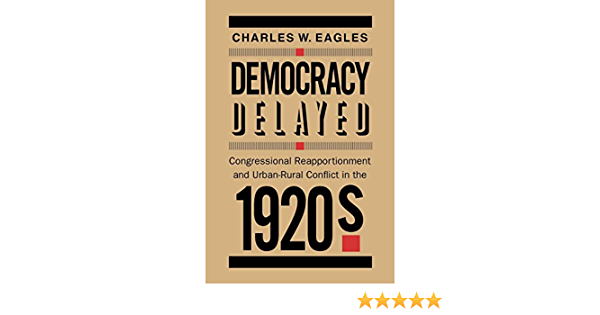
Charles W. Eagles’ novel “Democracy Delayed” shows a distinct urban-rural tension within the United States by examining how states are represented and in particular the 1920s centennial election. Eagles starts off by examining the 3/5 th compromise noting that it gave slave states undue representation. As population increased and slavery ended the amount of representatives to each state was changed in an attempt for smaller states to seize more representatives. Eagles points to the 1920s centennial to clearly show an urban-rural conflict. The population boom in the 1920s allowed cities, urban states to have higher populations than rural areas. Eagles uses the example where Democrats blocked Republicans from adding new seats because Republicans in cities had a higher population than rural Democrats. Eagles also examines how racist attitudes in the North empowered Democrats to pass policies that favor rural communities and small states. Overall Eagles’ novel fits into the 1920s by examining the centennial election to show a political divide that still affects how Americans are represented today.
Ramapo College senior majoring in history. My concentration is in the 1920s machine politics in major cities. In particular the unsustainability of the machine politic model.
